
Macomb County Basement Flooding: A Homeowner's Guide
Sewer districts, flood history, claims and cleanup, from Warren to St. Clair Shores
Water or sewage coming up through the floor drain after a storm? This guide covers Macomb County basement flooding start to finish: why the sewers back up, who to call, the 45-day claim rule, insurance gaps and what cleanup really costs.
Macomb County basement flooding rarely starts with a river spilling over its banks. Most of the time it starts in the pipes. A storm drops three or four inches of rain in a couple of hours, the sewers under your street fill up, and the overflow finds the lowest opening it can. In a lot of Macomb homes, that opening is the basement floor drain.
This guide is for homeowners from Warren to Chesterfield who have water on the floor right now, or who want to be ready before the next storm. It covers how the county's sewer districts work, the storms that have already soaked thousands of local basements, the 45-day claim rule, the insurance gaps, and what a proper cleanup looks like. We are Dryout Michigan, an IICRC-certified water damage (S500) and mold (S520) crew working out of Dearborn since 2019. This is what we explain on site, written down.
Basement Flooding in Macomb County Starts in Two Different Sewer Systems
Macomb County Public Works, led by Public Works Commissioner Candice Miller, runs the large pipes, pump stations and basins that sit between your house sewer and the treatment plant. Together these systems collect sewage for about 800,000 residents and businesses in 14 Macomb communities and deliver it to the Great Lakes Water Authority treatment plant in Detroit. Which system your street drains into says a lot about how your basement behaves in a storm.
Central and north Macomb: the Macomb Interceptor
The Macomb Interceptor Drain Drainage District (MIDD) serves about 600,000 people in Chesterfield, Clinton Township, Fraser, Harrison Township, Lenox Township, Macomb Township, New Haven, Shelby Township, Sterling Heights, Utica and Washington Township. The county bought the system from the Detroit Water and Sewerage Department in 2010. It includes 38 miles of interceptor sewer, some of it 11 feet across and about 60 feet underground, plus the Clintondale, North Gratiot and CS-12 pump stations.
Because one trunk line carries the flow for so many communities, trouble on it is felt widely. When part of it collapsed in Fraser in 2016, residents of 11 communities were asked to take shorter showers, run only full loads of laundry and flush less. Miller said at the time, "we have no capacity in the system for any additional sewage flow."
South Macomb: combined sewers and retention treatment basins
The older cities near Lake St. Clair work differently. In Eastpointe and most of St. Clair Shores, storm runoff and household sewage share the same pipes. That combined flow normally heads toward Detroit, with the Chapaton Pump Station and Retention Treatment Basin at the foot of Nine Mile Road, east of Jefferson, as the local safety valve. The pump station opened in 1968. Its basin was built in the late 1960s at 28 million gallons and expanded to 31 million gallons in the early 2000s.
When a storm fills the basin, the excess is disinfected with sodium hypochlorite and released to Lake St. Clair as a combined sewer overflow (CSO). The Martin retention treatment basin on Bon Brae in St. Clair Shores is a second, smaller basin: 8.6 million gallons, also disinfecting its flow, serving about 69,000 residents of Roseville and St. Clair Shores. The Southeast Macomb Sanitary District, a joint venture of Eastpointe, Roseville and St. Clair Shores, runs about 30 miles of sewer and four pump stations, and also carries flow from Grosse Pointe Woods, Harper Woods and Grosse Pointe Shores.
Miller has described the trade-off plainly: "If we don't discharge to the lake in those kinds of situations, the sewage will end up in basements." The county has spent heavily to shrink both outcomes. In 2023 it announced a $27 million rehabilitation of the Chapaton canal that adds about 13 million gallons of storage, and a $16 million electrical upgrade with three 2-megawatt generators. Officials said the upgrade was "needed to prevent station failure that would result in sewage backing up into basements and neighborhoods." A 2022 project added inflatable dams inside the 8.5 Mile district's interceptor to hold back flow in heavy rain.
If you live in one of the 11 MIDD communities, your sanitary sewage rides the Macomb Interceptor to Detroit. If you live in Eastpointe, St. Clair Shores or Roseville, it runs through the southeast Macomb systems and the Chapaton or Martin basins. Warren has its own water and sewer department at (586) 759-9200. Your city can tell you whether your block is combined or separated.
Red Run, the Clinton River and Lake St. Clair
Rain that does not go into a sanitary pipe still has to go somewhere, and in Macomb that usually means the Clinton River watershed. The Clinton River Watershed Council puts the watershed at 760 square miles across 63 communities in Oakland, Macomb, Lapeer and Wayne counties. The river runs 81.5 miles and empties into Lake St. Clair in Harrison Township.
The Red Run, a Clinton River tributary that runs through Warren and Sterling Heights, drains about 142 square miles with more than 550,000 residents, and close to half of that land is paved or roofed. Michigan Public reported in 2023 that southern Macomb sits mostly on clay soils that drain poorly, and that Warren has roughly half the sewer capacity it would need to handle a 10-year storm. In Sterling Heights, the Sterling Relief Drain carries stormwater from about one-fifth of the city into the Red Run behind Freedom Hill County Park.
The Red Run also receives overflow from Oakland County's George W. Kuhn basin in Madison Heights, which released 3.1 billion gallons of partially treated stormwater and sewage in 2021. In April 2025, about 1.2 million gallons of raw sewage and roughly 800,000 gallons of minimally treated flow reached the Red Run from Oakland County. "It's 2025. Seriously, this is what we're doing? This has to stop," Miller said. Our Oakland County water damage restoration guide explains how that upstream system works.
The lake adds its own pressure. In May 2019, St. Clair Shores residents were sandbagging against high water. By May 2020, Lake St. Clair stood about 2.75 feet above its average and 3.5 inches above its previous May record. Lakefront homes deal with that on top of the same storm sewers everyone else relies on.
Macomb County Water Damage History: The Storms That Filled Basements
The same pattern shows up again and again: a short, intense storm, overloaded pipes and a wave of flooded basements. Here are the events that shaped how the county and its cities handle water today.
| Date | Event | Macomb County impact |
|---|---|---|
| Aug. 11, 2014 | 4 to 6 inches in about 4 hours | Warren under a state of emergency; federal disaster DR-4195 |
| Dec. 24, 2016 | Interceptor collapse in Fraser | 15 Mile Road sinkhole; 22 homes evacuated, 3 condemned |
| July 6, 2019 | Flash flooding | Roseville state of emergency; City Hall basement under water |
| Jan. 11, 2020 | More than 2 inches of rain | More than 60 million gallons of CSO to Lake St. Clair |
| June 25–26, 2021 | Nearly 4 inches in St. Clair Shores and Eastpointe | Chapaton emergency bypass opened; Macomb added to DR-4607 |
| Aug. 24–26, 2023 | Severe storms and flooding | Macomb included in DR-4757 individual assistance |
| July 28, 2025 | 4 inches in 2 hours in St. Clair Shores | Flooded streets and basements in St. Clair Shores |
August 11, 2014: the storm that defined Macomb flooding
The National Weather Service recorded 4 to 6 inches of rain over about four hours across Wayne, southern Oakland and Macomb counties, with the worst flooding there. Warren measured 5.2 inches. Mayor Jim Fouts declared a state of emergency, more than 1,000 cars were abandoned on Warren's roads, and about 400 people were rescued by boat. Fouts later estimated that more than 18,000 Warren homes were affected. I-696 closed near Van Dyke, and in Sterling Heights the city offices and police department flooded.
The Clinton River gauge in Clinton Township reached a record 20.84 feet on August 12. The federal disaster declaration, DR-4195, came on September 25, 2014, for Macomb, Oakland and Wayne. FEMA's damage assessment counted 2,269 affected residences across the three counties, and only 43.9% of them were insured.
December 2016: the Fraser sinkhole
On Christmas Eve 2016, the 11-foot interceptor under 15 Mile Road near Eberlein Drive, east of Hayes, collapsed and opened a sinkhole about 260 feet long. Twenty-two homes were evacuated and three were condemned. While the line was down, sewage was pumped into the Clinton River and homes along Garfield Road faced backup risk. The road reopened on December 5, 2017, after 347 days, and the repair cost about $75 million. A forensic review announced in 2019 blamed human error: sewer gates had been reopened too quickly during earlier work. In 2023 crews were still digging out about 6,000 tons of sediment the collapse had left in the pipe, in places 24 to 36 inches deep.
2019 to 2025: shorter storms, same result
In July 2019, a storm overwhelmed Roseville's pumps and sewers, flooding basements across the city with water and sewage; Blumfield Street was among the hardest hit. In June 2021, Detroit's Connor Creek pump station shut down during a storm that dropped nearly four inches on St. Clair Shores and Eastpointe. With their normal outlet gone, the county opened the Chapaton emergency bypass to the lake. Miller said the move "prevented thousands more basements in St. Clair Shores and Eastpointe from flooding." Macomb and Oakland were added to the June 2021 federal declaration in late September of that year.
The August 2023 storms forced the same bypass into use for the third time since it was installed in 2017, and Chesterfield Township and New Baltimore declared local emergencies. In August 2024, St. Clair Shores logged fewer than 125 flooded homes out of about 23,000 properties after one storm, by early city counts. Then on July 28, 2025, the weather service measured 4.00 inches in two hours in St. Clair Shores and 3.01 inches in three hours in Roseville. One St. Clair Shores family told a local paper they lost nearly everything in their finished basement.
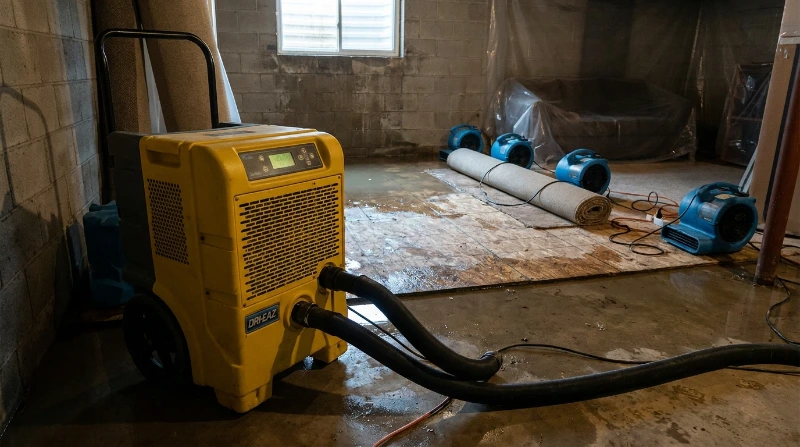
The First Two Hours in a Flooded Macomb County Basement
What you do before help arrives protects both your family and your claim. Work through these in order:
- Keep power and water apart. Warren's fire department advises calling your electric provider or a licensed electrician to cut power to a flooding basement. Do not wade to the panel.
- Treat floor-drain water as sewage. Keep kids and pets upstairs and the basement door closed.
- Photograph everything first. Shoot the water line, the drain it came from and each damaged item before you move or toss anything.
- Report it to your city. Call the water or public works department, and write down who you spoke with and when.
- Use less water. Every load of laundry and every flush goes into the same overloaded pipe.
- Call your insurer and a restoration company. Extraction that starts within hours keeps the job smaller.
- Mark day 45 on your calendar. The claim clock starts the day you discover the damage.
Warren's fire department also says to treat any appliance that has been under water, including furnaces and water heaters, as damaged until a professional checks it. Cities often run extra curbside pickup after big storms, as Warren did in 2014 and St. Clair Shores did in 2025, but photograph items before they go to the curb.
Who to Call After Basement Flooding in Macomb County
Your city or township is the first call for a sewer backup. Local crews check whether the problem is in the public main or in your private sewer lead, which the homeowner usually maintains. The county does not handle individual basement reports, though it runs the interceptors and basins described above.
- Warren: Water Department, (586) 759-9200. Damage claims go to the Risk Management Division, One City Square, Suite 410, Warren, MI 48093, (586) 574-4670.
- St. Clair Shores: Department of Public Works, (586) 445-5363. The city has directed flood claims to its finance department for review by its insurer.
- Macomb County Emergency Management and Communications: 586-469-5270, for preparedness and disaster information.
- Macomb County main line: 586-469-5100.
- FEMA: 800-621-3362, only after a federal declaration covers Macomb.
- Michigan DIFS insurance hotline: 877-999-6442, weekdays 8 a.m. to 5 p.m.
Report the backup to your city, start cleanup right away, and send your written claim within 45 days. In MIDD communities, the city runs the local sewers and the county runs the interceptor. If you send notice to the wrong agency, state law requires it to tell you in writing within 15 business days which agency it believes is responsible.
The 45-Day Sewer Backup Claim Under Michigan PA 222
Michigan Public Act 222 of 2001 is the route for recovering sewer backup damage from a public agency, and its deadline is strict. You must give written notice within 45 days after you discovered the damage, or should have discovered it with reasonable diligence. The notice only needs:
- Your name, address and phone number
- The address of the affected property
- The date you discovered the damage
- A brief description of the claim
Agencies that run sewer systems must publish how to give notice, and if you ask before filing, they must give you written instructions. The agency may inspect your basement, and you should not unreasonably refuse. If no agreement is reached within 45 days after the agency receives your notice, you may file suit.
When a backup does not qualify
The law excludes a backup if a substantial proximate cause was an obstruction in your service lead that the agency did not cause, or a connection on your property such as a sump system, building drain, surface drain, gutter or downspout. "Substantial proximate cause" means 50% or more of the cause. Acts of war or terrorism are also excluded. A sump pump tied into the sanitary line can sink a claim by itself.
Filing on time does not guarantee payment. You still have to show the system had a defect the agency knew or should have known about, and failed to fix in a reasonable time. Dated photos and moisture readings from the first visit help prove what was damaged. We are not lawyers, so talk to one if your loss is large.
Insurance for Macomb County Water Damage
Michigan's Department of Insurance and Financial Services (DIFS) says water and sewer backup is not automatically covered under a homeowners or renters policy. Coverage usually comes from a sewer backup endorsement added to the policy. Surface flooding from outside is typically not covered at all unless you bought federal flood insurance through the National Flood Insurance Program (NFIP), and a new NFIP policy generally does not take effect until 30 days after purchase.
The gap is real here. After the 2014 storm, FEMA's assessment found only 43.9% of affected homes in the three counties were insured. Flood insurance has also gotten pricier: Michigan Public reported that average annual flood premiums in Macomb rose 32%, from $764 to $1,007, between 2020 and 2021. Describe the cause accurately to your adjuster. A sewer backup or failed sump pump is not the same as a flood, and the difference decides which coverage applies. Our guide to whether homeowners insurance covers basement flooding in Michigan walks through the wording.
FEMA individual assistance is not insurance. It only opens after a federal declaration covers the county, as happened in 2014, 2021 and 2023, and it comes with its own application deadline.
Macomb County Flooded Basement Cleanup, Step by Step
Every cleanup starts by naming the water, because the IICRC S500 category decides how much has to come out.
| Category | Typical Macomb source | What it means for cleanup |
|---|---|---|
| Category 1 (clean) | Supply line break, water heater leak | Dry in place where possible; carpet often saved if dried fast |
| Category 2 (gray) | Sump pump failure, washer overflow | Disinfect surfaces; pad usually removed; wicking drywall cut |
| Category 3 (black) | Floor-drain backup from a combined or overloaded sewer, outside floodwater | Porous materials removed; full decontamination; protective gear |
Clean water does not stay clean. After a day or two, Category 1 water can degrade to Category 2, and in a storm that also brings up the floor drain, assume Category 3.
1. Inspect and document
We find the source, confirm the category and map wet areas with moisture meters and thermal imaging. Photos and readings go into a file for your insurer or your PA 222 notice. You get a written estimate before work starts.
2. Extract the water
Truck-mounted and portable extractors remove standing water, usually in 2 to 6 hours. Pulling liquid water out is far faster than evaporating it later.
3. Tear out and decontaminate
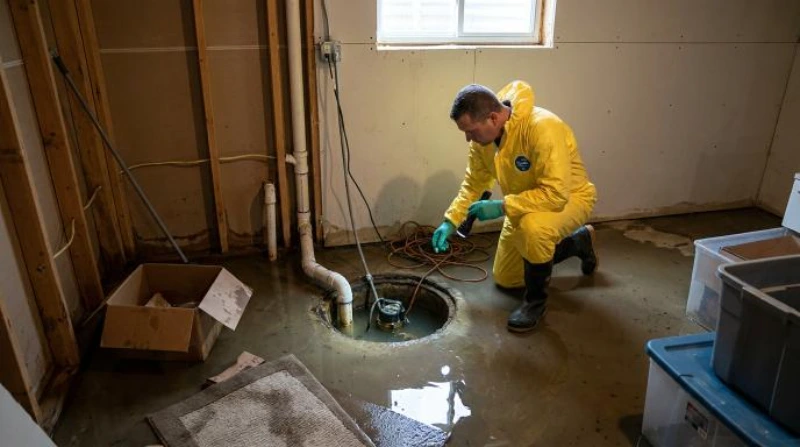
After a sewage backup, wet drywall below the flood line, carpet, pad, insulation and soaked cardboard come out. Hard surfaces are cleaned and treated with an antimicrobial. Our sewer backup cleanup page covers containment and protective gear.
4. Dry the structure
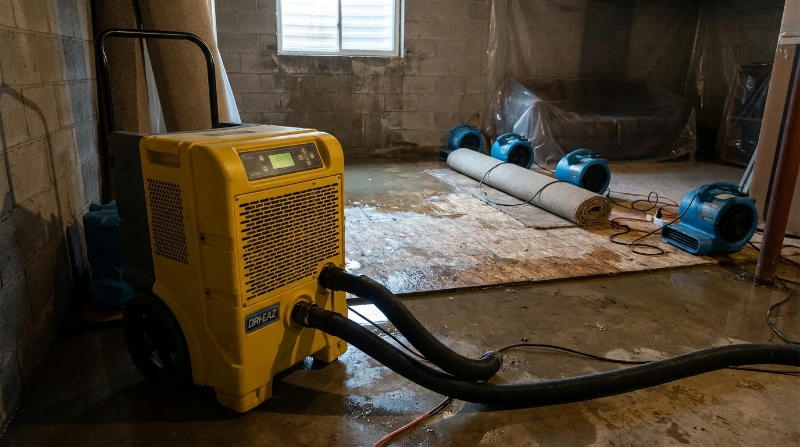
LGR dehumidifiers and air movers usually run 3 to 5 days, with readings every day until the slab, framing and walls reach dry standard. The EPA says water-damaged areas should be dried within 24 to 48 hours to prevent mold growth, which is why the first day matters most.
5. Check for mold, then rebuild
If growth has started, it is handled under the IICRC S520 standard before new drywall or flooring goes in.
What Basement Flood Cleanup Costs in Macomb County
Three things drive the price: the water category, whether the basement is finished, and how long the water has been sitting. These are typical ranges from our jobs, not quotes:
| Situation | Typical range |
|---|---|
| Clean water, small unfinished basement | $500 – $1,500 |
| Sump pump failure (Category 2), unfinished | $1,500 – $4,000 |
| Sewage backup (Category 3), unfinished | $3,000 – $8,000 |
| Finished basement with sewage | $7,000 – $18,000 |
| Mold remediation, if growth has started | adds $1,500 – $5,000+ |
Finished basements cost more because drywall, trim, carpet and built-ins below the waterline usually have to go after a sewage backup. For a rough number on your own space, try our basement flood cost estimator. We charge the same rate nights and weekends.
Keeping the Next Storm Out of Your Macomb Basement
No basement is flood-proof, but repeat Macomb County basement flooding usually traces back to the same few skipped fixes. Macomb County Emergency Management tells residents in flood-prone areas to install check valves in building sewer traps and keep sandbags and plastic sheeting on hand. Warren's own checklist adds most of the rest.
- Install a backwater valve. It lets sewage leave the house but stops it from flowing back up the floor drain. See our check valve installation page.
- Get roof water away from the house. Warren recommends keeping gutters clean and directing downspouts at least 5 feet from the foundation, and grading soil to slope away.
- Keep sump and downspout lines out of the sanitary sewer. They overload the pipes and can disqualify a PA 222 claim. If footing drains or a sump tie into the sewer, ask a plumber about rerouting.
- Add a battery backup to the sump pump. Summer storms knock out power at the same moment the pit fills fastest.
- Maintain your sewer lead. Warren suggests routine cleaning and camera inspection, and only flushing toilet paper. Wipes and grease clog laterals.
- Clear the catch basin grate in front of your house before a forecast storm.
- Raise what matters. Store items in plastic bins off the floor, and protect the furnace and water heater where you can.
- Sign up for alerts. The county points residents to NOAA Weather Radio, Wireless Emergency Alerts and Smart911.
Flooded Basement Cleanup by Macomb County City
Each community has its own sewer setup, flood record and phone numbers. Here is the short version; the city pages go deeper.
Warren
Warren was the center of the 2014 flood, with 5.2 inches of rain and more than 1,000 abandoned cars. The Red Run cuts through the city, and Michigan Public reported Warren has about half the sewer capacity a 10-year storm requires. Claims go to the Risk Management Division at One City Square. More on flooded basement cleanup in Warren.
Sterling Heights
Sterling Heights is a MIDD community, so its sanitary sewage rides the Macomb Interceptor. City offices and the police department flooded in 2014, and in July 2025 a trained spotter reported numerous roads completely flooded. See Sterling Heights flooded basement cleanup.
Clinton Township
The Clinton River gauge in Clinton Township hit its 20.84-foot record during the 2014 storm. The township was also among the 11 communities asked to cut water use after the Fraser collapse. Read about basement flood cleanup in Clinton Township.
St. Clair Shores
Combined sewers, the Chapaton and Martin basins and the lake all meet here. The city got 4.00 inches in two hours on July 28, 2025, and its DPW line is (586) 445-5363. Details on St. Clair Shores flooded basement cleanup.
Roseville
Roseville shares the Martin basin and the Southeast Macomb Sanitary District with its neighbors. It declared a state of emergency after the July 2019 storm flooded basements and City Hall, and logged 3.01 inches in three hours in July 2025. See flooded basement cleanup in Roseville.
If you are just over the line in Detroit or the Grosse Pointes, our Wayne County basement flooding guide covers the systems there. Every Macomb community is served by the same IICRC-certified team that handles flooded basement cleanup in Dearborn, with a 60-minute response target and documentation from the moment we arrive. Call (866) 838-7745.