
Flooded Basement Cleanup Roseville MI
Post-war basements, the Martin sewer district and storms like July 2019 that filled Roseville basements.
Sewage or storm water rising through your floor drain? Our flooded basement cleanup Roseville MI crews pump it out, clean and disinfect, and dry post-war basements to IICRC S500 standards, with a 60-minute response target and a written estimate before any work starts.
Where Roseville's Water Goes When It Rains Hard
Every flooded basement cleanup Roseville MI call starts with the same question: did the water come up through the floor drain, or in through the walls? In Roseville the answer is often the drain, and the reason sits a few miles east in St. Clair Shores.
Roseville is part of the Martin Sanitary Diversion Drainage District, run by Macomb County Public Works. The district's retention treatment basin at 22301 Bon Brae in St. Clair Shores was built in the late 1960s to hold 8.6 million gallons. It serves about 69,354 residents of Roseville and St. Clair Shores across 8,984 acres. Roseville carries the bigger share of the cost: 78.09% of the district's apportionment, against 21.91% for St. Clair Shores.
The Martin basin treats combined sewer overflow, meaning wet-weather flow that mixes rain and household sewage. When a storm sends more water into the pipes than they can carry, the basin fills, treated overflow goes out toward Lake St. Clair, and the pressure in the local system rises. Basements connected to that system by a floor drain are the lowest openings on the line. That is why heavy rain in Roseville so often produces Category 3 black water in the basement instead of clean water.
In 2021 the Martin district put out a $5,873,400 plan to add in-system storage devices inside the existing Martin Drain. County records describe the goal as cutting treated overflow to Lake St. Clair by about 20% a year. The Southeast Macomb Sanitary District's master plan identified roughly 5.2 million gallons of storage available in the pipes. Upgrades like this lower the odds of a backup. They do not remove them.
A City Built Almost All at Once
Roseville's housing grew in one big burst. The population jumped from 15,816 in 1950 to 50,195 in 1960, and the city was fully built out by 1970, when it peaked at 60,529 residents. Census survey data for the Roseville Community Schools area shows 69.8% of homes built before 1970 and just 3.2% built since 2000.
Today the city has about 47,710 people and 21,256 housing units. The median home value in ZIP 48066 is about $155,800, and roughly two-thirds of occupied homes are owner-occupied. For most of those homes, the basement walls and the sewer line under the yard are now 55 to 75 years old.
Here is what that age means when water gets in:
- Floor drains at the low point. Post-war basements were commonly built with a floor drain tied to the sanitary line. It is the first place sewage appears in a backup.
- Old service laterals. The line from your house to the city main is private in most Michigan cities. Roots, grease and wipes in an aging lateral can back up sewage with no storm at all.
- Older wall systems. Decades of freeze-thaw cycles open cracks and mortar joints, so seepage along the walls is common after long, soaking rains.
- Low-ceiling finishes. Paneling, drop ceilings and carpet over slab hold water and odor. They usually come out after sewage.
Storms That Put Water in Roseville Basements
Roseville homeowners have been through several serious floods in a little over a decade. Each one hit a little differently.
August 11, 2014
The National Weather Service recorded 4 to 6 inches of rain in about four hours over Wayne, southern Oakland and Macomb counties. Around 75,000 homes and businesses across Southeast Michigan were damaged. Macomb County was included in the federal disaster declaration, FEMA DR-4195, which covered the August 11 to 13 storm period.
July 6, 2019
This one was Roseville's own. The city manager said parts of the city got roughly 2 to 4 inches while other areas stayed nearly dry. About a dozen homes on Blumfield Street near I-696 had flooded basements, with one family reporting floodwater and sewage that drove them out of the house. Hayes Road washed out near the I-696 service drive, and manhole covers lifted. Even City Hall's basement flooded, soaking the city's voting machines. The city manager said none of the pumps failed; the system was simply overwhelmed. The mayor signed a local emergency declaration two days later. One Blumfield resident told reporters it was the second flood in five years.
June 25–26, 2021
Martin district records logged 2.46 inches of rain on June 25, 2021, and 48.5 million gallons of treated discharge from the basin. Street flooding was bad enough to delay staff getting to the facility. Macomb County was later added to FEMA DR-4607, which opened federal aid to residents with storm losses.
July 28, 2025
The National Weather Service logged 3.01 inches in Roseville over three hours and 4.00 inches in two hours in neighboring St. Clair Shores. Road flooding was photographed at 14 Mile and Groesbeck. Rain that heavy and that fast is exactly the pattern that pushes combined systems past their limit.
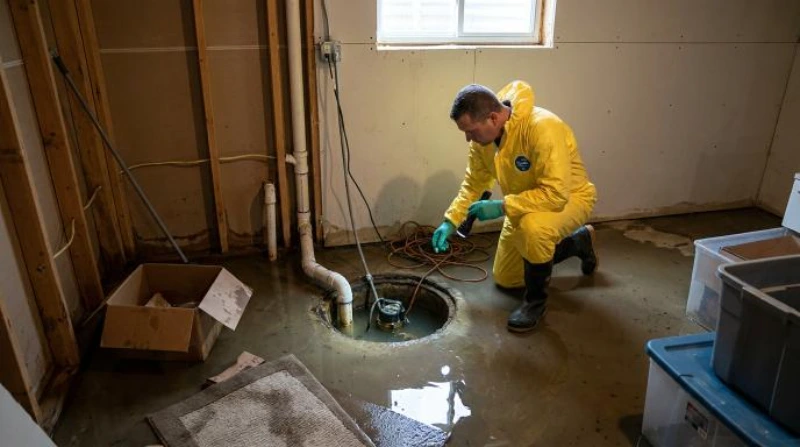
Sewage Backup Cleanup in Roseville Basements
If the water came up through a floor drain, toilet or laundry tub, treat it as sewage. Under the IICRC S500 standard that is Category 3 water, and it carries bacteria and viruses that soak into anything porous. Our crews work in full protective gear and follow a set order:
- Pump out standing water and sludge with the power off in wet areas.
- Remove porous materials the sewage touched: carpet, pad, drywall cut above the water line, insulation, cardboard and upholstered items.
- Scrub the slab, walls and framing, then apply an antimicrobial.
- Set LGR dehumidifiers and air movers, and log moisture readings every day until the materials reach dry targets.
Our sewer backup cleanup process page covers each step in more detail. The short version: speed matters. The EPA notes mold can start growing on wet materials within 24 to 48 hours, and a July storm in a humid basement gives it every advantage.
Basement Water Removal in Roseville When It Isn't Sewage
Not every wet basement in Roseville is a sewer problem. Clean and gray water losses are common too, and they cost less to fix:
- Wall seepage: water entering at the cove joint or a crack after days of rain. Usually clean water, Category 1, if caught early.
- Sump pump failure: a full pit with a silent pump, often during a power outage in a storm. This is Category 2 gray water. If your home relies on a sump, see our sump pump failure cleanup page.
- Plumbing and appliance leaks: a split supply line, water heater or washer hose. Shut the main valve and the flow stops.
- Window wells: leaves and clogged drains let a well fill and pour over the sill during a downpour.
For water damage restoration in Roseville MI, we use a moisture meter and thermal imaging to find water behind paneling and under floors before we set equipment. Extraction usually takes 2 to 6 hours, followed by 3 to 5 days of drying.
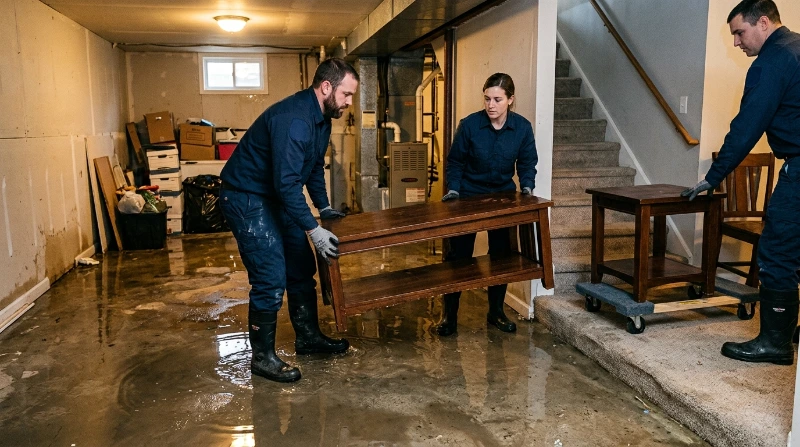
Reporting a Backup and the 45-Day Notice in Roseville
If you believe the public sewer caused your backup, two clocks start the day you discover it: one for your insurer and one for the government. Call your insurance carrier the same day. Then report the backup to the City of Roseville, whose City Hall is at 29777 Gratiot Ave, Roseville, MI 48066.
Michigan Public Act 222 of 2001 governs claims against a public agency for sewage disposal system events. You must give written notice within 45 days of discovering the damage. The notice needs only four things:
- Your name, address and phone number
- The address of the damaged property
- The date you discovered the damage
- A short description of the claim
Under Act 222, when you report a backup to a public agency, that agency must give you in writing the name and address of the person who receives claims and what the notice must include. Ask for it when you call, keep it, and send your notice well before day 45. Because the Martin district is run by Macomb County Public Works, the county may be one of the agencies involved.
Know the limits before you count on a payout. The law requires proof that a defect in the public system was at least 50% of the cause, that the agency knew or should have known about it, and that it failed to fix it in a reasonable time. A blocked private lateral, or a backup caused by a sump, drain or downspout connection on your own property, does not qualify. That makes a sewer backup endorsement on your homeowners policy important. Our guide on whether homeowners insurance covers basement flooding explains the usual exclusions and how NFIP flood insurance differs.
Whatever route your claim takes, documentation helps. During every flooded basement cleanup Roseville MI job we photograph the water line and damaged items, and record moisture readings from the first hour.
Roseville Basement Flood Cleanup Costs
Storm backups in Roseville usually mean sewage, so pay closest attention to the Category 3 rows. These are typical ranges from our jobs, not quotes:
| Situation | Typical range |
|---|---|
| Clean water, small unfinished basement | $500 – $1,500 |
| Sump failure (Category 2), unfinished | $1,500 – $4,000 |
| Sewage backup (Category 3), unfinished | $3,000 – $8,000 |
| Finished basement with sewage | $7,000 – $18,000 |
| Mold remediation, when needed | Adds $1,500 – $5,000+ |
A partly finished Roseville basement with paneling and carpet often lands in the middle of the sewage range, since those materials come out but the block walls behind them clean up well. You get a written estimate before work starts, and nights and weekends cost the same as weekdays.
Lowering the Odds of the Next Roseville Backup
You can't change the size of the county's pipes, but you can change what happens at your own floor drain.
- Backwater valve: a check valve on the sewer line lets wastewater out and closes when the main surcharges. See our check valve installation page for how it works and what it costs.
- Clean the lateral: have the line from the house to the street camera-inspected and cleared of roots, especially in homes with original 1950s lines.
- Keep grease and wipes out: they build up in your lateral, and a blockage there is not a public sewer claim under state law.
- Battery backup for the sump: storms that flood Roseville streets often knock power out too.
- Move valuables up: keep photos and documents off the basement floor. In 2019, Blumfield Street families lost albums stored in totes on the floor and on shelves that tipped over.
The city has been working on its side as well. In June 2026 Roseville finished rebuilding its 13 Mile Road sewer pump station, west of the Groesbeck and Utica Road intersection. The original station dated to the late 1970s and serves about 1,000 homes on the west side. It now has new pumps and a permanent backup generator that starts on its own during outages, so crews no longer have to haul in portable generators. State funding of about $6.5 million covered roughly half of the pump station and force main estimate.
Roseville Areas We Cover
Roseville has one ZIP code, 48066, and we cover all of it, from the Eastpointe line at 10 Mile north to 14 Mile, and from the Warren side near Groesbeck to I-94 and the St. Clair Shores border.
Utica Junction
Gratiot and Utica Road, the city's historic center and an old Detroit Interurban stop. The city replaced an aging water main here in 2017. Older buildings around the junction get the same source check we use citywide.
Macomb Mall & Masonic
The mall opened in 1964 at Gratiot and Masonic, with Beaconsfield on its western edge. The neighborhoods around it were built in the same post-war boom, so expect block foundations and floor drains.
Blumfield & the I-696 Area
The hardest-hit residential street in the July 2019 storm, when about a dozen basements flooded and Hayes Road washed out near the service drive.
West Side & 14 Mile at Groesbeck
Served by the rebuilt 13 Mile Road pump station. During the July 2025 storm, 14 Mile and Groesbeck flooded as Roseville took 3.01 inches in three hours.
13 Mile & Little Mack
Along I-94 near the St. Clair Shores line, where the county restored eroded banks on the Rohrbeck Extension Drain in 2022.
Eastgate & South Gratiot
Around Gratiot and Frazho, where Packard Field, Michigan's first commercial airport, once stood before Eastgate Shopping Center replaced it in the 1950s.
Our crews also work the cities around Roseville. Basement flood cleanup in St. Clair Shores shares the Martin district with you, Warren flooded basement cleanup covers the city to the west, and we also serve Clinton Township homeowners to the north. The Macomb County basement flooding guide covers sewer districts and flood history for the whole county. Every job is run by the same IICRC-certified team behind our flooded basement cleanup in Dearborn, serving Michigan homeowners since 2019. For flooded basement cleanup Roseville MI help at any hour, call (866) 838-7745. Our response target is 60 minutes.