
Sewer Backup Cleanup Dearborn MI — Do Not Enter. Call.
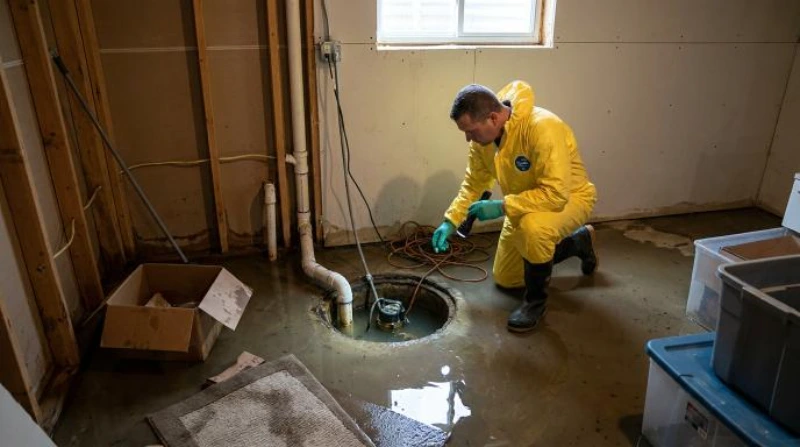
Sewage in your basement? That's a Category 3 biohazard — bacteria, viruses and parasites. Don't go down there; turn off the breaker. Our sewer backup cleanup Dearborn MI crews are certified for decontamination and respond 24/7.
Do not enter. Call first. We walk you through safe steps.
Before You Do Anything Else
DO NOT enter the basement. DO NOT use household fans. DO NOT let children or pets near the space. DO NOT try to clean it yourself. Sewage is the most urgent kind of flooded basement cleanup in Dearborn we handle, and it needs a certified crew.
Turn off the basement breaker at the main panel — not the one in the basement, but the main panel elsewhere in the house.
Call us now: We walk you through what to do while the crew is dispatched with full Category 3 equipment.
Why Sewage Backs Up Into Dearborn Basements — The CSO Problem
Sewer backup in Dearborn is not a fluke. It is the predictable result of an infrastructure system built for a different era operating under modern storm conditions. Understanding why it happens is the first thing we explain to every Dearborn homeowner we work with, because most have been told it is a plumbing issue in their home. It is not.
Dearborn's combined sewer system carries both household sewage and storm water runoff in a single shared pipe. Under normal rainfall conditions, this combined flow moves through the system to the treatment plant. The system was designed to handle approximately 3.5 inches of rain per day. A city infrastructure study commissioned by Mayor Hammoud and presented in September 2025 confirmed this capacity threshold. When storms dump more than that — and Dearborn's history shows they increasingly do — the pipe fills faster than it can drain.
When the pipe fills beyond capacity, something has to give. The physics are simple: pressure builds in the pipe and finds the path of least resistance. In a residential setting, that path is the basement floor drain — the lowest connection point in the home's plumbing. The pressure reverses and pushes sewer content back up through that drain and into your basement. This is called a combined sewer overflow (CSO) event. According to FEMA documentation on Disaster 4607, approximately 20,000 Dearborn homes experienced exactly this on June 25 and 26, 2021.
Dearborn's position at the downstream end of the Rouge River watershed compounds the problem. When communities upstream receive heavy rain, that runoff flows toward Dearborn. The city is receiving not only its own storm volume but volume from the entire upper watershed. The Colson Palmer Stormwater Line, one of the projects funded through HUD's Community Development Block Grant Disaster Recovery program, was designed specifically to route northeast Dearborn stormwater directly to the Rouge River to reduce this pressure on the combined sewer. That project and others represent the city's ongoing effort to address a systemic problem that will not be solved overnight.
Which Dearborn Neighborhoods Have the Most Sewer Backup Risk
East Dearborn along the Warren Avenue and Michigan Avenue corridor, including the blocks surrounding Fordson High School on Ford Road and the Arab American National Museum on Michigan Avenue, sits on some of the oldest combined sewer mains in the city. When CSO events occur, these older mains stay backed up longer than newer infrastructure in other parts of the city.
The Fordson neighborhood along Dix Avenue and Schaefer Road experiences frequent CSO backup because of flat terrain — there is no natural elevation gradient to help move water through the system quickly. Springwells, bounded by Rotunda Drive and Greenfield Road and listed on the National Register of Historic Places, carries the highest overall flood risk in Dearborn because of its location directly on the Rouge River and its drainage infrastructure dating to the early 1900s.
FEMA's July 2026 Hazard Mitigation Grant for east Dearborn specifically targets the Chase Road to Greenfield Avenue corridor with approximately 6,200 feet of new storm sewers and flapgate structures. Mayor Hammoud described the flapgates as neighborhood-wide backflow preventers for about 3,000 homes. That work is ongoing. Individual check valve installation remains the only immediate protection for homes outside that project area.
Category 3 Black Water — What You Are Actually Dealing With
The IICRC S500 Standard for Professional Water Damage Restoration classifies water damage into three categories based on contamination level. Category 3 — black water — is the highest. The IICRC defines it as water that is grossly contaminated and poses a substantial health risk through contact, inhalation, or ingestion.
Raw sewage is Category 3. The Centers for Disease Control and Prevention identifies sewage exposure as a source of more than 120 different viruses along with numerous bacterial and parasitic organisms. Specific pathogens commonly present in sewage backup include E. coli and other coliform bacteria, Salmonella, Hepatitis A virus, Norovirus, Cryptosporidium, and Giardia. These organisms cause gastroenteritis, liver disease, respiratory illness, and in severe cases can be life-threatening for immunocompromised individuals.
Exposure does not require drinking the water. The CDC warns that bioaerosols — microscopic droplets and particles — become airborne during improper cleanup, creating respiratory exposure risk particularly for people with existing health conditions. Running a household fan in a sewage-flooded basement spreads these aerosols throughout the space and potentially into the upper living areas of the home.
Even after visible water is removed, the CDC and EPA confirm that pathogens persist in porous materials — the concrete block, the drywall, the insulation, the wood framing. This is why the IICRC S500 requires removal of porous materials rather than attempting to clean them. Cleaning the surface of a drywall panel that absorbed sewage water does not address the contamination that penetrated the substrate. The panel must come out.
Our Dearborn Sewer Backup Cleanup Process
Step 1 — Safe Entry Assessment
Our crew arrives in full PPE: N95 or higher respirator, Tyvek full-body suit, nitrile gloves, and rubber boots. We assess water category, check electrical status, evaluate structural stability, and determine the extent of the contamination zone before anyone else enters. You stay upstairs. We go in, assess, and report back to you with what we found and what needs to happen before work begins.
Step 2 — Sewage Extraction with Sealed Equipment
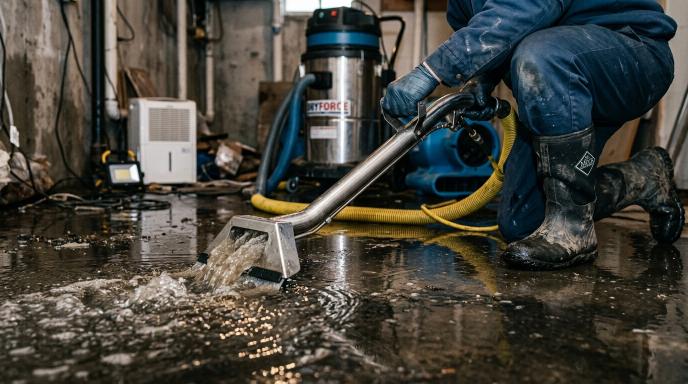
Category 3 extraction requires sealed equipment and proper disposal. Sewage water is transferred to sealed waste tanks for transport to a licensed disposal facility. It is not discharged onto your property or into the storm drain — both of which would create health and legal problems. Solid waste present in the basement is bagged separately as contaminated hazardous material.
Step 3 — Contaminated Material Removal
Under the IICRC S500 standard, all porous materials that contacted Category 3 water must be removed rather than cleaned. In a typical Dearborn sewer backup event, this means: carpet and carpet padding, the lower 12 to 24 inches of drywall depending on the water level, any insulation that sustained contact, and stored cardboard or fabric items on the floor. Non-porous materials — concrete, ceramic tile, metal, HDPE plastic — can be decontaminated and retained. Every item removed is photographed and documented for your insurance claim before disposal.
Step 4 — Disinfection and Decontamination
After material removal, every remaining surface is physically scrubbed to remove visible biofilm and contamination. EPA-registered hospital-grade disinfectant is applied to all surfaces at the labeled concentration. Dwell time — the time the disinfectant must remain wet on the surface to achieve the rated kill level — is followed exactly per manufacturer specifications, typically 10 to 15 minutes. Air scrubbers with HEPA filtration run throughout the space to capture airborne pathogens and particles. A second disinfection pass follows the air scrubbing phase.
Step 5 — Structural Drying and Clearance
After decontamination is confirmed, LGR dehumidifiers and air movers are set up for structural drying. Sewer backup events require five to seven days of drying time rather than the three to five days typical for clean water events. The extended timeline exists because decontamination steps precede drying and because the materials remaining after porous item removal still carry higher moisture content than clean water scenarios. Daily pin meter readings are taken and logged. Clearance is issued when every reading meets IICRC S500 certified dry standards.
Step 6 — Documentation Package for Insurance
You receive the complete documentation package: arrival photos taken before any work began, the contamination assessment and water category determination, a detailed log of all materials removed with photos of each item before disposal, the disinfection protocol used, daily drying readings, and the final clearance document. This package is formatted for insurance adjuster review. We communicate with adjusters from all major carriers and, where sewer backup coverage applies, bill the carrier directly.
Does Insurance Cover Sewer Backup Cleanup in Dearborn?
This is the most painful question for Dearborn homeowners, and the honest answer is the one most people do not want to hear: standard homeowners insurance in Michigan typically excludes sewer backup flooding. The most common cause of Dearborn basement flooding — combined sewer overflow during heavy rain — is the one most standard policies do not cover.
You need a sewer backup rider or water backup endorsement added separately to your policy. Many Dearborn homeowners discovered this coverage gap for the first time when they called their insurer after the June 2021 disaster. FEMA disaster assistance under Disaster 4607 was available to qualifying residents, but required application within a specific window and covered limited amounts — one resident near Ecorse Creek in Dearborn Heights reported receiving $250 from a FEMA claim against a cleanup that cost her $1,500 to $2,000.
If you do not currently have sewer backup coverage, call your insurer and ask specifically: Do I have a sewer backup rider or water backup endorsement? Adding this coverage typically costs $10 to $25 per month and applies to future events.
Regardless of current coverage status, we document everything from the moment we arrive. That documentation maximizes whatever claim you can file. We also advise on Wayne County and City of Dearborn assistance programs that may be available and can walk you through which programs apply to your situation.
Installing a check valve now. The City of Dearborn's flood preparedness page at dearborn.gov specifically recommends check valve installation on basement floor drains for properties susceptible to sewer backflow during heavy rain. A check valve allows water to flow out but prevents it from flowing back in during a CSO event. Professional installation typically costs $300 to $800 and is the most effective individual protection available while the city's infrastructure upgrades continue.
Why Wayne County Homeowners Call Us — Not a 1-800 Franchise
✓ Dryout Michigan
- Real person answers — no hold queue
- 60-minute response, Wayne County
- IICRC S500/S520 certified protocol
- Written estimate before work begins
- Insurance documentation from arrival
- No upselling of unnecessary demo
✗ Common complaints about franchise companies
- Callback promised, never comes
- Multiple visits to bring equipment
- Slow — working multiple projects
- Over-demolition to maximize insurance
- Communication gaps during drying
- Family moved to hotel for weeks
Sewer Backup Cleanup Dearborn MI — Frequently Asked Questions
Is it safe to go into my basement after a sewer backup in Dearborn?
No. Raw sewage is Category 3 under the IICRC S500 standard. The CDC identifies sewage as a source of more than 120 viruses plus bacterial and parasitic organisms including E. coli, Salmonella, Hepatitis A, Norovirus, and Cryptosporidium. These pathogens cause serious illness through skin contact and inhalation of airborne bioaerosols during improper cleanup. Turn off the breaker at the main panel. Keep children and pets away. Call us before entering.
Why does sewage back up into Dearborn basements when it rains?
Dearborn's combined sewer system carries both storm water and sewage in one pipe with a 3.5-inch daily rainfall capacity. When storms exceed that, the pipe fills beyond capacity and pressure reverses, pushing sewage up through basement floor drains. This is combined sewer overflow (CSO). The June 2021 storm, classified by FEMA as a 1,000-year rainfall event, pushed sewage into approximately 20,000 Dearborn homes this way. It is a city infrastructure problem, not a plumbing failure in your house.
What is black water and is sewer backup considered black water?
Yes. Sewer backup is Category 3 — black water — under the IICRC S500 standard, the highest contamination level in water damage restoration. It contains raw sewage with bacteria, viruses, and parasites. The IICRC S500 requires removal of all porous materials that contacted Category 3 water. Hard non-porous surfaces like concrete and tile can be decontaminated. Everything porous — carpet, drywall, insulation — must be removed and properly disposed of as contaminated material.
Does homeowners insurance cover sewer backup cleanup in Dearborn?
Standard homeowners insurance typically excludes sewer backup flooding. You need a sewer backup rider or water backup endorsement added separately. Many Dearborn homeowners discovered this gap after June 2021. Adding this coverage typically costs $10 to $25 per month. We document all damage from the moment we arrive to support whatever coverage you have. If you are not sure whether you have this endorsement, call your insurer and ask specifically.
How do I stop sewage from backing up into my Dearborn basement?
Install a check valve or backflow prevention valve on your basement floor drain. This allows water to flow out but prevents it from flowing back in during CSO events. The City of Dearborn's flood preparedness page specifically recommends this for properties susceptible to sewer backflow. Professional installation costs $300 to $800. The FEMA-funded flapgate project in east Dearborn between Chase Road and Greenfield Avenue protects about 3,000 homes at the neighborhood scale, but individual valves remain the immediate option for homes outside that project area.
How long does sewer backup cleanup take in Dearborn?
Initial extraction and decontamination takes 6 to 12 hours. Material removal takes one to two additional days. Structural drying under IICRC S500 takes five to seven days for sewage backup events — longer than clean water because decontamination precedes drying and contaminated materials require thorough moisture elimination before clearance can be issued. You receive a clearance document with certified moisture readings at completion for your insurance file.
Can I clean up a sewer backup myself in Dearborn?
No. Category 3 cleanup requires hospital-grade EPA-registered disinfectants, full PPE including respirator and Tyvek suit, sealed extraction equipment, and licensed disposal for contaminated porous materials. The CDC confirms sewage exposure in an enclosed space creates illness risk through contact and inhalation of bioaerosols. DIY cleanup also fails to meet the documentation standards insurance adjusters require for a valid claim. Call us for a free assessment — do not enter first.
How do I know if my basement flooding is sewage or just storm water?
The smell is the clearest indicator — raw sewage has a distinct odor that clean flooding does not. The entry point is the second indicator: water coming up through the floor drain or the cove joint at the base of the wall during or after heavy rain is almost always CSO with sewage content. Discolored or dark water from the floor drain is also a strong sign. When in doubt, treat it as Category 3 and call us — we confirm the category on arrival before anyone enters.
Sewer Backup Resources — Dearborn MI
FEMA — $8.1 Million Dearborn Stormwater Hazard Mitigation Grant, July 2026
NOAA — Lower Rouge River Gauge at Dearborn
FEMA Disaster Assistance — disasterassistance.gov
Rep. Debbie Dingell — FEMA Disaster 4607 Resources for Dearborn Residents
Complete Dryout Michigan Resource Library
IICRC Water Damage Restoration Technician (WRT) #WRT-48291
IICRC Applied Structural Drying Technician (ASD) #ASD-32817
Licensed Contractor · Serving Dearborn MI since 2019
Written by our certified sewage cleanup crew. Health and safety guidance follows IICRC S500, the CDC and the EPA. Last reviewed: October 2026.
Head Office
No extra charge for nights or weekends
+ Dearborn Heights · Allen Park · Lincoln Park · Wayne County
Serving all of Dearborn, Wayne County, and surrounding communities 24/7
Flooded Basement Cleanup — All Wayne County Cities
Sewage in Your Dearborn Basement?
Do not enter. Do not try to clean it yourself. Call us now — we arrive with Category 3 certified crews, sealed equipment, and hospital-grade decontamination. 24/7 across all Dearborn neighborhoods.
📞 (866) 838-7745 — Emergency Line 24/7