
Flooded Basement Cleanup Dearborn Heights MI
Ecorse Creek on the south end, sewer backups up north, and a 45-day city claim clock.
Creek water or sewage in your basement after a storm? Our flooded basement cleanup Dearborn Heights MI crews find the source, whether it's Ecorse Creek, a floor drain or a dead sump, then extract, disinfect and dry, with a 60-minute response target and a written estimate first.
One City, Two Watersheds, Two Kinds of Basement Flood
Dearborn Heights was put together in 1960 from two separate pieces of the old Dearborn Township, joined by a quarter-mile strip of land from Inkster. That odd shape still decides how your basement floods. The southern part of the city sits in the North Branch of Ecorse Creek watershed. The northern part drains to the Rouge River.
In practice that means two different problems. On the south end, around Telegraph and Van Born, the trouble that makes the news is creek water rising out of its banks and into yards, garages and basements. Further north, the usual culprit is the sewer: storm and sanitary flow backing up through a floor drain during a hard rain. A flooded basement cleanup Dearborn Heights MI call starts with figuring out which one you have, because it changes the water category, the cleanup method and who you file a claim with. Our guide to Ecorse Creek vs Rouge River basement flooding explains the split in more detail.
We work out of Dearborn, right next door, and the same crews that handle flooded basement cleanup in Dearborn cover every Dearborn Heights street, with a 60-minute response target.
Ecorse Creek Flooding in South Dearborn Heights
The North Branch of Ecorse Creek runs about 17 miles through seven communities, including Westland, Romulus, Dearborn Heights, Allen Park, Melvindale and Lincoln Park, before it reaches the Detroit River. More than a century ago it was straightened for farming. Today, over 90% of the land draining to it is paved or roofed, so rain reaches the channel fast.
In Dearborn Heights the worst of it sits in a FEMA-designated flood zone of several blocks near Telegraph and Van Born roads. Hanover Street and Currier Street, on opposite sides of the creek, flood again and again. McKinley Street has taken water too. Residents of Hanover sued the city back in 2010, and a consent agreement followed. In March 2016, about an inch of rain was enough to push the creek onto Hanover, which neighbors had nicknamed "Lake Hanover."
The big recent events:
- May 1, 2019: More than 100 homes near Van Born Road, between South Gulley Road and Telegraph, were hit. Firefighters handled about 30 calls that morning, rescued people from cars and homes, and the city opened a shelter at the Justice Center at Beech Daly and Michigan Avenue. One Hanover resident lost her washer, dryer, water heater, clothes and furniture.
- April 2–3, 2025: Detroit logged 2.18 inches of rain in 24 hours. The creek again spilled into streets and basements in south Dearborn Heights, with residents knee-deep in water.
After the 2014 flood, Dearborn Heights won a $2.8 million grant to buy and demolish 15 homes on Hanover Street. In 2024, FEMA spent $3.18 million buying 18 more flood-prone homes along the creek, now deed-restricted green space. Wayne County has put about $10 million into creek maintenance. The Army Corps of Engineers is designing a detention basin at Inkster Road and Powers Avenue, and a one-mile restoration of the North Branch from east of Telegraph to near Pardee Park was in design in 2024.
The Army Corps puts average annual flood damage in the watershed at about $22 million, with more than 9,000 properties affected. Our neighbors to the west see the same creek; see our Westland flooded basement cleanup page and the Inkster basement flood cleanup page if you own property across the line.
Creek water is not clean water. It picks up street runoff, lawn chemicals and, in a flood, sewer overflow. Residents have reported a sewage smell during past Hanover floods. We treat creek floodwater as Category 3 black water until testing or the source says otherwise.
Sewage Backup Cleanup in Dearborn Heights
Not every Dearborn Heights flood comes from the creek. Part of the city still has combined sewers, where rain and household wastewater share one pipe. Dearborn Heights owns a combined sewer overflow (CSO) retention basin that holds about 2.7 million gallons, built at a cost of roughly $18.7 million. University of Michigan factsheets show it serves a drainage area of about 1.12 square miles and discharged on average two to three times a year between 2005 and 2016.
The rest of the city drains to separate sanitary sewers. Two Wayne County lines in the Rouge Valley Sewage Disposal System, the Middle Rouge and Lower Rouge interceptors, end in Dearborn Heights, and that system carries wastewater on to the treatment plant in Detroit run by the Great Lakes Water Authority. Wayne County's own planning documents describe sanitary sewer overflows (SSOs) and basement backups on that system during wet weather.
Sewer trouble here does not always need a storm. In October 2019, a broken city sewer main sent raw sewage into at least five Dearborn Heights homes around 4 a.m. on a dry Saturday. One family said they had already spent more than $12,000 on cleanup. In the 2019 creek flood, a resident on a nearby street watched water rise out of the corner sewer instead of draining into it.
Whatever the cause, water from a floor drain, toilet or sewer is Category 3. Our sewer backup cleanup crews wear full protective gear, remove porous items the sewage touched, clean and disinfect with an EPA-registered antimicrobial, then dry the structure to IICRC S500 standards. A backwater or check valve on the main line can cut the odds of a repeat.
2014, 2021 and the Storms That Hit Dearborn Heights Hardest
The August 11, 2014 storm flooded large parts of the city. One Hanover Street resident told FOX 2 that 2014 was worse than the 2019 creek flood, with water in both the front and back of her home. It was that storm that led the city to apply for the Hanover buyout grant.
On June 26, 2021, heavy rain flooded streets and basements across Dearborn Heights, with sewage backups more than a foot deep in some homes. The storm became FEMA disaster DR-4607, covering Wayne and Washtenaw counties for the June 25–26 incident period. By late August, FEMA grants to individuals had passed $100 million, plus $59 million in SBA disaster loans. Our June 2021 Dearborn flood guide covers how that aid worked.
Then on July 16, 2021, it rained hard again. Some Dearborn Heights residents paddled kayaks down their streets. By July 18, Local 4 reported that about 1,500 Dearborn Heights homes had been damaged, and Mayor Bill Bazzi was meeting with FEMA, state and Wayne County officials. Amherst Street, residents said, floods nearly every time there is a major downpour.
Basement Water Removal in 1950s Dearborn Heights Homes
Dearborn Heights is a city of mid-century houses. Census survey data (2019–2023) puts the median year built at 1958, and 46% of all homes went up in the 1950s alone. Only about 4% of the housing stock is newer than 1990. Nearly 87% of homes are single-family detached, and about 70% are owner-occupied. The 2020 census counted 63,292 residents in 24,076 housing units across about 11.75 square miles.
Houses that age have had seventy years for basements to be finished, refinished, waterproofed and re-plumbed by different owners. That is why we never assume. Here is what we check in a typical Dearborn Heights basement:
The floor drain and main line
In a home from the 1950s, the floor drain is often the lowest opening to the sewer, so it is the first place backed-up water shows. We note whether a check valve exists and whether it held.
The sump, if there is one
Newer additions and waterproofing jobs often added a sump pit. A pump that dies during a power outage leaves gray water across the floor. That is a different job from a sewer backup, and our sump pump failure cleanup page walks through it.
Finished walls and floors
Paneling, drywall, carpet and pad hold water for days. After clean water, some materials can be dried in place. After sewage or creek water, porous materials below the water line come out.
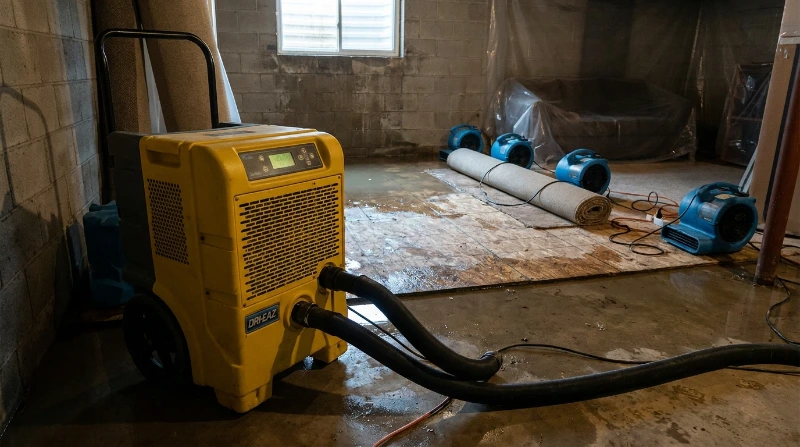
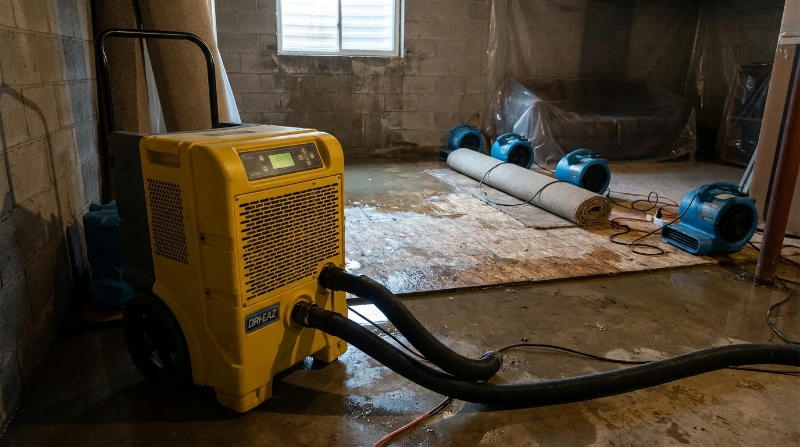
Once the source is stopped, we extract standing water, then set LGR dehumidifiers and air movers. Our structural drying crews check walls, framing and slab with moisture meters and thermal imaging and log readings every day, usually for 3 to 5 days. The EPA says mold can start growing on wet materials within 24 to 48 hours, so fast drying is the point.
What to Do Before Our Crew Arrives
- If the creek is still rising or water is near outlets and appliances, stay out of the basement. Shut off power to it only from a dry spot.
- If water came up through a floor drain or toilet, treat it as sewage. Keep kids and pets away and do not mop it.
- Stop running water, washers and dishwashers. Everything you drain adds to a backed-up line.
- Take dated photos and video of the water line, every wet room and damaged items before anything is moved.
- Call us at (866) 838-7745. If you think a city sewer caused it, report it to the city the same day too.
Filing a Sewer Backup Claim With Dearborn Heights
If a public sewer backed up into your home, Michigan Public Act 222 of 2001 gives you 45 days from when you discovered the damage to send written notice to the public entity responsible. The notice should include your name, address and phone number, the address of the damaged property, the date you found the damage and a short description of what happened. Keep a copy and proof of delivery.
For Dearborn Heights, start at City Hall, 6045 Fenton, Dearborn Heights, MI 48127, phone (313) 791-3490, and ask which office receives sewage backup claims. After the 2019 sewer main break, the city's emergency manager told families to pay for repairs and send in a flood form for reimbursement. After the June 2021 storm, the city also ran an online flood damage survey. A survey or a phone call is not the same as written notice, so send the notice regardless.
The 45-day notice covers sewer system events. Damage from Ecorse Creek overflowing is surface flooding. Standard homeowners policies exclude it, and it is normally covered only by NFIP flood insurance. Sewer backup, on the other hand, usually needs a separate sewer backup endorsement on your homeowners policy.
That split matters on the south end, where a single storm can bring both creek water and a sewer backup into the same basement. Our photos, moisture logs and notes start the moment we arrive and are written to show the source. For what policies in Michigan usually cover, read whether homeowners insurance covers basement flooding.
Dearborn Heights Basement Flood Cleanup Costs
These are typical ranges from our jobs, not quotes. You get a written estimate before any work starts, and nights and weekends are billed at the same rate.
| Situation | Typical range |
|---|---|
| Clean water, small unfinished basement | $500 – $1,500 |
| Sump failure (Category 2), unfinished | $1,500 – $4,000 |
| Sewage backup or creek water (Category 3), unfinished | $3,000 – $8,000 |
| Finished basement with sewage or creek water | $7,000 – $18,000 |
| Mold remediation, if needed | adds $1,500 – $5,000+ |
Creek floods on the south end often run higher than a floor-drain backup, because the water can come in through doors and window wells as well as drains and may reach the first floor. In a finished 1950s basement, most of the cost comes from what has to be removed.
Where We Work in Dearborn Heights
We cover both Dearborn Heights ZIP codes, 48125 and 48127, and both halves of the city.
Telegraph and Van Born
The FEMA flood zone around Hanover and Currier streets along Ecorse Creek. Expect creek water, mud and silt, sometimes on top of a drain backup.
Inkster Road and Powers
Site of the planned Army Corps detention basin on the North Branch. Homes upstream and down see the same creek after heavy rain.
Michigan Avenue and Beech Daly
The Wayne County Lower Rouge interceptor follows Michigan Avenue. Away from the creek, we check the floor drain, the sump and the walls before assuming a source.
Rouge River side
The northern section drains to the Rouge River, not Ecorse Creek. Here a wet basement more often traces back to a floor-drain backup or a failed sump than to surface water.
For a city-by-city look at flood causes across the county, see our Wayne County basement flooding guide. Wherever you are in town, flooded basement cleanup Dearborn Heights MI service runs 24/7, and a real person answers at (866) 838-7745.