⚠ Wayne County Flood Alert: Combined sewer capacity is 3.5"/day. Any storm above that pushes sewage into basements. Mold begins within 24 hours.Call (866) 838-7745
Dryout Michigan — Michigan Flooding Guide
Downriver Michigan Flooding — What Every Homeowner Needs to Know
📅 September 23, 2026👷 James Novak, IICRC WRT #WRT-48291 & ASD #ASD-32817⏱ 7 min read
Basement flooding again? Downriver Michigan flooding comes from aging combined sewers, active rivers and flat land that won't drain — shared by the communities south of Detroit. This guide explains why it's different and what proper cleanup requires.
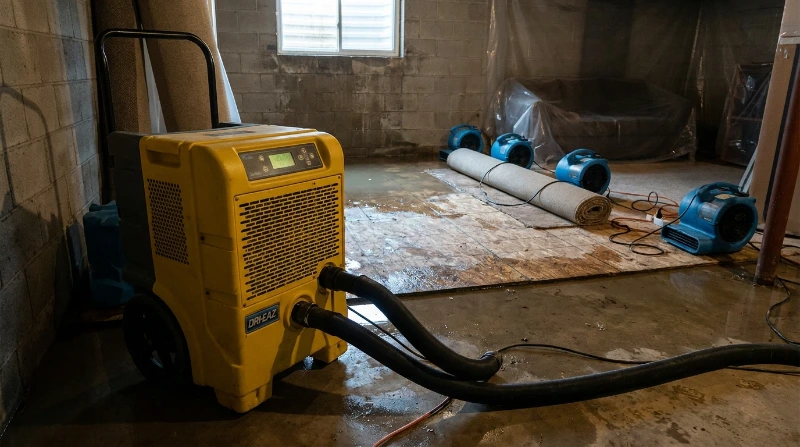
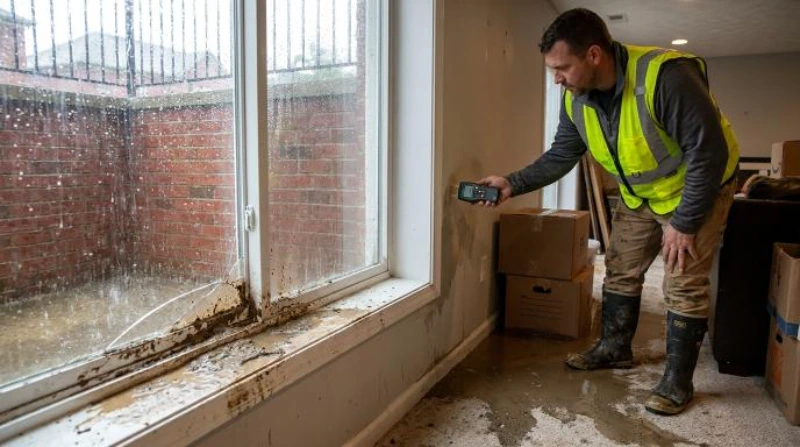
Downriver area basement flooding during Wayne County CSO event — the single pipe carrying storm water and sewage fills and reverses.
Downriver is an informal term for the communities south of Detroit along the Detroit River corridor. There is no official geographic boundary — the term generally covers municipalities in southern Wayne County that developed as industrial and working-class residential communities between 1920 and 1970. These cities include Wyandotte, Lincoln Park, Southgate, Taylor, Trenton, Riverview, Ecorse, Melvindale, Allen Park, and in broader usage, communities further inland like Westland, Garden City, Romulus, and Inkster. Dryout Michigan is based in Dearborn, and our Dearborn flooded basement cleanup page shows how a job runs from first call to final dry-out.
The unifying characteristic of Downriver communities is their development timeline and their infrastructure age. These cities grew rapidly during and after World War II to house the families of autoworkers employed at the Detroit, Dearborn, and Downriver industrial facilities. The housing stock that remains today is largely the same housing built for those families between 1940 and 1970. The sewer infrastructure that serves it was built during the same period and has not been comprehensively replaced.
The Three River Systems That Define Downriver Flooding
Three distinct river systems drive basement flooding across Downriver Michigan, and understanding which system affects your city helps explain when and why your basement floods.
The Rouge River System
The Rouge River and its tributaries — the Middle Rouge, the Upper Rouge, and the Lower Rouge — drain 466 square miles of southeast Michigan before reaching Wayne County. By the time this water reaches the cities of Dearborn, Lincoln Park, Allen Park, Melvindale, and Inkster, it has collected runoff from Oakland, Washtenaw, and Livingston counties in addition to the Wayne County precipitation that fell locally. The Rouge River is the primary driver of CSO flooding in the dense urban core of Downriver Michigan.
The Detroit River System
The Detroit River flows from Lake St. Clair to Lake Erie along Wayne County's eastern edge. Communities directly on the river — Wyandotte, Trenton, Riverview, and Ecorse — face a flooding mechanism that differs from the Rouge River cities: river-level rise pushes hydraulic pressure through the combined sewer system even without significant local rainfall. A storm upstream can raise the Detroit River level and back up floor drains in riverside communities before any local rain begins.
The Huron River System
The Huron River drains southwestern Wayne County, affecting communities like Flat Rock, Romulus, and Belleville. The Huron River watershed has different flooding timing than the Rouge system — events often build more gradually over multi-day rain periods rather than the rapid-onset CSO events driven by the Rouge. Belleville Lake, fed by the Huron River, rises during regional rain events and can push hydraulic pressure into Belleville's combined sewer independently of local rainfall.
Key Difference: Rouge River flooding is typically rapid-onset — it can develop within 90 minutes of heavy rain starting. Detroit River flooding can occur during long-duration regional storms before local rain exceeds CSO threshold. Huron River flooding often builds more gradually over multi-day events.
Why Downriver Infrastructure Is the Core Problem
Downriver's flooding is not primarily a natural phenomenon — it is an infrastructure problem. The combined sewer systems that serve these communities were designed for 1950s and 1960s population densities and impervious surface ratios. Since then, commercial development, expanded impervious surface, and in some cases population growth have increased the storm water load these systems must handle without a corresponding increase in sewer capacity.
Simultaneously, the clay tile lateral connections that run from Downriver homes to the street sewer mains are now 60 to 80 years old. Clay tile joints fail with freeze-thaw cycling over decades — the joints between tiles crack, allowing groundwater to infiltrate the lateral pipe. This infiltration adds volume to the combined sewer during wet periods, pushing the system toward CSO threshold even when rainfall alone wouldn't get there. It also allows sewage to escape the lateral in the other direction during normal operation — contributing to the deteriorated soil conditions that further complicate flooding in many neighborhoods.
Downriver City Flooding Profiles
City
Primary Flood Source
Housing Era
Key Characteristic
Wyandotte
Detroit River + Lower Rouge
1920s–1950s
Brick construction holds flood line visible for years
Built all at once in 12 years — infrastructure failure is uniform
Taylor
Taylor Drain
1950s–1970s
Drain fills in 90 minutes. Mixed slab/basement complicates response
Trenton
Detroit River
1900s–1960s
River-level alone floods drains without local rain
Riverview
Detroit River + Flat Rock Creek
1950s–1960s
Two water body exposure — flooding from east and west
Ecorse
Detroit River + Ecorse Creek
1900s–1940s
Wayne County's oldest infrastructure Downriver
Melvindale
River Rouge (3-direction)
1940s
2.3 sq mi — CSO pressure from three directions simultaneously
Allen Park
Lower Rouge / Allen Creek
1950s–1960s
Dense with high sewer load; borders Lincoln Park and Melvindale
Inkster
Middle Rouge
1940s–1950s
Among oldest/most underfunded CSO infrastructure Downriver
Garden City
Middle Rouge
1940s–1950s
5.2 sq mi — most compact Wayne County city, all in CSO zone
Cleanup: What the IICRC S500 Standard Actually Requires
Professional extraction in progress — truck-mounted units remove thousands of gallons per hour in Downriver homes.
The IICRC (Institute of Inspection, Cleaning and Restoration Certification) S500 standard is the document that governs water damage restoration in the United States. It specifies three water categories (described elsewhere on this site) and requires specific protocols for each. For Category 3 events — which includes all combined sewer backflow — the requirements are non-negotiable:
Extraction: All standing water removed with industrial-grade equipment — not wet-dry vacuums, not consumer pumps.
Material removal: All porous materials that contacted Category 3 water must be removed — carpet, carpet pad, drywall to the flood line, insulation, and any soft goods that cannot be reliably disinfected.
Disinfection: All hard surfaces receive EPA-registered disinfectant at the manufacturer's required dwell time. This is not bleach solution applied with a mop.
HEPA air scrubbing: Negative pressure HEPA air scrubbers run during the job to prevent aerosolized contamination from spreading above the flood line.
Structural drying: LGR dehumidifiers and air movers run continuously for 3 to 5 days minimum, with daily pin meter readings at documented test points.
Written clearance: A documented statement that certified dry has been reached at every test point before equipment is removed.
Any contractor who skips material removal "to save you money" or who removes equipment after two days because the basement "looks dry" is not following IICRC S500. The risks of incomplete remediation are documented: active mold colonization in wall cavities, persistent bacterial contamination on hard surfaces, and structural deterioration from continued moisture retention.
Basement flooded anywhere Downriver? IICRC S500 protocol on every truck.
The June 2021 Flood — What Happened and What It Means
The June 25-26, 2021 storm event is the benchmark Downriver flood event of the current decade. Over 6 inches of rain fell across Wayne County in under 24 hours — roughly double the daily CSO overflow threshold — producing a federal disaster declaration and an estimated $750 million in damage across the county. Thousands of Downriver basements flooded simultaneously.
The June 2021 event illustrated several realities about Downriver flooding that are relevant to every future storm season. First, the combined sewer system's overflow is not a slow process at these rainfall rates — backflow into basement floor drains began within 90 minutes of heavy rain starting in many locations. Second, the volume of sewage that entered basements in many homes exceeded what any consumer-grade equipment could address — multiple feet of standing Category 3 water in finished basements was common. Third, restoration companies that were not pre-positioned with IICRC S500 protocol were unable to respond adequately, leaving homeowners waiting days for proper service.
Prevention Options Specific to Downriver Communities
The most effective prevention measure for Downriver's combined sewer flooding is overhead sewer conversion. Because gravity is the mechanism that drives sewage up through the floor drain during CSO events, installing a sewer lateral that exits the house above the street sewer level eliminates that gravity pathway. Cost: $3,000 to $8,000 in most Downriver municipalities. Several municipalities have offered partial rebates for overhead sewer conversion — check with your city's water department for current programs.
Backwater valves are the less expensive alternative — $500 to $1,500 installed — but require regular maintenance and can stick in either position. Wayne County has documented multiple backwater valve failures during major CSO events. They are not a substitute for overhead sewer conversion in the highest-risk Downriver neighborhoods.
For Detroit River communities like Wyandotte, Trenton, Riverview, and Ecorse, overhead sewer conversion addresses the CSO backflow component of flooding but does not address river-level hydraulic pressure events. These communities sometimes require additional perimeter drainage measures for complete flood protection — a conversation to have with a licensed plumber or structural engineer familiar with Downriver river-zone construction.
Downriver is an informal term for the communities south of Detroit along the Detroit River corridor in Wayne County — including Wyandotte, Lincoln Park, Southgate, Taylor, Trenton, Riverview, Ecorse, Melvindale, Allen Park, Inkster, Garden City, and in broader usage, Westland, Romulus, and other Downriver Wayne County communities. These cities share similar flooding causes and infrastructure age.
Why do Downriver basements flood during every hard rain?
Downriver flooding is primarily a combined sewer overflow problem — an infrastructure issue, not a natural one. The combined sewer systems were sized for 1950s and 1960s populations and have not been comprehensively upgraded. Commercial development and impervious surface growth since then has increased the storm water load without a matching increase in capacity. The CSO threshold is exceeded multiple times per year.
What three river systems cause Downriver flooding?
The Rouge River (and its Middle and Lower branches), the Detroit River, and the Huron River. The Rouge system drives CSO flooding in the dense urban core from Lincoln Park to Inkster. The Detroit River creates hydraulic pressure events in riverside cities like Wyandotte, Trenton, Riverview, and Ecorse. The Huron River affects Flat Rock, Romulus, and Belleville.
Is the water in my Downriver basement sewage?
During heavy rain, almost certainly yes. Downriver communities have combined sewers — when the combined system overflows, the water that enters through your floor drain is Category 3 sewage: grossly contaminated, carrying bacteria and viruses, requiring full decontamination protocol under IICRC S500.
Can I clean my Downriver basement myself after flooding?
Extraction from a Category 3 event is not something consumer equipment can address adequately. More importantly, the IICRC S500 protocol requirement to remove all porous materials that contacted Category 3 sewage — carpet, drywall, insulation — is not optional under proper remediation standards. A DIY cleanup that leaves these materials in place leaves active contamination in your living space.
What prevention options work for Downriver flooding?
Overhead sewer conversion is the most effective measure — it eliminates gravity-driven CSO backflow entirely. Backwater valves are less expensive but less reliable. Sump pumps do not address CSO backflow, which is the primary flooding mechanism. Check with your city for any rebate programs for overhead sewer conversion.
How fast does mold grow after a basement flood?
The EPA and CDC both confirm mold begins growing on wet materials within 24 to 48 hours. In Wayne County basements during summer — typically 65–80°F — conditions are ideal. Mold growth starts inside drywall, insulation, and wood framing before it becomes visible on the surface. If professional drying did not begin within 24 hours of flooding, antimicrobial treatment is necessary even if you see no mold yet.
Basement flooded right now? We respond in 60 minutes — 24/7/365.
Lead Water Damage Restoration Technician · Dryout Michigan IICRC WRT #WRT-48291 · IICRC ASD #ASD-32817 Licensed Contractor · Serving Dearborn MI & Wayne County since 2019
Coverage Area
Flooded Basement Cleanup — All Wayne County Cities
Every hour of standing water in your basement increases mold risk, contamination spread, and your final cleanup bill. The EPA gives you 24–48 hours. The clock is already running.
🦠
Mold starts growing within 24–48 hours
EPA and CDC confirmed. In Michigan summer basements (65–80°F), growth hits the fast end of that window. Visible mold means it has been inside the walls for days already.
📈
Every 12-hour delay adds ~7% to your cost
IICRC data. A $3,000 sewage cleanup becomes $5,000+ when mold remediation is added. Calling now is the cheapest decision you can make today.
☣️
Wayne County flooding is mostly Category 3 sewage
When the combined sewer system overflows, raw sewage pushes back through your floor drain. Do not enter. Do not use fans. Call us first.