
Flooded Basement Cleanup Troy MI
Separate sewers, finished basements and a 45-day claim clock most owners never hear about.
Water across a finished floor, and no idea where it came from? Our flooded basement cleanup Troy MI technicians find the source, pull the water and dry finished lower levels, with a 60-minute response target and a written estimate first.
Troy Basement Flooding Depends on Which Sewer Serves Your Street
Most of Troy runs on separated sewers, so a wet basement here is less likely to be a storm-driven sewage surge and more likely to come from a sump, a foundation, a plumbing line or a sanitary backup. That makes finding the source the first job on every flooded basement cleanup Troy MI call. The answer changes the water category, the cleanup method and who pays. Separated sewers lower the flood risk from sewage, but they don't stop groundwater or a failed sump from soaking a finished floor.
Of Troy's land in the Red Run subwatershed, only 0.83 square miles is in the George W. Kuhn combined-sewer area. The rest of that land is storm-sewer area, with rain carried in pipes kept apart from household wastewater. A small corner of the city does share pipes the way neighboring Royal Oak does, though, so we never assume.
Troy's wastewater also moves through three different Oakland County Water Resources Commissioner districts: Evergreen-Farmington, Oakland-Troy and George W. Kuhn. In November 2022, City Council took up a corrective action plan for the Evergreen-Farmington district aimed at wet-weather sanitary sewer overflows and backups into homes and businesses. Separated sewers lower the odds of a storm backup. They do not make it impossible.
Two Watersheds Run Through Troy
Troy drains in two directions. About 82.8% of the city, or 27.80 square miles, sits in the Red Run subwatershed of the Clinton River. Part of the city drains instead toward the Rouge River.
The clearest example is the Sprague Drain in Firefighters Park, a tributary of the Main 1-2 Branch of the Rouge. In 2023 it received about $900,000 in Great Lakes Restoration Initiative money for habitat restoration. For homeowners, the split matters mostly for one reason: your drainage, your county sewer district and the office you call can differ from the house a mile away.
Finished Basements Change Basement Water Removal in Troy
Troy housing is younger than most of southeast Oakland County, and that shapes the damage. Census survey data puts the median home at 1977, with about a third of units built in the 1970s and only about 11% before 1960. The city's population roughly doubled in the 1960s, from 19,402 to 39,419. About 71% of homes are single-family detached and 73% are owner-occupied.
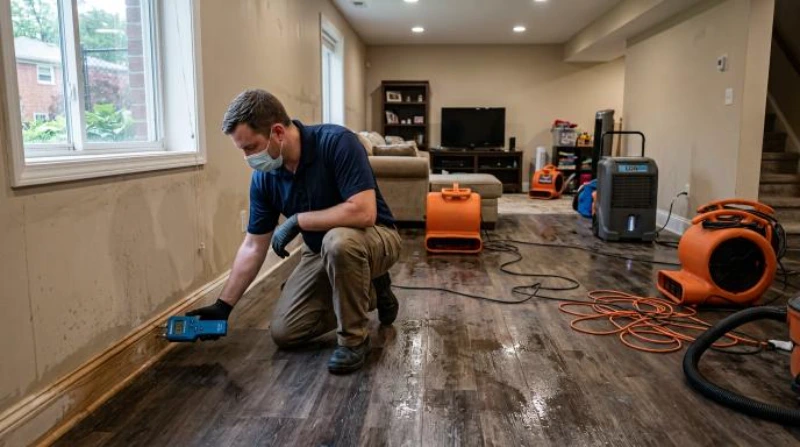
A house from that era is old enough that its lower level has often been finished at least once. When it has, a few inches of water does far more harm than it would on bare concrete. Here is what we check in a finished Troy basement.
Drywall and insulation
Drywall wicks water upward. If the water was clean and we reach it fast, walls can often be dried in place. If it was sewage, or it sat too long, the wet section is cut out above the water line.
Carpet, pad and flooring
Pad soaks up water like a sponge and is usually replaced. Carpet can sometimes be saved after clean-water losses. Laminate and engineered wood over concrete trap moisture underneath and often need to come up so the slab can dry.
Hidden cavities
Bottom plates, wall cavities, built-in cabinets and the space under a basement bar or stairs hold moisture longest. We use moisture meters and thermal imaging to find it, then dry it with our structural drying setup and log readings every day for 3 to 5 days.
When Sewage Came Up in Troy Basements
Separated sewers have not kept sewage out of every Troy basement. In 2013, more than a dozen Troy basements took in raw sewage. The residents' attorney blamed grease from the nearby Somerset Collection, and after an earlier settlement, residents filed a negligence suit against the city in 2015.
Grease backups are a useful reminder that a sanitary sewer can back up with no rain at all. Troy was also one of the communities covered by the $11.5 million class-action settlement over the August 11, 2014 sewage backups, and Oakland County was part of the federal disaster declaration for that storm. Whatever the cause, sewage is Category 3 black water. Our crews handle it in full protective gear, remove porous materials it touched, then clean, disinfect and dry.
How We Track Down Where the Water Came From
We find the source before we set a single fan, because drying a basement that is still taking on water wastes your money. These are the patterns we look for in Troy homes:
- Floor drain or toilet backup: water pooled around the lowest drain, often dark and smelly. Treat it as sewage.
- Sump failure: the pit is full and the pump is silent or running nonstop. This is usually Category 2 gray water.
- Wall seepage: damp bands along the cove joint where floor meets wall, or wet spots that track a window well.
- Plumbing leak: water near the water heater, softener, laundry hookups or a supply line, often clean and steady.
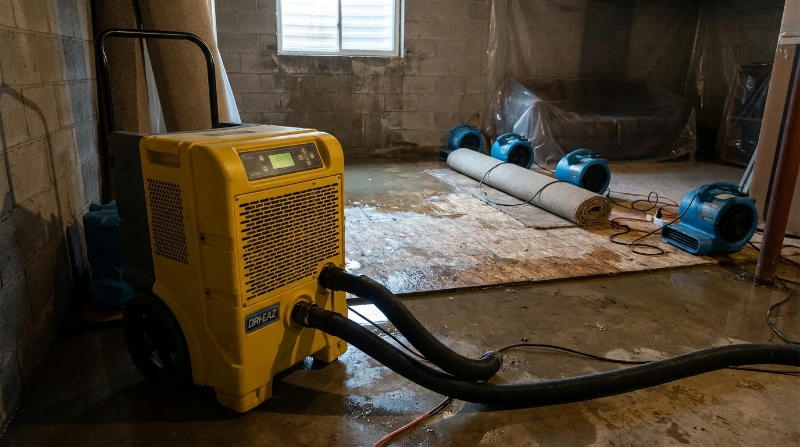
Once the source is stopped, our basement water removal crews extract the standing water, which typically takes 2 to 6 hours, then set dehumidifiers and air movers for drying.
Five Things to Do Before Our Truck Reaches Your Troy Home
- If water is touching outlets, cords or appliances, stay upstairs. Turn off the basement circuits only from a dry floor.
- If the water came from a drain or toilet, do not walk through it or try to mop it.
- Shut off the main water valve if a pipe or appliance is the source.
- Photograph the water line, every wet room and the items that got soaked, with your phone's date stamp on.
- Call us at (866) 838-7745, and if you suspect a city sewer backup, call the Water Division too.
Filing a Sewer Backup Claim With the City of Troy
If you think the city's sewer backed up into your home, Troy gives you 45 days to put it in writing. Call the Water Division at 248.524.3370 first, or Troy Police at 248.524.3477 after hours. Then send a written Notice of Sewer Backup Claim to the City Attorney's Office at 500 W. Big Beaver, Troy, MI 48084, or fax it to 248-524-3259. That 45-day clock is for the city notice; your insurance claim has its own deadline, so call your carrier the same day.
Troy states that missing the 45-day written notice deadline bars recovery. That window starts when you discover the backup, not when cleanup ends. Send the notice early, keep a copy, and save our photos and moisture readings, which we start recording from the moment we arrive.
The 45-day rule comes from Michigan Public Act 222 of 2001. The clock keeps running even while your flooded basement cleanup Troy MI job is still underway. The city claim is separate from your homeowners policy, and many standard policies exclude sewer backup unless you added a rider. Our guide on whether homeowners insurance covers basement flooding in Michigan walks through the usual exclusions. For storm drainage questions on your street, Troy Engineering is at 248.524.3383.
Flooded Basement Cleanup Costs for Troy Homes
In Troy, the size of the bill tracks whether the basement is finished and what kind of water got in. These are typical ranges from our jobs, not quotes:
- Clean water, small unfinished basement: $500 to $1,500
- Sump failure (Category 2), unfinished: $1,500 to $4,000
- Sewage backup (Category 3), unfinished: $3,000 to $8,000
- Finished basement with sewage: $7,000 to $18,000
- Mold remediation, when needed: adds $1,500 to $5,000 or more
A clean-water leak in a finished basement caught early is often closer to the low end, because drywall and carpet can sometimes be dried in place. Every extra 24 hours of standing water adds roughly $1,500 to $3,000 of scope. You get a written estimate before work begins, and we charge the same rate at 3 a.m. on a Sunday as on a Tuesday afternoon. In carpeted lower levels, mold growth usually shows up as a musty smell days before any spots appear.
Troy Areas We Cover
We serve all four standard Troy ZIP codes, 48083, 48084, 48085 and 48098, from the I-75 corridor out to the city's edges.
Northfield Hills
Bounded by Square Lake, Long Lake, Crooks and Coolidge, on land Chrysler bought in 1957 and planned with architect Minoru Yamasaki. We handle sump, seepage and backup cleanup throughout the subdivision.
Big Beaver Corridor
Troy's business district, home to City Hall at 500 W. Big Beaver and the Somerset Collection. In 2013, residents' attorney blamed grease from Somerset for sewage backups in Troy basements.
Troy Corners
The historic settlement in north-central Troy. We dry basements here with the same IICRC process and daily moisture logs we use across the city.
Firefighters Park & Sprague Drain
Where Troy drains toward the Rouge River's Main 1-2 Branch. Drainage on this side heads to a different river system than most of Troy, so we confirm the source on every call.
Our flooded basement cleanup Troy MI crews also cover nearby cities. See basement flood cleanup in Royal Oak, where the entire city is combined sewer, plus our pages for Bloomfield Hills and Auburn Hills homeowners. The Oakland County restoration guide covers the whole county, and if your Troy home relies on a sump pump, read our winter sump pump failure guide before the first hard freeze. Every job is run by the same IICRC-certified team behind our flooded basement cleanup in Dearborn, serving Michigan homeowners since 2019. For water damage restoration in Troy, a real person picks up at (866) 838-7745 every hour of the year. A wet-dry vac is handy for the last film of water after extraction, not for an inch spread across the whole basement.