
Flooded Basement Cleanup Wyandotte MI
Two Rivers Are Why — We Fix It Tonight.
Basement flooded? The Lower Rouge meets the Detroit River here — two overflow systems that can hit your floor drain at once. Our flooded basement cleanup Wyandotte MI crews respond 24/7 with IICRC S500 protocol.
Why Wyandotte Basements Flood — The Two-River Problem
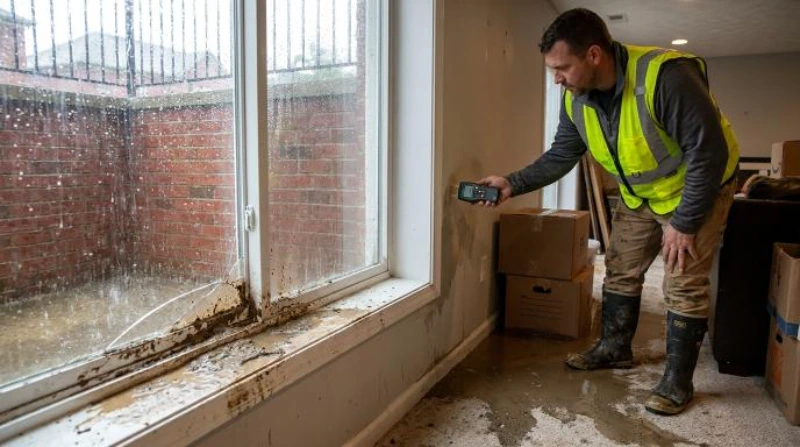
No city in Downriver Michigan floods the way Wyandotte does. Incorporated in 1869, Wyandotte is one of the oldest cities in Wayne County — and its infrastructure reflects every decade of that age. The city sits at the precise point where the Lower Rouge River empties into the Detroit River, creating a drainage situation that no amount of individual home maintenance can fully protect against. Wyandotte jobs follow the same protocol as our flooded basement cleanup in Dearborn.
When a storm drops more than 3.5 inches of rain per day — the confirmed overflow threshold for Wayne County's combined sewer system — the pressure in the underground pipe network reverses. That reversal pushes sewer content back up through the lowest drain in your home. In Wyandotte, that reversal doesn't just come from one direction. The city can experience backpressure from the combined sewer main feeding into the Lower Rouge AND from the Detroit River outfall pressure simultaneously. Two systems, one basement floor drain, one outcome.
The 1920s-era cast iron combined sewer mains that run beneath Biddle Avenue and the historic core of Old Wyandotte were designed for a smaller city with a fraction of today's impervious surface area. Parking lots, driveways, and rooftops that didn't exist in 1925 now shed water directly into a system that was already undersized by modern standards. The result is that any storm with sustained rainfall over 2 inches starts producing CSO events in Wyandotte before the rest of Downriver Michigan reaches that threshold.
During the June 2021 FEMA Disaster 4607 event — when 6 to 7 inches fell on Wayne County in under five hours — Wyandotte's riverside neighborhoods were among the first in the county to report floor drain backups. The Detroit River's own level rose during that storm, reducing the outfall capacity at exactly the moment the combined sewer was already at overflow pressure. Riverside blocks along Biddle Avenue reported water in basements before many Dearborn streets were even wet.
If your Wyandotte basement fills with water during or after heavy rain — especially if there is an odor — assume Category 3 sewage until proven otherwise. Do not enter. Do not use fans. Turn off the electrical breaker to the basement at the main panel. Then call us. We confirm the category on arrival and tell you exactly what you're dealing with before anything else happens.
Emergency Flood Cleanup in Wyandotte MI
A flooded Wyandotte basement is a same-night problem, not a tomorrow problem. The gap between when your basement fills and when professional extraction begins is the single variable you control — and it determines both the final cleanup cost and the mold risk that follows. Every additional hour of standing water in a Wyandotte basement means more moisture absorbed into the brick, more contamination spreading through porous materials, and a longer drying period ahead.
When you call us, a live dispatcher answers. We confirm the Wyandotte address, ask about odor to assess water category, and dispatch a crew immediately. We carry Category 3 sewage protocol on every truck — we don't assess first and then return with different equipment. One call, one truck, full protocol available from the moment we arrive.
Our 60-minute response target applies to all Wyandotte ZIP 48192 addresses. We know the Biddle Avenue corridor, the Fort Street grid, and the riverside blocks that flood first. We've been in these basements before.
See our full emergency response protocol →
Sewage Backup Cleanup in Wyandotte MI
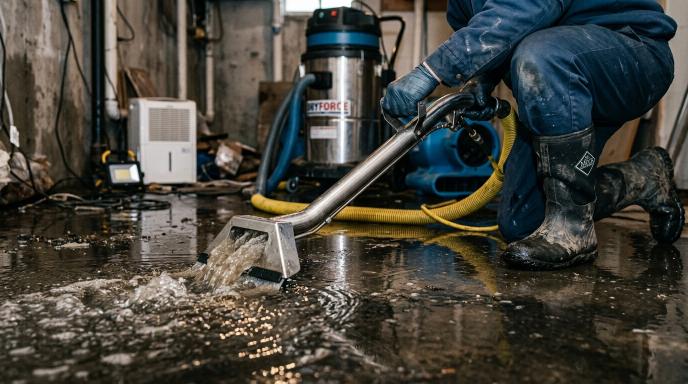
Wyandotte's combined sewer system means most basement flooding during rain events is Category 3 — the highest contamination level in the IICRC S500 standard. This is raw sewage: bacteria, viruses including Hepatitis A and Norovirus, parasitic organisms. The IICRC S500 is explicit on what Category 3 water requires: full PPE for every person in the space, sealed extraction equipment, removal of all porous materials that contacted the sewage water, hospital-grade EPA-registered disinfectant with proper dwell time, and HEPA air scrubbing.
What you cannot do after a Wyandotte sewage backup: enter without protective equipment, run household fans (which aerosolize contaminated particles), attempt to mop or shop-vac the water, or save carpet, insulation, or drywall that contacted the sewage. These materials must come out. No exceptions under IICRC S500 Category 3 protocol.
What we do: arrive in full PPE, set up contained extraction, remove contaminated porous materials under proper disposal protocol, apply hospital-grade EPA-registered disinfectant to all hard surfaces, run HEPA air scrubbers, and begin structural drying only after decontamination is confirmed. You receive a Category 3 clearance document for your insurance file.
Full Category 3 sewage backup protocol →
Basement Water Removal in Wyandotte MI
Wyandotte's oldest homes — the brick two-stories from the 1900-1930 era that define the Old Wyandotte historic district — present a specific challenge for water extraction that newer construction doesn't. These homes have original clay tile lateral drain connections to the combined sewer main. Those clay tile joints have been cracking and shifting through Michigan's freeze-thaw cycles for 90 to 120 years. Groundwater can enter through those failing joints independent of the CSO event happening above them.
This means a Wyandotte water removal job is often a multi-source event: sewer backflow coming up through the floor drain AND groundwater seeping in through deteriorating lateral connections AND potential surface water entry through below-grade windows. Industrial submersible pumps handle the standing water. Commercial extraction equipment pulls moisture from concrete floors and subfloor joists that shop vacs cannot reach. Getting to certified dry in a Wyandotte brick basement requires the right equipment and enough time — usually more of both than in newer construction.
Our complete water removal process →
Structural Drying in Wyandotte MI
This is where Wyandotte is different from the rest of Downriver Michigan. Brick foundation walls — standard in homes built before 1940 throughout Old Wyandotte — absorb water at a different rate and release it more slowly than the concrete block found in 1950s and 1960s construction elsewhere in Wayne County. Pin moisture meters inserted into a Wyandotte brick foundation wall after extraction will read 35% to 45% moisture content. The IICRC S500 certified dry standard requires 15% to 17% for masonry. Getting from 40% to 16% in a Wyandotte brick basement takes 5 to 7 days of continuous LGR dehumidification — sometimes longer in the winter when the basement temperature drops.
We use LGR (Low-Grain Refrigerant) dehumidifiers positioned for the specific dimensions of your basement. Industrial air movers create directed airflow calculated per IICRC S500 guidelines — not randomly placed. Daily pin meter readings at marked test points are logged and provided to you in writing. Equipment stays until every reading hits certified dry. Not surface dry. Not dry-looking. Certified dry by the standard your insurance carrier will ask for.
How IICRC S500 structural drying works →
Mold Remediation in Wyandotte MI
Wyandotte homeowners face elevated mold risk compared to inland Wayne County cities for a reason that has nothing to do with flooding: the Detroit River. Year-round humidity levels near the river keep Wyandotte basement humidity baselines higher than average. Even a basement that has never flooded typically runs 55% to 65% relative humidity in summer without a dehumidifier — already in the range where mold grows slowly on organic materials. When a flood event adds water to that already-elevated baseline, mold establishment happens faster than in a drier inland basement.
Wyandotte's proximity to the Detroit River creates a year-round ambient humidity baseline that's already elevated before a flood event begins. In that environment, the documented mold establishment window — 24 to 48 hours per EPA and CDC research — effectively collapses to the shorter end. A Wyandotte basement at 65 to 75 degrees Fahrenheit in July, already running 60% relative humidity before the flood, is not a 48-hour situation. Visible mold on a wall surface means growth has been happening inside the material for days before it reached the surface. If your Wyandotte basement flooded more than 24 hours ago, antimicrobial treatment is necessary regardless of whether you see mold yet.
Our IICRC S520 mold remediation protocol covers assessment, HEPA-filtered containment, material removal where required, EPA-registered antimicrobial treatment with proper dwell time, air quality scrubbing, and post-remediation air sampling. You receive a clearance document at completion.
Full mold remediation process →
Wyandotte Neighborhoods We Serve
Old Wyandotte — Biddle Ave Corridor
The oldest blocks in the city, bounded by Biddle Avenue and the Detroit River shoreline. Brick two-story homes from 1890 to 1930. The combined sewer mains beneath these streets are among the oldest in Wayne County — some still carrying original cast iron pipe. Floor drain backflow during CSO events is documented every heavy rain season. Mold risk is elevated year-round due to river proximity.
Fort Street Corridor
The commercial-residential mix along Fort Street running north-south through the city. Residential side streets off Fort Street feature 1930s and 1940s construction — slightly newer than the historic core but still on original combined sewer infrastructure. Flat terrain means water sits rather than drains between events. Secondary flooding from neighbor properties is common in extended rain events.
South Wyandotte — Riverview Border
The southern portion of Wyandotte bordering Riverview along the Detroit River. Mixed-era housing from the 1950s through 1970s. Infrastructure is marginally newer than the historic core but still connected to the Wayne County combined system. River proximity creates the same humidity baseline challenges. Some streets here experience pooling from both directions during simultaneous CSO and river-level events.
What Does Flooded Basement Cleanup Cost in Wyandotte?
Wyandotte cleanup costs follow the same IICRC-based pricing structure as the rest of Wayne County, with one consistent difference: brick foundation homes take longer to dry, which adds to structural drying costs. A clean water event from a pipe failure in an unfinished Wyandotte basement typically runs $1,500 to $3,500. A Category 2 gray water event (sump pump failure) runs $2,500 to $5,500. A Category 3 sewage backup — the most common Wyandotte event — runs $3,500 to $9,000 for an unfinished basement and $6,000 to $15,000 for a finished basement, depending on how much material requires removal and how long water sat before extraction began.
The single biggest cost variable is response time. Every hour of additional standing sewage in a Wyandotte basement increases the materials requiring removal and extends the drying period. Calling at midnight rather than waiting until morning is not an inconvenience — it is the difference between a $4,000 job and a $7,000 job.
Why Wayne County Homeowners Call Us — Not a 1-800 Franchise
✓ Dryout Michigan
- Real person answers — no hold queue
- 60-minute response, Wayne County
- IICRC S500/S520 certified protocol
- Written estimate before work begins
- Insurance documentation from arrival
- No upselling of unnecessary demo
✗ Common complaints about franchise companies
- Callback promised, never comes
- Multiple visits to bring equipment
- Slow — working multiple projects
- Over-demolition to maximize insurance
- Communication gaps during drying
- Family moved to hotel for weeks