
Flooded Basement Cleanup Waterford MI
Lake country basements, glacial soils and headwater streams that rise fast
Water creeping across your basement floor after a downpour? Our flooded basement cleanup Waterford MI crews pump it out, find where it came from and dry the slab and walls with daily moisture logs.
Waterford Basement Water Removal in Michigan's Lake Country
Waterford Township was named for its water, and that water shapes how basements flood here. Wikipedia's lake table lists 34 named lakes in the township, and about 11% of its total area, 4 square miles, is water. Cass Lake, the largest and deepest lake in Oakland County, borders the township, and Pontiac Lake, Elizabeth Lake, Loon Lake, Lake Oakland, Watkins, Maceday and Williams lakes all sit fully or partly inside the township. When lake water levels run high in spring, the ground around nearby foundations stays wet for longer.
Lakes don't flood basements on their own. What matters is what sits between the lakes: glacial soils, wetlands and a network of headwater streams that carry storm runoff toward the Clinton River. Our flooded basement cleanup Waterford MI work starts with figuring out which of those paths brought water into your house, because seepage, a sump failure and a sewer backup each need different handling. Damp soil keeps basements damp, and damp basements see mold growth sooner after any flood.
Waterford is also a town of owners. About 75.8% of homes are owner-occupied, and the median home value is $250,900. When we get a flooded basement cleanup Waterford MI call, the person on the phone is usually dealing with their own house, their own insurance policy and their own deductible, so we keep the paperwork as clear as the cleanup. Groundwater seepage is often excluded from homeowners policies, so read yours before you open an insurance claim.
If Water Is in Your Waterford Basement Right Now
Start with safety, then document, then call. These five steps fit most Waterford basement floods:
- Stay off a wet floor near outlets, furnaces or extension cords. Switch off the basement circuits only from dry footing.
- Look at the water before touching it. Gray, smelly or drain-fed water should be treated as contaminated.
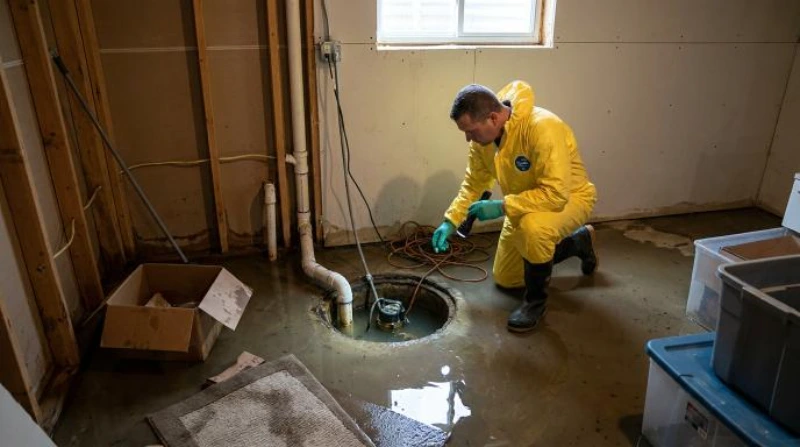
- Check your sump pit. If the pump is silent and the pit is full, note it and take a photo of the pit.
- If you are on sewer, hold off on laundry, dishes and flushing. If you are on septic, do the same so the tank isn't overloaded.
- Call us at (866) 838-7745, and write down the time you found the water.
How Glacial Ground Shapes Basement Flooding in Waterford
Waterford's soils come from glaciers that retreated 13,000 to 16,000 years ago, and they behave very differently from one street to the next. The ice left outwash sands, moraines, kames, eskers and kettle lakes. According to the township's watershed plan, kettle depressions with poorly drained soils formed many of the local lakes and wetlands.
Sandy ground versus muck
At least 47% of the township's soils are sands and loams, mostly with high to moderate infiltration. Rain soaks into those soils quickly, which is good for the yard and means water reaches foundation walls fast during a long storm. About 11% of soils are muck, the dark organic ground typical of wetlands. Muck drains slowly, so homes near wetland edges can see soil stay saturated for a long time after rain.
What that means in the basement
Two general patterns follow from that. Homes on sandier ground tend to take water through wall cracks and at the joint where the wall meets the floor, often during heavy rain. Homes near low, poorly drained ground put steady load on the sump, and when the pump stops, the basement fills from below. Knowing your soil helps us tell you which fix is worth paying for. For water coming through a floor crack, a wet-dry vac buys time while you trace the source.
Flashy Headwaters: The Clinton River Through Waterford
The upper Clinton River runs right through Waterford, and its streams have been rising faster after storms since the 1990s. A 2005 draft plan for the Upper Clinton Subwatershed, an 86-square-mile area holding most of the river's headwaters, found that peak stream flows had increased and streams had become "flashy." The plan tied that change to urbanization and more frequent flooding. Faster-rising streams mean flood risk can build within hours of a heavy storm.
About 65% of Waterford's land, roughly 14,620 acres, lies in that subwatershed. Wetlands and open water cover about 21.5% of it, and hard surfaces such as roofs, roads and parking average about 17%. More pavement means rain runs off faster instead of soaking in slowly.
The river itself threads a chain of lakes. It flows from Lake Oakland into the north end of Loon Lake, leaves to the southwest past the Drayton Plains State Fish Hatchery, and continues south toward Cass Lake, passing through Elizabeth Lake on the way. Sashabaw Creek is another mapped stream in the subwatershed, sampled near Drayton and Maybee Road. When these waters rise quickly, nearby storm systems and low yards feel it first.
About 65% of Waterford drains to the Clinton River headwaters, and those streams have turned flashy since the 1990s. Short, heavy storms now push more water through faster, which is when sumps get overwhelmed and wall seepage starts.
Waterford Sewer Backup Cleanup, Sewer and Septic
Waterford homes are on either the township sewer system or a private septic system, and a backup works differently on each. Waterford DPW runs more than 350 miles of sanitary sewer main and 63 sewer pump stations. Its after-hours emergency line is 248-618-7550, and it is the first call if you suspect the public sewer is backing up into your house.
Michigan PA 222 of 2001 sets the rules for claims against a public sewer agency. Written notice has to reach the agency within 45 days of discovering the damage, with your name, address, phone, the property address, the discovery date and a short description. The Oakland County Water Resources Commissioner, which handles claims for systems it operates, is headquartered in Waterford at One Public Works Drive, 48328.
Septic homes are a different case. The Oakland County Health Division regulates septic systems when they are installed, but their performance isn't monitored afterward. A backed-up septic line is still Category 3 black water under IICRC S500, and we handle it with full protective gear, extraction, removal of affected porous materials and antimicrobial treatment. Our page on water damage categories explains why sewage and septic water get stricter treatment than rainwater.
Our Drying Sequence for Waterford Homes
Every Waterford job follows the same order: extract, remove, clean, dry, verify. We dispatch on a 60-minute response target, and the same rate applies nights, weekends and holidays. James Novak, our lead technician, holds IICRC WRT #WRT-48291 and ASD #ASD-32817, and you get a written estimate before work starts.
Extraction takes 2 to 6 hours in most basements. Our basement water removal service uses truck-mounted and portable units, then we pull out wet carpet, pad, insulation and drywall below the wet line. Contents are photographed and sorted before anything leaves the house.
Structural drying follows over 3 to 5 days. Dehumidifiers and air movers run nonstop, and we take moisture readings daily on the slab, walls and framing. The readings go into your file with dates, so your adjuster can see the house reached dry standard before equipment left. That same record is what our Dearborn headquarters team keeps for every job across metro Detroit.

Flood Cleanup Costs for Waterford Homes
Typical Waterford basement floods run from $500 for small clean-water jobs to $18,000 for a finished basement hit by sewage. The township's housing sits in the middle of the age range, with a median build year of 1970 and about a third of homes built before 1960. A basement that has been finished since the house was built costs more to clean up, because drywall, carpet and framing all have to be dried or removed.
- Clean water, small unfinished basement: $500 to $1,500.
- Sump failure (Category 2), unfinished: $1,500 to $4,000.
- Sewage or septic backup (Category 3), unfinished: $3,000 to $8,000.
- Finished basement with sewage: $7,000 to $18,000.
- Mold remediation if growth has started: adds $1,500 to $5,000 or more.
- Backwater valve installation: $300 to $800.
These are typical ranges, not quotes. Each extra 24 hours of standing water adds roughly $1,500 to $3,000 of scope, and mold can begin within 24 to 48 hours. We found no township backwater valve program, so a valve is paid out of pocket. If your home has backed up before, our check valve installation page explains how the device stops sewage from flowing back in.
Waterford Communities and Lake Areas We Serve
We cover all of Waterford Township, plus the addresses that share Clarkston and Union Lake ZIPs. Here are some of the communities we are called to most:
Drayton Plains
On Dixie Highway at the west end of Loon Lake, near where the Clinton River passes the state fish hatchery. Sump checks are part of every call here.
Elizabeth Lake
Shares its name with the 363-acre lake on the Clinton River, bounded by Elizabeth Lake, Cass-Elizabeth, Cooley Lake and Cass Lake roads. The 330-acre Elizabeth Lake Woods Conservation Area is nearby.
Waterford Village
Home to the Waterford Village Historic District, listed on the National Register. Older foundations here get careful moisture mapping before any tear-out.
Clintonville and Four Towns
Two of the township's unincorporated communities. We handle seepage, sump failures and sewer or septic backups throughout both.
Clarkston and Union Lake addresses
Parts of Waterford use the 48346 Clarkston ZIP or the 48387 Union Lake ZIP. If your house is in the township, we treat it as a Waterford call.
Our crews also work the towns around the lakes. Next door, basement flood cleanup in Pontiac deals with much older housing on the same river. We also offer flooded basement cleanup in Clarkston, and on the far shore of Cass Lake we cover West Bloomfield water damage restoration. Oakland County was included in the federal disaster declarations for the August 2014 floods and the June 2021 storms, and our Oakland County restoration guide covers storm history, drains and claims across the county.
Protecting a Waterford Basement Before the Next Storm
For most Waterford homes, prevention centers on the sump. A pump in good shape, a backup power source, and a discharge line that empties well away from the foundation handle most of what flashy storms throw at a basement. Add a backwater valve if you are on sewer and have had a backup.
Winter is when sumps fail quietly, because a frozen discharge line can leave a pump running against ice. Our Michigan winter sump pump guide lists the checks to make before the first hard freeze. If water gets in anyway, call for flooded basement cleanup Waterford MI service and a real person will pick up, day or night.