
Flooded Basement Cleanup Taylor MI
The Taylor Drain Fills in 90 Minutes Flat — Then It Backs Into Your Basement.
Basement flooded? Taylor sits on some of the flattest land in Wayne County, and when the Taylor Drain hits capacity it reverses through your floor drain. Our flooded basement cleanup Taylor MI crews respond 24/7.
Why Taylor Basements Flood — Taylor Drain + Lower Rouge Tributary
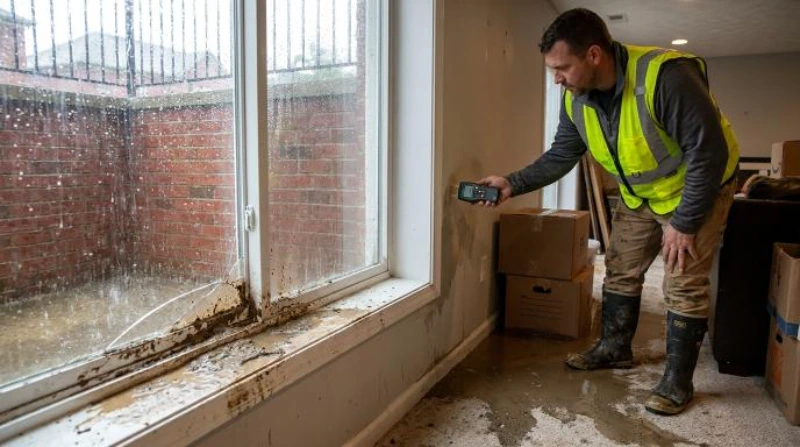
Taylor's housing stock spans two distinct types: concrete block basement homes from the 1950s and 1960s, and slab-on-grade ranch homes built through the 1970s. Basement homes follow the standard Wayne County CSO flooding pattern — floor drain backflow during overflow events. Slab homes don't flood the same way — water enters at ground level through door thresholds, foundation cracks, and low-lying windows. Both types are well represented in Taylor, so knowing which you have matters before calling any cleanup company. We handle both. Taylor is covered by the same IICRC-certified crew behind our flooded basement cleanup in Dearborn.
If the Taylor Drain has backed up into your basement, treat the water as Category 3 sewage until it's been tested. Don't go down without protection, don't run fans, and turn off the basement breaker at the main panel. Call us — we confirm the category before any work begins.
Emergency Flood Cleanup in Taylor MI
Taylor's drain-based flooding moves fast. Unlike river-overflow events that build gradually, the Taylor Drain reaches backflow threshold quickly — sometimes within 90 minutes of heavy rainfall starting. By the time you notice water coming up through the floor drain, the drain system is already at or past capacity. Calling us mid-storm rather than after it ends is the correct move. We dispatch to all Taylor 48180 addresses 24 hours a day with Category 3 protocol pre-loaded. One call, one truck, full capability from the moment we arrive at your door.
See our full 24/7 emergency response protocol →
Sewage Backup Cleanup in Taylor MI
When the Taylor Drain combined sewer backs up, the water entering your basement is not rainwater — it is the Category 3 sewage that the IICRC S500 standard classifies at the highest contamination level. Raw waste carrying bacteria including E. coli and Salmonella, viruses including Hepatitis A and Norovirus, and parasitic organisms enters through the floor drain. Every porous material that contacted this water — carpet, drywall, insulation, wood — must be removed. This is not a judgment call under IICRC S500. It is the standard, and we follow it on every Taylor job regardless of the extent of visible contamination.
Full Category 3 sewage backup protocol →
Basement Water Removal in Taylor MI
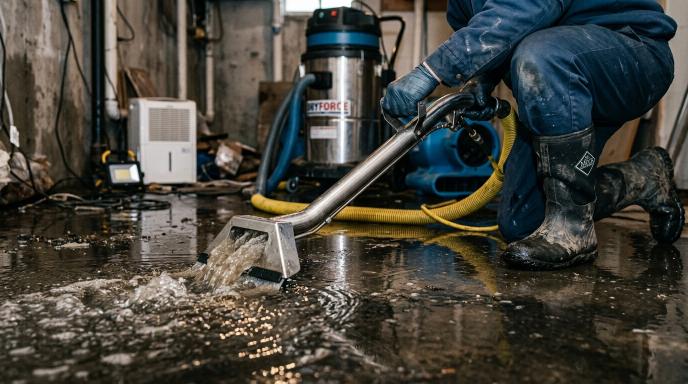
Industrial submersible pumps handle standing water in phase one. Commercial extraction equipment — truck-mounted wand systems applying significant vacuum at the floor surface — follows immediately to pull moisture the pumps cannot reach from concrete slabs and block walls. In Taylor's basement homes, the block construction absorbs water at the cellular level rather than just on the surface. Getting from wet to truly dry requires continued LGR dehumidification after extraction is complete — not just blotting the visible water. For Taylor slab homes, extraction focuses on the slab surface and any wall cavities where water has wicked upward through the foundation.
Our complete water removal process →
Structural Drying in Taylor MI
Taylor's concrete block basements dry in 3 to 5 days of continuous LGR dehumidification at IICRC S500 protocol — assuming extraction was timely and finished materials that couldn't be saved were removed promptly. Slab homes dry faster for the floor surface but require careful attention to wall cavities and door frame areas where water has penetrated interior framing. We position LGR dehumidifiers and air movers based on the specific layout of your Taylor home — not a standard template. Daily pin meter readings at marked test points are provided to you in writing. Equipment comes out when every reading hits certified dry.
How IICRC S500 structural drying works →
Mold Remediation in Taylor MI
Taylor's flat terrain and the drainage patterns that create its flooding problem also slow post-flood drying. Water that ponds in Taylor's low-lying areas stays on the ground longer than it does in areas with natural grade. The same flatness affects how quickly the exterior of flood-affected Taylor homes dry out — and exterior moisture affects basement humidity levels even after interior extraction is complete. Federal research from the EPA and CDC documents mold establishment in 24 to 48 hours on wet building materials. In a Taylor basement at summer temperatures with slow-drying exterior conditions, prompt interior drying is the only reliable way to stay ahead of that window.
Full IICRC S520 mold remediation protocol →
Taylor Neighborhoods We Serve
South Taylor — Core Drain Zone
The original 1950s residential core of Taylor, closest to the Taylor Drain's main channel. Combined sewer infrastructure here is the oldest in the city — original clay tile connections to the drain system, cracking at joints after 65+ years of Michigan freeze-thaw cycles. CSO backflow hits this zone first and hardest during any storm exceeding two inches per hour.
North Taylor — Ecorse Road Corridor
North Taylor's commercial density along Ecorse Road feeds enormous volumes of impervious surface runoff into the drainage system. Parking lots, strip mall rooftops, and the Telegraph Road corridor all drain into infrastructure that ultimately connects to the Taylor Drain. Residential streets north of Ecorse experience flood events correlated directly with commercial overflow — not just residential rainfall.
East Taylor — Telegraph Road Strip
East Taylor's 1960s and 1970s housing is marginally newer than the south core but still connected to the same combined sewer system. The Telegraph Road commercial spine adds substantial runoff load to this zone. Slab-on-grade construction is more prevalent here — meaning flooding presents differently than in the city's south, through door seeps and foundation cracks rather than floor drain backflow.
West Taylor — Van Horn Rd District
West Taylor was developed latest in the city's growth period — 1970s housing with later-era infrastructure. The Van Horn Road corridor has better-maintained sewer connections, but during county-wide CSO events, backpressure propagates from the central drain system into this zone regardless of local infrastructure condition.
What Does Flooded Basement Cleanup Cost in Taylor?
Taylor cleanup costs depend heavily on whether you have a basement or a slab foundation. Slab flooding events — water entering at threshold level — typically run $800 to $2,500 for extraction and drying, with no basement materials to remove. Basement flooding follows Wayne County standard pricing: clean water pipe failure $1,200–$3,200, sump failure $2,200–$5,000, Category 3 sewage backup $3,000–$8,500 for unfinished space and $5,000–$13,000 finished. Response time is the primary cost variable in either case.
Why Wayne County Homeowners Call Us — Not a 1-800 Franchise
✓ Dryout Michigan
- Real person answers — no hold queue
- 60-minute response, Wayne County
- IICRC S500/S520 certified protocol
- Written estimate before work begins
- Insurance documentation from arrival
- No upselling of unnecessary demo
✗ Common complaints about franchise companies
- Callback promised, never comes
- Multiple visits to bring equipment
- Slow — working multiple projects
- Over-demolition to maximize insurance
- Communication gaps during drying
- Family moved to hotel for weeks