
Flooded Basement Cleanup Flat Rock MI
Flat Rock Sits on the Huron River. When the River Rises, This City's Basement Floor Drains Are First to Know.
Basement flooding? You're in the Huron River watershed, not the Rouge, so river overflow and Stony Creek hit your sewer on a different timeline. Our flooded basement cleanup Flat Rock MI crews respond 24/7.
Why Flat Rock Basements Flood — Huron River — Stony Creek Tributary
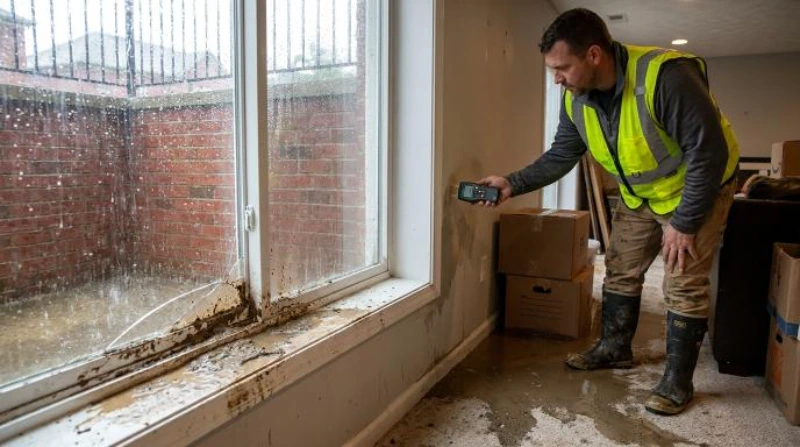
Flat Rock's housing spans a wider era range than many Wayne County cities — original older homes near the river from the 1920s and 1930s, post-war 1940s and 1950s construction in the residential core, and 1960s through 1980s development in the areas surrounding the Ford Motor Company plant on the city's south side. This range means infrastructure age varies significantly by neighborhood. Flat Rock work is handled by the same IICRC-certified team that runs our flooded basement cleanup in Dearborn.
Water rising after a Huron River storm should be handled as Category 3 sewage until proven otherwise. Keep out of the basement, don't turn on fans, and shut off the basement breaker. When we arrive in Flat Rock, testing the water category is the first thing we do.
Emergency Flood Cleanup in Flat Rock MI
We cover all Flat Rock 48134 addresses 24 hours a day. Huron River flooding has different timing characteristics than Rouge River flooding — events can build more gradually during sustained multi-day rain rather than the faster threshold events common to the Downriver Wayne County combined sewer. But when the Huron River crests, the CSO pressure it creates in Flat Rock's sewer system is immediate.
See our full 24/7 emergency response protocol →
Sewage Backup Cleanup in Flat Rock MI
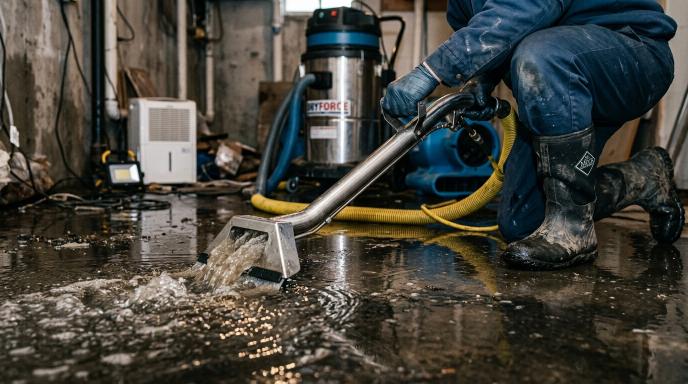
Flat Rock's combined sewer drains to the Huron River watershed — a different system than the Rouge River CSO infrastructure that serves most Downriver Wayne County communities. The contamination level in your basement when this system backs up is identical: Category 3 sewage under IICRC S500. Full decontamination protocol, PPE, EPA disinfectant, HEPA scrubbing, written clearance.
Full Category 3 sewage backup protocol →
Basement Water Removal in Flat Rock MI
Industrial extraction and LGR dehumidification follow standard Wayne County protocol. Flat Rock's older river-zone housing may have stone or older block foundations that require longer drying windows — 5 to 7 days rather than the 3 to 5 days typical for 1960s concrete block. We assess foundation type on arrival and adjust drying protocol accordingly.
Our complete water removal process →
Structural Drying in Flat Rock MI
Flat Rock's drying timeline varies by construction era. 1960s concrete block: 3 to 5 days. 1930s and 1940s stone or older brick foundations: 5 to 7 days. Huron River proximity elevates baseline humidity slightly, similar to the Detroit River effect seen in Trenton and Wyandotte. Daily pin meter readings provided in writing.
How IICRC S500 structural drying works →
Mold Remediation in Flat Rock MI
Flat Rock's Huron River position creates a humidity baseline similar to other Wayne County river communities. Post-flood mold risk is slightly elevated compared to inland cities — river proximity means ambient basement humidity runs higher year-round. The 24-to-48-hour mold establishment window documented by EPA and CDC research applies at the shorter end during Flat Rock summer conditions.
Full IICRC S520 mold remediation protocol →
Flat Rock Neighborhoods We Serve
West Flat Rock — Huron River / Telegraph Rd
West Flat Rock along Telegraph Road sits closest to the Huron River's bank. Properties here experience the most direct river-level flooding — bank overflow during major rain events and hydraulic pressure in the sewer network during any significant Huron River level rise. Older housing from the 1930s and 1940s in this zone has infrastructure of corresponding age.
Central Flat Rock — Gibraltar Road Core
Central Flat Rock's residential core around Gibraltar Road is the primary 1950s and 1960s development zone. Standard Wayne County concrete block construction with clay tile laterals of similar age to Downriver neighbors. The combined sewer here connects to the Huron River watershed system rather than the Rouge system — the flooding mechanism is the same (CSO backflow) but the trigger is Huron River dynamics rather than Rouge River.
East Flat Rock — Ford Plant Adjacent
East Flat Rock borders the Ford Motor stamping plant. The plant's industrial impervious surface adds significant runoff to the local drainage system during major storms. Residential streets between the plant perimeter and the Huron River face a combined pressure from industrial runoff loading and river-level rise that can produce flooding at lower rainfall thresholds than purely residential areas.
North Flat Rock — Stony Creek Zone
North Flat Rock borders the Stony Creek tributary. Stony Creek drains a watershed that covers portions of Downriver Wayne County before reaching Flat Rock. When the creek exceeds capacity, it adds to the Flat Rock combined sewer's CSO load from the north, independent of the Huron River's influence from the east.
What Does Flooded Basement Cleanup Cost in Flat Rock?
$1,300 to $3,500 clean water. $2,300 to $5,500 gray water. $3,000 to $9,000 Category 3 sewage unfinished. Older river-zone homes may have additional cost from aging infrastructure revealed during cleanup.
Why Wayne County Homeowners Call Us — Not a 1-800 Franchise
✓ Dryout Michigan
- Real person answers — no hold queue
- 60-minute response, Wayne County
- IICRC S500/S520 certified protocol
- Written estimate before work begins
- Insurance documentation from arrival
- No upselling of unnecessary demo
✗ Common complaints about franchise companies
- Callback promised, never comes
- Multiple visits to bring equipment
- Slow — working multiple projects
- Over-demolition to maximize insurance
- Communication gaps during drying
- Family moved to hotel for weeks