
Flooded Basement Cleanup Southgate MI
The Whole City Was Built in One Decade. Every Pipe Is Due at Once.
Basement flooding every storm? Nearly all of Southgate was built in 1953–1965, so its sewer lines are failing on the same timeline. Our flooded basement cleanup Southgate MI crews respond 24/7 across ZIP 48195.
Why Southgate Basements Flood — The Bowl, the Creek, and the Timeline
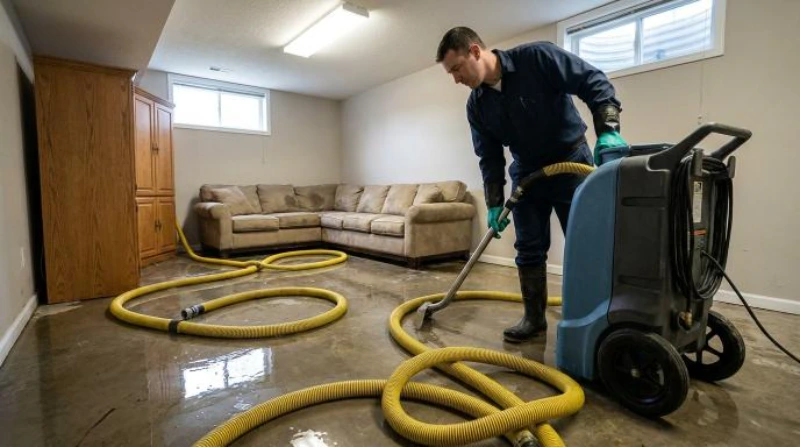
Three independent factors combine to make Southgate basements flood more often and more severely than its neighbors would suggest. Understanding all three is the difference between knowing why your basement floods and just watching it happen again each year. Southgate jobs are handled by the same team that runs our Dearborn flooded basement cleanup.
Factor One — The Drainage Bowl. Southgate occupies a geographic low point between Allen Park to the north and Riverview to the south. Elevation across the city gently slopes inward rather than outward — meaning when Allen Park's streets fill with more water than their sewer system can handle during a storm, that overflow travels downhill into Southgate. The Rauch Creek watershed, which cuts through the central and western portions of the city before draining south, collects storm water runoff from a surface area larger than Southgate itself. Your basement is at the bottom of a funnel shaped by geography you cannot change.
Factor Two — The Simultaneous Infrastructure Failure Wave. Southgate is one of Michigan's most uniform post-WWII suburbs. The city was developed almost entirely between 1953 and 1965 — driven by autoworker housing demand in the Downriver Wayne County market. Nearly every residential structure in Southgate was built within a 12-year window. This means the clay tile lateral sewer connections throughout Southgate — which connect individual homes to the municipal combined sewer main — were all installed between 1953 and 1965. Clay tile joints last approximately 50 to 70 years before cracking becomes structurally significant. That timeline has now elapsed for the entire city simultaneously. Southgate is experiencing a city-wide lateral failure event that cities with 60-year development histories spread across decades never face in the same way.
Factor Three — Ranch Home Basement Physics. The dominant Southgate housing type is the 1950s and 1960s ranch — a single story structure built on a full or partial basement with typically 5.5 to 6 feet of ceiling height. That low clearance eliminates the stack-effect air movement that taller basement spaces use to naturally circulate and exhaust humid air. After a flood event, moisture in a Southgate ranch basement is trapped more effectively than in the same volume of a two-story home's basement. Industrial equipment compensates for this — but only when called in promptly. A Southgate ranch basement left to "air out" after flooding is a Southgate ranch basement growing mold in 24 hours.
Geography, timing, and construction type are all working against a Southgate basement during a heavy rain event. None of these factors can be solved with a better sump pump alone. When your basement floods, call immediately. The longer sewage-category water contacts the porous concrete block of a Southgate basement, the higher the total cleanup cost and the greater the mold risk in the days that follow.
Emergency Flood Cleanup in Southgate MI
The Southgate flooding pattern follows a predictable timeline during major storm events. Rauch Creek fills first, typically within 2 to 4 hours of sustained heavy rain. When the creek exceeds its bank capacity, it feeds back into the combined sewer network. The Wayne County CSO threshold at 3.5 inches per day is frequently reached and exceeded in Southgate before neighboring cities hit that same threshold — because Southgate's catchment area includes runoff from Allen Park and portions of Taylor flowing into the same drainage basin. Floor drain backup in Southgate basements can begin while rain is still falling and before the storm ends.
This means calling us while rain is still coming down is correct — do not wait for the storm to stop. We respond to Southgate 48195 addresses 24 hours a day. A live dispatcher confirms your address, assesses water category based on drain source and odor, and dispatches immediately with the appropriate protocol. For Southgate sewage events — the most common — Category 3 protocol is standard: full PPE, sealed extraction, hospital-grade disinfectant, HEPA air scrubbers.
See our full 24/7 emergency response protocol →
Sewage Backup Cleanup in Southgate MI
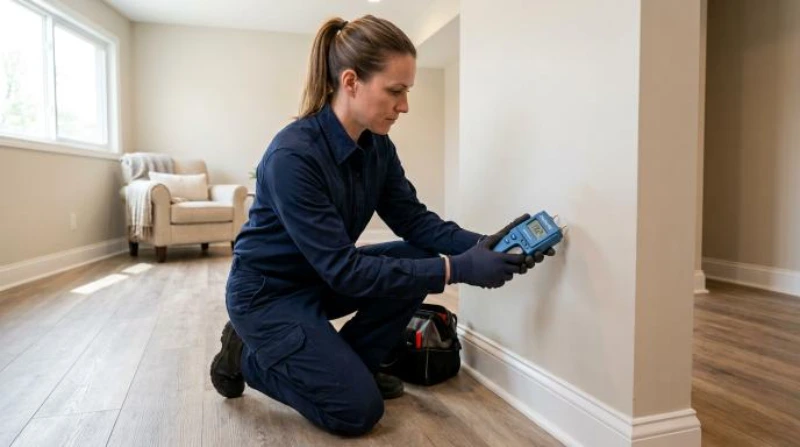
Southgate's combined sewer system carries household sewage and storm water in the same pipe — the same infrastructure design that defines most Downriver Wayne County communities built before 1970. When that system backs up under CSO conditions, what reverses through your floor drain is Category 3 sewage: raw waste contaminated with bacteria, viruses, and parasitic organisms at concentrations the CDC classifies as a serious public health risk.
The specific risk profile in Southgate is compounded by the lateral failure wave described above. When a Southgate clay tile lateral cracks at the joint, it creates a gap through which groundwater can enter the lateral and a gap through which sewer gases and trace contamination can exit into surrounding soil. Homes with failed laterals may experience ambient sewage contamination in their crawl space or basement even between major CSO events — not at flooding levels, but at levels that affect air quality and accelerate mold growth. If your Southgate basement has a persistent odor even when dry, a lateral inspection is warranted.
Our Category 3 protocol covers the full scope required by IICRC S500: containment, PPE, sealed extraction, removal of all porous materials in contact with the water, hospital-grade EPA-registered disinfectant at proper concentration and dwell time, HEPA air scrubbing, and written clearance documentation. We do not cut corners on any of these steps because the IICRC S500 does not allow corners to be cut in Category 3 situations — and because the health consequences of incomplete decontamination are real.
Full IICRC S500 Category 3 sewage protocol →
Basement Water Removal in Southgate MI
Southgate's 1950s and 1960s concrete block foundations present the same moisture absorption challenge found throughout Downriver Michigan — with one Southgate-specific variable: the basement ceiling height. At 5.5 to 6 feet of clear height, the usable space above the water extraction equipment is minimal. Industrial submersible pumps work at the same efficiency regardless of ceiling height. Commercial extraction wands require careful positioning in low-clearance spaces to achieve even coverage of the floor slab and block wall bases. We account for Southgate's ranch basement dimensions before positioning equipment.
Water removal from a Southgate basement is a two-phase process: mechanical removal of standing water with submersible pumps and commercial extraction wands, followed by continuous structural drying with LGR dehumidifiers and directed air movers. The extraction phase is measured in hours. The drying phase is measured in days — specifically 3 to 5 days for unfinished concrete block at certified IICRC S500 dry standard, and longer if finished materials were present and not immediately removed.
Our complete basement water removal process →
Structural Drying in Southgate MI
Drying a Southgate ranch basement requires accounting for physics that work against you. The 5.5 to 6 foot ceiling height — standard for this era of construction — eliminates the stack-effect convection that would naturally move humid air upward in a taller space. Without that convection, humid air settles and circulates horizontally rather than venting upward. LGR dehumidifiers must be positioned at floor level where humid air concentrates, not elevated as they might be in taller spaces. Air movers create directed cross-ventilation paths that substitute for the natural convection the ceiling height prevents.
We calculate air mover placement per the IICRC S500 Psychrometric Calculations methodology — specific cfm per square foot of affected surface area, positioned to eliminate dead air zones in corners and under mechanicals. In a typical Southgate unfinished ranch basement of 900 to 1,100 square feet, we typically run 3 to 5 air movers and 1 to 2 LGR dehumidifiers for 3 to 5 days. Daily pin meter readings are taken at a minimum of 8 test points per 1,000 square feet of affected area. All readings are logged and provided to you in writing. We remove equipment when every reading reaches certified dry — not before.
How IICRC S500 structural drying works →
Mold Remediation in Southgate MI
The mold risk in a Southgate ranch basement after flooding is higher than the Wayne County average — and it's specifically tied to the ceiling height. Mold spores are present in every basement. They become active mold growth when three conditions are present simultaneously: a food source (organic material — wood, drywall paper, dust), moisture above 60% relative humidity, and temperature above 40 degrees Fahrenheit. A Southgate basement after a flood event satisfies all three conditions immediately — and the low ceiling height prolongs the period during which humidity remains elevated even after water is removed.
In summer conditions — Southgate basement temperatures typically 65 to 75 degrees Fahrenheit — mold can establish on wet materials in as little as 24 hours. If your Southgate ranch basement flooded yesterday and was not professionally extracted and dried within 24 hours of the event, mold remediation services are likely already required even if no visible growth appears on surfaces yet. Visible surface mold represents growth that has been active inside the material for days before it reached the visible surface.
Our IICRC S520 mold remediation protocol for Southgate basements addresses the ceiling-height physics directly. Negative pressure containment in a low-clearance space requires specific setup to maintain effective airflow. HEPA air scrubbers placed in Southgate ranch basements operate at positions that ensure full air changes per hour despite the limited vertical space. We don't use the same equipment layout in every house — we adapt to the specific dimensions of your Southgate basement.
Full IICRC S520 mold remediation protocol →
Southgate Neighborhoods We Serve
North Southgate — Allen Park Border
The northern edge of Southgate along the Allen Park boundary is the first area affected when Allen Park's drainage exceeds local capacity and flows south. Streets closest to the Allen Park line experience the earliest onset of floor drain backup during large CSO events — often while storm rain is still falling. Homes here are 1953 to 1958 construction, placing them at the leading edge of Southgate's lateral failure cohort. Some North Southgate residents have replaced their laterals proactively; most have not.
Central Southgate — Rauch Creek Corridor
The Rauch Creek watershed runs through the central portion of Southgate, making this corridor the hydraulic heart of the city's flooding problem. Properties within three to four blocks of the creek's path are the most consistently affected during any storm exceeding 2 inches per hour. The Trenton Road commercial spine cuts through this area; residential streets east and west of Trenton Road represent the highest CSO frequency in the city. 1958 to 1963 construction here places these homes mid-cohort in Southgate's lateral failure timeline.
South Southgate — Riverview Border
The southern portion of Southgate borders Riverview and represents slightly younger construction — 1963 to 1968 — than the northern and central areas. These homes are approaching the leading edge of significant lateral failure but have not yet entered the most acute period of the infrastructure wave. Flooding here tends to occur later in large storm events when CSO pressure has built across the city rather than during the initial onset. The Riverview municipal boundary means drainage from South Southgate eventually feeds into a shared downstream system.
What Does Flooded Basement Cleanup Cost in Southgate?
Southgate cleanup costs follow Wayne County averages with one consistent variable: the low ceiling height of ranch basements requires slightly more precise equipment positioning, which can add marginally to setup time but does not significantly change total cost. A clean water pipe failure in an unfinished Southgate ranch basement typically runs $1,400 to $3,400. A sump pump or gray water event runs $2,400 to $5,500. Category 3 sewage backup — the standard Southgate heavy rain event — ranges from $3,500 to $9,000 for unfinished space and $5,500 to $14,500 for finished basements.
As with all Wayne County cleanup, the primary cost variable is time from flood event to professional extraction. In a Southgate ranch basement where ceiling height already limits natural air circulation, leaving sewage-contaminated water in contact with concrete block walls for additional hours compounds damage faster than in taller-ceiling spaces. Call at midnight. Call during the storm. It costs less than calling in the morning.
Why Wayne County Homeowners Call Us — Not a 1-800 Franchise
✓ Dryout Michigan
- Real person answers — no hold queue
- 60-minute response, Wayne County
- IICRC S500/S520 certified protocol
- Written estimate before work begins
- Insurance documentation from arrival
- No upselling of unnecessary demo
✗ Common complaints about franchise companies
- Callback promised, never comes
- Multiple visits to bring equipment
- Slow — working multiple projects
- Over-demolition to maximize insurance
- Communication gaps during drying
- Family moved to hotel for weeks