
Basement Check Valve Installation Dearborn MI — CSO Prevention
Tired of sewage coming up the floor drain every storm? Check valve installation Dearborn MI homeowners get for $300–800 can prevent $3,000–$15,000+ in Category 3 cleanup. The City of Dearborn recommends it — here's how it works.
Basement Check Valve Installation in Dearborn MI — The CSO Prevention Solution
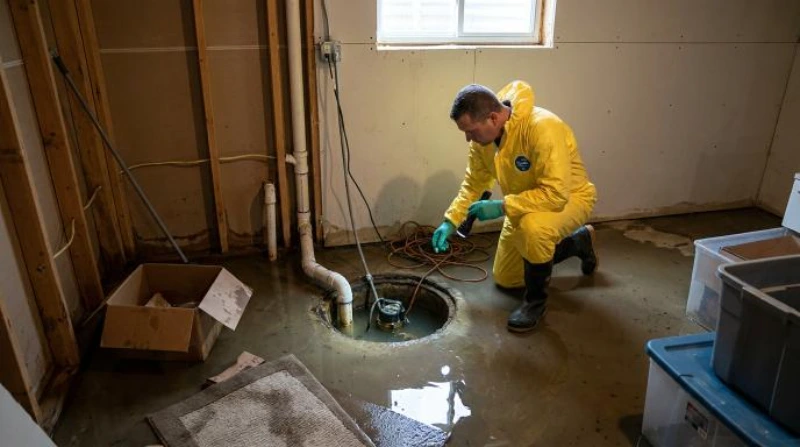
The City of Dearborn's flood preparedness page at dearborn.gov specifically recommends check valve or backflow prevention valve installation for properties susceptible to sewer backflow. This is the city's own acknowledgment that the combined sewer overflow problem cannot be fully solved at the infrastructure level — individual homes need protection. A check valve on the basement floor drain is that protection. A valve is prevention — if sewage has already come up, start with flooded basement cleanup in Dearborn first.
A check valve (also called a backflow preventer or backwater valve) is installed on the basement floor drain connection to the sewer main. It allows water to flow out of your basement normally but closes automatically when the pressure in the sewer main reverses — preventing sewage from pushing back up through the drain. During a combined sewer overflow event, the valve closes before sewage can enter your basement.
Professional installation costs $300 to $800 for a standard Dearborn basement floor drain. This is a one-time cost that prevents $3,000 to $15,000+ in cleanup expenses from a single Category 3 sewage event. Given that many Dearborn homes have flooded multiple times, the return on investment is typically achieved after one prevented event.
The $8.1 million FEMA Hazard Mitigation Grant approved in July 2026 for east Dearborn (Chase Road to Greenfield Avenue) includes flapgate structures that function as neighborhood-scale backflow preventers. Mayor Hammoud described them as "neighborhood-wide backflow preventers." These protect approximately 3,000 homes in the grant area. For homes outside that project area, individual check valve installation remains the primary prevention option.
How a Basement Floor Drain Check Valve Works
Normal flow — valve open
Under normal conditions, the float or flapper in the check valve sits open. Water from your basement — condensation, spills, routine drainage — flows through normally.
CSO event — pressure reverses
During a combined sewer overflow event, pressure in the sewer main increases beyond atmospheric pressure. The backflow begins pushing toward your drain.
Valve closes automatically
The pressure differential causes the float or flapper to close before sewage reaches the floor drain opening. No moving parts require power — it is entirely mechanical.
CSO passes — valve reopens
When the CSO event ends and sewer pressure normalizes, the valve opens again automatically. No reset required.
Types of Check Valves for Dearborn Basements
Float-type backwater valve
The most common type for residential installation. A buoyant float closes against the valve seat when backpressure occurs. Reliable, requires minimal maintenance. Recommended for standard Dearborn floor drains.
Gate-type backwater valve
A gate or flapper that closes mechanically when flow reverses. Slightly more maintenance (annual inspection recommended) but effective for higher-volume drain lines. Used in some Dearborn commercial applications.
Powered backwater valve (sump)
For sump pit protection specifically. The check valve on the sump discharge line prevents water from flowing back into the pit after the pump shuts off — extending pump life and maintaining pit level.
In-line drain check valve
Installed in the floor drain pipe below floor level — invisible, no moving parts above the floor surface. Requires cutting into the drain line. More complex installation, highest long-term reliability.
Before and After a CSO Event — What a Check Valve Actually Does
During the June 2021 FEMA Disaster 4607 event, approximately 20,000 Dearborn homes had sewage push through floor drains. The average Category 3 cleanup cost for a finished Dearborn basement exceeded $8,000. A check valve costing $500 installed would have prevented that event entirely for any home where the primary entry point was the floor drain.
Check valves do not prevent all forms of basement flooding. They specifically prevent combined sewer overflow backflow through the floor drain. They do not prevent groundwater seepage through foundation cracks, sump pump failure, or pipe bursts. For comprehensive prevention, a check valve on the floor drain should be paired with a battery-backup sump pump system and foundation crack sealing.
Why Wayne County Homeowners Call Us — Not a 1-800 Franchise
✓ Dryout Michigan
- Real person answers — no hold queue
- 60-minute response, Wayne County
- IICRC S500/S520 certified protocol
- Written estimate before work begins
- Insurance documentation from arrival
- No upselling of unnecessary demo
✗ Common complaints about franchise companies
- Callback promised, never comes
- Multiple visits to bring equipment
- Slow — working multiple projects
- Over-demolition to maximize insurance
- Communication gaps during drying
- Family moved to hotel for weeks