
Flooded Basement Cleanup Warren MI
18,047 Warren homes flooded in August 2014. Here is what changed, and what to do when yours floods.
Sewage or storm water coming up through the floor drain? Our flooded basement cleanup Warren MI crews pump it out, disinfect and dry post-war basements to IICRC S500 and S520 standards, with a 60-minute response target and a written estimate before any work starts.
Warren Treats Its Own Sewage, So Your First Call Stays Local
Most of Macomb County sends its sewage through county-run systems to the Great Lakes Water Authority plant in Detroit. Warren is different. The city runs its own wastewater plant at 32360 Warkop Avenue, near 14 Mile and Van Dyke, and Warren is not on the county's list of communities in those systems. When sewage comes up a Warren floor drain, the pipes, the pump stations and the claims office all belong to the city.
The plant was first designed in 1957, the year Warren became a city. Today it is rated for 50 million gallons a day and up to 100 million gallons at peak wet-weather flow, while it usually treats about 22 million. That gap is the whole story of basement flooding here. On a dry day there is plenty of room. In a cloudburst, rain gets into the sanitary system, flows can more than quadruple, and the lowest openings in the system are often basement floor drains.
Mayor Lori Stone has said the local system was built to handle about 2 inches of rain over several hours. Storms that beat that number are when our flooded basement cleanup Warren MI calls spike.
August 11, 2014: The Day 18,047 Warren Homes Flooded
Rain started around 11 a.m. that Monday and kept falling hard into the evening. Rainfall measured 4.57 inches, the area's second-largest single-day total on record. Within days, Warren assessors estimated that 18,047 homes had flood damage, and Mayor Jim Fouts put the city's losses near $1.2 billion. "Every neighborhood has been hit," he said.
The details from that week show how deep the water got:
- At least 1,000 cars were abandoned on Warren streets, including about 40 underwater on Van Dyke and more than 200 on Mound.
- City Hall and the police department took on water, and police switched to generators with 3 feet in their basement.
- The GM Tech Center closed. I-696 had some of the worst freeway flooding in the region.
- At the Detroit Arsenal on 11 Mile, one building had about 10 feet of water in its basement and another about 7.
The President declared a major disaster, FEMA DR-4195, on September 25, 2014, covering Macomb, Oakland and Wayne counties. Macomb County ran a damage reporting center that summer at the Southwest Health Center, 27690 Van Dyke. If your basement was rebuilt after that storm, a second flood goes straight into newer drywall, carpet and furniture, which is where flooded basement cleanup Warren MI costs climb.
Warren Basement Flooding Since 2014
The big storms did not stop. On June 25 and 26, 2021, heavy rain flooded homes across southeast Michigan. FEMA added Macomb County to disaster DR-4607 that September, and its hazard mitigation team set up at the Menards at 32501 Van Dyke to talk with Warren homeowners about cleanup and rebuilding.
On August 12, 2021, the Red Run overflowed and flooded Warren streets. The city said that water was stormwater, the plant was running smoothly, and only a few basements took on water. Then on January 26, 2024, rain on saturated ground filled the city's storm basins, sewer basins and pump station to capacity, and basement flooding reports came in from across Warren. By early 2025 the mayor said Warren had seen three severe rain events in one year that overwhelmed its capacity.
When the Red Run backs up, streets flood with stormwater. When the sanitary sewer surcharges, sewage rises through your floor drain. A basement can get both in the same storm. We test and treat anything that came up a drain as Category 3 black water until proven otherwise.
The Stephens Road Basin and the 9 Mile Relief Sewer
After 2014, Warren spent close to $95 million on a basement flooding relief program. The main pieces sit in the southeast part of the city:
- 9 Mile relief sewer: a 4-foot sanitary relief sewer tunneled under 9 Mile from Van Dyke to Stewart, plus a 4-foot force main toward the Eastpointe line.
- Nine Mile pump station: rebuilt at the northeast corner of Stewart and 9 Mile.
- Stephens Road Detention Basin: a $37.5 million basin on Stephens Road between Gratiot and Groesbeck that holds 22 million gallons in wet weather. It opened February 24, 2025.
These projects lower the odds of a backup. They do not end them. A storm bigger than the system's design will still push sewage toward the lowest drain on the line, which is why a backwater check valve on your own lateral is still worth pricing.
The Red Run Drain is a separate fight. It began as a creek, as did Bear Creek, and both are now part of an open inter-county drain that carries water through Warren to the Clinton River and Lake St. Clair. Overflows from Oakland County's George W. Kuhn basin enter the Red Run at Dequindre north of 13 Mile. In December 2025, Warren City Council asked the state to stop them. For homeowners near the drain, that means more water in the Red Run during big storms and slower drainage on nearby streets.
Sewage Backup Cleanup in Warren
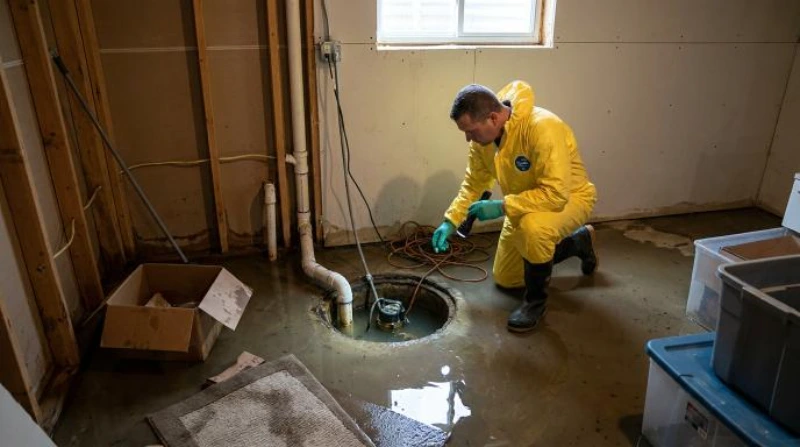
Sewage is Category 3 black water under the IICRC S500 standard. It carries bacteria and viruses, and it soaks into anything porous. Our crews wear full protective gear and work in this order:
- Pump out standing water and sludge, then extract what is left in the floor and carpet.
- Remove porous items the sewage touched: carpet, pad, cardboard, drywall below the water line plus a margin above it.
- Clean and apply an antimicrobial to the slab, walls and framing.
- Set LGR dehumidifiers and air movers, then check moisture readings every day until the materials reach dry standard.
If water came in through a cracked wall, a window well or a failed sump instead, it is usually Category 1 or 2, and much more of the basement can be dried in place. Our sewer backup cleanup page explains the full Category 3 process in more detail.
Post-War Ranches and Basement Water Removal in Warren
Warren grew faster than almost any city in Michigan after World War II. It had about 42,653 people in 1950 and 179,260 by 1970. The GM Technical Center was built in the middle of that boom, between 1949 and 1956, and Warren incorporated as a city in 1957.
That growth shows in the housing data. The median home in Warren was built in 1963, and about 64% of homes date from 1940 to 1969. Roughly three in four are single-family detached houses, and about 70% are owner-occupied. Census figures put the 2020 population at 139,387.
A house that is 60 or 70 years old has a few weak spots we see over and over:
- Basement floor drains tied straight into the sanitary lateral, with no backwater valve.
- Old service laterals that have never been cleaned or camera-inspected. The city tells owners to clean and televise their lateral routinely and repair it as needed.
- Downspouts and grading that dump roof water next to the foundation. Warren advises sending downspouts at least 5 feet from the house and sloping soil away from the walls.
- Older basement windows and wall cracks that let water in when the ground is saturated. The city lists sealing cracks and repairing failed basement windows among its prevention steps.
Our basement water removal crews start by finding which of these let the water in, because the source decides the water category and the cleanup scope.
Who to Call When Your Warren Basement Floods
Report the flooding to the city first, then call us. Warren's own guidance lists these numbers:
- Warren Water Department: (586) 759-9200, also used after hours. You can report your address through the city's Q-Alert system too.
- Mayor's Office: (586) 574-4520, for flooding on your property, in your basement or in the street.
- City Hall: 1-586-574-4500, One City Square, weekdays 8:30 a.m. to 5 p.m.
- Red Cross flood help: 1-800-733-2767.
If the water is near outlets, a furnace or a water heater, stay out of the basement. The city advises calling DTE or a licensed electrician to cut power to a flooded lower level, and having an electrician check the system before power goes back on.
Michigan Public Act 222 of 2001 gives you 45 days from discovering a sewage backup to file a written claim with the public agency. Include your name, address and phone, the property address, the date you found the damage and a short description. Warren's 311 system directs sewer backup claims to the Risk Management Division, One City Square, Suite 410, Warren 48093, (586) 574-4670. Call to confirm the current form.
That city claim is separate from your homeowners policy. Many standard policies exclude sewer backup unless you added a sewer backup endorsement, and NFIP flood insurance is a different policy again. Our guide on whether homeowners insurance covers basement flooding in Michigan explains the usual gaps. We photograph every room and log moisture readings from the moment we arrive, so you have records for both claims.
Warren Basement Flood Cleanup Costs
In Warren, the water category and whether the basement is finished drive the bill more than anything else. These are typical ranges from our jobs, not quotes:
| Situation | Typical range |
|---|---|
| Clean water, small unfinished basement | $500 to $1,500 |
| Sump failure (Category 2), unfinished | $1,500 to $4,000 |
| Sewage backup (Category 3), unfinished | $3,000 to $8,000 |
| Finished basement with sewage | $7,000 to $18,000 |
| Mold remediation, when needed | Adds $1,500 to $5,000 or more |
You get a written estimate before work begins, and the rate is the same at night and on weekends. The cheapest flooded basement cleanup Warren MI job is the one that starts early. The EPA notes mold can begin growing on wet materials within 24 to 48 hours, so a basement left to sit over a weekend usually costs more than one dried the same day.
Water Damage Restoration in Warren MI, Start to Dry
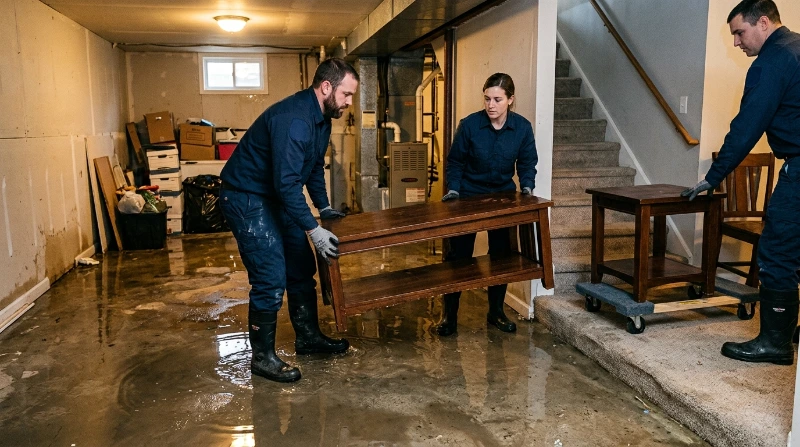
Extraction usually takes 2 to 6 hours. Drying takes longer, typically 3 to 5 days, and it is the part that decides whether mold shows up a month later. We use moisture meters and thermal imaging to find water hiding in bottom plates, behind paneling and under stairs, then run our structural drying setup until readings hit target.
If a past flood left a musty smell or stains on paneling, tell us. A basement dried after 2014 with box fans and a wet-dry vac can still hold old moisture behind newer finishes. Our page on mold after a basement flood covers what to look for.
Warren Areas We Serve
We cover all of Warren, from the 8 Mile border with Detroit up to 14 Mile, across ZIP codes 48088, 48089, 48091, 48092, 48093 and 48397.
Southeast Warren
Homes along East 8 Mile, 10 Mile and Hoover. This is where the 9 Mile relief sewer, the Nine Mile pump station and the Stephens Road basin were built.
Southwest Warren
Streets off Ryan and Dequindre between 8 and 11 Mile, wrapping around Center Line. We check floor drains and laterals first on every call here.
Civic Center & Van Dyke
Home to City Hall at One City Square and the wastewater plant on Warkop near 14 Mile. FEMA met flooded homeowners at the Van Dyke Menards in 2021.
East Warren
The east side toward Fraser and Roseville. We handle sump failures, seepage and sewage backups here with the same IICRC process.
Detroit Arsenal Area
Around the Arsenal on East 11 Mile, where two basements took 7 to 10 feet of water in August 2014.
Our crews also work in neighboring cities. See basement flood cleanup in Sterling Heights to the north, plus our pages for Roseville homeowners and St. Clair Shores. Across Dequindre, Royal Oak sits in the George W. Kuhn district that drains to the Red Run. For the countywide picture, read the Macomb County basement flooding guide. Every job is run by the same IICRC-certified team behind our flooded basement cleanup in Dearborn, serving Michigan homeowners since 2019. A real person answers (866) 838-7745 every hour of the year.