
Flooded Basement Cleanup Sterling Heights MI
Separate sewers, an 11-foot interceptor under 15 Mile and a Clinton River that has set records.
Water or sewage rising through a floor drain? Our flooded basement cleanup Sterling Heights MI crews find the source, extract the water and dry your lower level to IICRC standards, with a 60-minute response target and a written estimate before any work starts.
Where Sterling Heights Basement Water Actually Comes From
Sterling Heights keeps its sanitary sewers and storm sewers as separate public systems, which the city maintains along with its water mains. Rain is meant to travel in one set of pipes and household wastewater in another. That design is the main reason a wet basement here is more often a sump, seepage or plumbing problem than the storm-driven sewage surges that hit older combined-sewer cities to the south.
Separate does not mean sealed off from trouble. The city's sanitary lines feed the Macomb Interceptor Drain Drainage District, a county-run system of 38 miles of interceptor that carries sewage from about 600,000 people in 11 communities to the Great Lakes Water Authority treatment plant in Detroit. When that system is squeezed, or when a local sanitary line is clogged with grease or wipes, sewage can still come up a floor drain. So every flooded basement cleanup Sterling Heights MI call starts with the same question: is this clean water, gray water or sewage?
That answer sets the water category, the drying plan and, often, who ends up paying. Clean water from a supply line is Category 1. A failed sump usually brings Category 2 gray water. Anything that came up through a drain or toilet is Category 3 black water until proven otherwise.
The 11-Foot Sewer Under 15 Mile Road
The pipe that matters most to Sterling Heights sewage is one most residents never see. The Macomb Interceptor is an 11-foot-diameter concrete sewer roughly 60 feet below ground. It runs from Sterling Heights through Fraser and Clinton Township to the Clintondale Pump Station.
On Christmas Eve 2016 a section of it collapsed under 15 Mile Road at Eberlein Drive in Fraser, opening a sinkhole that forced families out of their homes. A month later, engineers found the full 11-foot pipe blocked with sediment. Sterling Heights was one of the 11 communities whose residents were asked to shorten showers, run only full loads of laundry and hold off on flushing, because the system had no spare capacity. Fraser's mayor warned at the time that sewage could back up into basements if usage did not drop.
The cleanup has dragged on for years. A $28 million rehabilitation began in late 2020, partly funded by a $12.5 million settlement. In 2023 the county started pulling about 6,000 tons of leftover sediment out of the line below 15 Mile Road near Hayes Road, inside Sterling Heights, at an estimated cost of $37 million. Officials said that much sediment cuts the capacity available for sewage flow. If your home sits on the south side of the city and your floor drain has ever gurgled during heavy rain, our sewer backup cleanup team treats it as Category 3 from the first minute.
Even when the water looks clear, anything rising out of a floor drain, laundry standpipe or basement toilet has been in the sanitary line. Keep children and pets upstairs, don't run the washer or dishwasher, and don't try to mop it before it's been assessed.
Clinton River, Plum Brook and Red Run Flooding in Sterling Heights
The Clinton River crosses the northeast part of the city on its way east to Lake St. Clair. The city's own flood page also lists the Red Run Drain, Plumbrook Drain and Beaver Creek as waterways that overflow during heavy storms, snowmelt and ice jams. River gauges sit on the Clinton River at Riverland Drive and on the Plumbrook Drain at Ryan Road, and both are linked from the city's flood services page.
These are not theoretical risks. In August 2019, overnight rain closed the road near Schoenherr and Plum Brook and turned part of the Plum Brook Golf Club into what one reporter called a lake. In April 2026, rising Clinton River water flooded Dodge Park, and Sterling Heights joined Utica, Rochester and Shelby Township in warning residents about unstable banks and fast currents. Just upstream in Utica, a homeowner on Davis Drive reported knee-high water in his basement and garage during that same rise.
River and drain flooding is a different loss from a sewer backup. It typically falls under flood insurance through the NFIP, not under a homeowners policy, and the water is treated as contaminated because it has crossed soil and pavement. If you are not sure whether your lot is in a mapped floodplain, the city's Office of Engineering at 586-446-2720 can tell you, and can also share past flood problems in your area and elevation certificates for floodplain buildings.
Sterling Heights keeps flood hazard maps at the Sterling Heights Public Library and the Office of Engineering, and as a layer on the city's GIS map. The city points out that properties outside the mapped floodplain can still flood.
August 2014 and June 2021 in Macomb County
The storm most Sterling Heights homeowners remember came on August 11, 2014. The National Weather Service recorded 4.57 inches at Detroit in 24 hours, the second-highest daily total on record, and parts of Wayne, southern Oakland and Macomb counties took 4 to 6 inches in about four hours. The Clinton River set a record stage of 20.84 feet. The next day, Macomb County Executive Mark Hackel said Sterling Heights' own city offices and police department were dealing with flooding.
FEMA declared disaster DR-4195 on September 25, 2014, covering Macomb, Oakland and Wayne. Of the three, Macomb had the highest per-capita damage estimate, at $6.21 per resident. Seven years later, the June 25 and 26, 2021 storms became disaster DR-4607, and Macomb was added for individual assistance in September 2021. Both application windows are long closed, but the pattern is clear: a big summer cell can overwhelm drains, sump pumps and sewer capacity in one night.
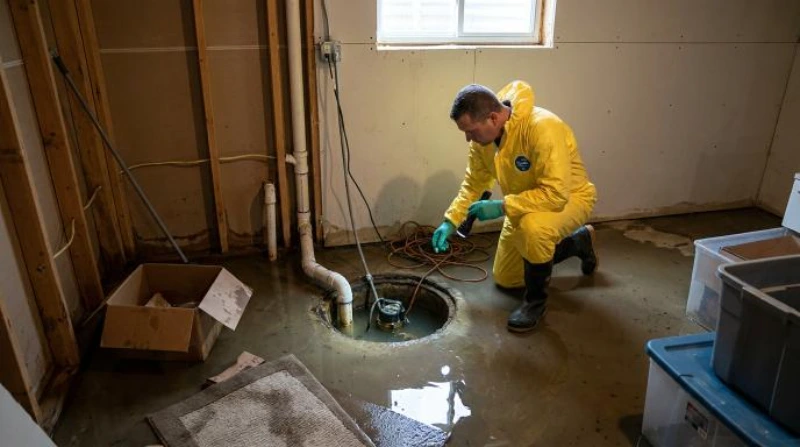
Basement Water Removal in Sterling Heights' 1960s and '70s Homes
Sterling Heights grew fast. It had 14,622 residents in 1960, 61,365 in 1970 and 108,999 by 1980, and it incorporated as a city in 1968. Today it is the fourth-largest city in the state, with 134,346 people at the 2020 census. Census survey data puts the median home in the city in the mid-1970s, and about three in four housing units are single-family.
That age matters for water. A house built around 1975 is now about 50 years old. A sump pump that came with the house is decades past its expected life, and many of these lower levels have been finished, refinished or carpeted along the way. Here is what we usually find in these homes:
- Tired sump systems: pumps near the end of their life, missing or stuck check valves, and discharge lines that freeze or ice over in winter. A sump pump failure cleanup is one of our most common calls here.
- Cove joint seepage: water entering where the floor slab meets the wall after long rains or snowmelt, often first seen as damp carpet edges.
- Old plumbing: water heaters, softeners and laundry supply lines that let go without warning, usually clean water if caught early.
- Floor drain backups: grease, wipes or root intrusion in the private lateral, which can back up sewage with no rain at all.
The city's Water and Sewer Division asks residents not to flush wipes, including ones labeled flushable, along with paper towels, cat litter and similar items, and to keep grease out of the sink. Those clogs are one of the few causes of a sewage backup you can actually control.
What Happens on a Sterling Heights Cleanup Call
We don't set a single fan until we know where the water came from and that it has stopped. Drying a basement that is still taking on water only burns your money. A typical job runs like this:
- Source and safety: we confirm the power is safe, trace the water to a drain, sump, wall or pipe, and classify it as Category 1, 2 or 3.
- Extraction: submersible pumps and extractors pull standing water out of the slab, carpet and pad, usually within 2 to 6 hours.
- Removal: for sewage, porous materials it touched, such as carpet, pad and the lower section of drywall, are cut out and bagged. Hard surfaces are cleaned and treated with antimicrobial.
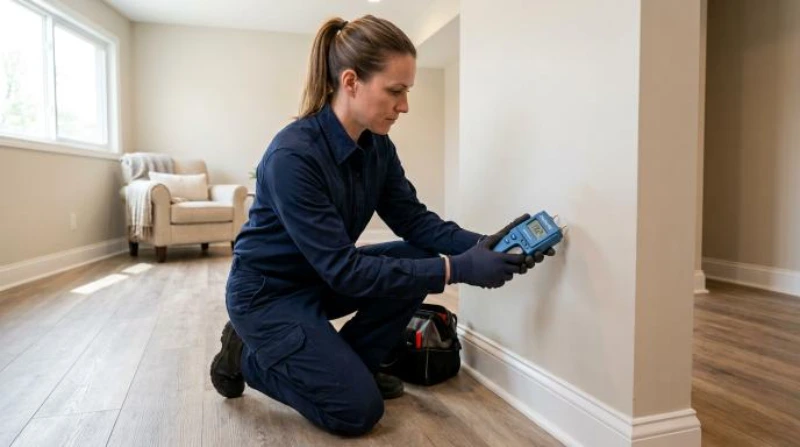
- Drying: LGR dehumidifiers and air movers run for 3 to 5 days. We take moisture meter and thermal imaging readings every day and log them.
- Sign-off: drying ends when readings reach dry standard, and you get the log for your insurer or a city claim.
This follows the IICRC S500 standard for water damage and S520 for mold. If water sat more than a day or two before anyone found it, the EPA's 24 to 48 hour guideline for mold growth comes into play, and our guide to mold after a basement flood explains what to watch for.
Sewage Backup Claims in Sterling Heights: City or County?
If you believe a public sewer caused your backup, Michigan Public Act 222 of 2001 gives you 45 days from when you discovered the damage to file a written claim with the governmental agency responsible. The notice should include your name, address and phone number, the address of the damaged property, the date you discovered the damage and a short description of what happened.
The tricky part in Sterling Heights is deciding who that agency is. The city maintains the local sanitary sewers. The big interceptor that carries the city's sewage away belongs to the Macomb Interceptor Drain Drainage District, run by the Macomb County Public Works Office. When in doubt, call both and ask where to send written notice:
- City of Sterling Heights, 40555 Utica Road, Sterling Heights, MI 48313: 586-446-2489. The city's Water and Sewer Division says it responds to emergency flooding conditions 24 hours a day.
- Macomb County Public Works Office: 586-469-5100.
Under the same law, winning a claim requires showing that the system had a defect the agency knew or should have known about and failed to fix in a reasonable time. That is a high bar, so your own policy is usually the faster route. Many homeowners policies exclude sewer backup unless you bought an endorsement. Our Michigan basement flooding insurance guide covers the usual exclusions. Either way, photos and our daily moisture logs are the proof you'll need.
Sterling Heights Basement Flood Cleanup Costs
Two things drive the price: what kind of water got in, and whether the basement is finished. These are typical ranges from our Michigan jobs, not quotes:
| Situation | Typical range |
|---|---|
| Clean water, small unfinished basement | $500 – $1,500 |
| Sump failure (Category 2), unfinished | $1,500 – $4,000 |
| Sewage backup (Category 3), unfinished | $3,000 – $8,000 |
| Finished basement with sewage | $7,000 – $18,000 |
| Mold remediation, when needed | Adds $1,500 – $5,000+ |
In a carpeted 1970s rec room, a sewage backup pushes the bill toward the high end because carpet, pad and lower drywall have to come out. A clean-water leak caught the same day often stays near the low end. You get a written estimate before work starts, and nights and weekends cost the same as weekdays. For a rough number before you call, try our basement flood cost estimator.
Water Damage Restoration Across Sterling Heights
We serve every Sterling Heights ZIP code, 48310, 48311, 48312, 48313 and 48314, from the Hall Road (M-59) corridor down through the Van Dyke and Mound Road neighborhoods to the 15 Mile area.
Southeast Sterling Heights
The stretch of the Macomb Interceptor where crews began removing 6,000 tons of sediment in 2023. Floor drain backups here get treated as sewage until we confirm otherwise.
Little Nineveh
The area around 15 Mile and Ryan, home to much of the city's Chaldean and Assyrian community. We handle sump, seepage and sewage cleanup throughout the neighborhood.
Clinton River Road Corridor
A $10 million road project that broke ground in September 2026 includes replacing deteriorated water main and problematic sanitary sewers along this 4.5-mile stretch near Henry Ford II High School.
City Hall & Dodge Park
Dodge Park flooded during the April 2026 Clinton River rise, near City Hall at 40555 Utica Road. Homes close to the river should know their flood zone.
Plum Brook Area
Where August 2019 rain closed roads and flooded the Plum Brook Golf Club. The Plumbrook Drain gauge at Ryan Road tracks how fast this drain rises.
Sterling Relief Drain
Macomb County's Phase II green infrastructure work along this drain corridor is designed to capture and soak in about 28.2 million gallons of stormwater a year.
Our flooded basement cleanup Sterling Heights MI crews also work in neighboring cities. See basement flood cleanup in Warren to the south, our Clinton Township flooded basement page downstream on the Clinton River, and Troy basement cleanup next door in Oakland County. The Macomb County basement flooding guide covers the whole county. Every Sterling Heights job is handled by the same IICRC-trained team behind our flooded basement cleanup in Dearborn, serving Michigan homeowners since 2019. When water damage restoration in Sterling Heights can't wait, call (866) 838-7745, any hour of the year.