
The June 2021 Dearborn Flood — What Homeowners Must Know
Worried June 2021 could happen again? A storm FEMA would classify as a 1,000-year event pushed sewage into about 20,000 Dearborn homes (FEMA DR-4607). Here's what happened, the federal aid that followed, and what it means for your risk.
June 2021 Dearborn Flood — Key Facts
Date: June 25 and 26, 2021
Rainfall: Approximately 6 to 7 inches in less than five hours across Metro Detroit
Dearborn sewer capacity: Approximately 3.5 inches per day
FEMA classification: 1,000-year rainfall event
FEMA Disaster designation: DR-4607
Presidential Disaster Declaration: Signed by President Biden for Wayne and Washtenaw Counties
Dearborn homes affected: Approximately 20,000
I-94 status: Submerged, eastbound between Dearborn and downtown Detroit
FEMA Disaster Recovery Center: 16301 Michigan Ave, Dearborn MI 48126
Second DRC: 4900 Pardee Ave, Dearborn Heights MI 48125
HUD CDBG-DR recovery funds: $27 million to Dearborn
FEMA debris removal reimbursement: $2.37 million to Dearborn
FEMA Hazard Mitigation Grant (July 2026): $8.1 million for east Dearborn sewer upgrades
What Happened on June 25 and 26, 2021
The storms began on the evening of Friday, June 25, 2021, and continued through Saturday, June 26. Rainfall totals varied across the Metro Detroit area, with some locations receiving close to 7 inches in a period of roughly five hours. The National Weather Service and FEMA later classified the event as approximately a 1,000-year rainfall occurrence — meaning a storm of this intensity at this location has a statistical probability of occurring once per 1,000 years. That classification reflects the severity of the event relative to historical storm data for this region, not a prediction that it will not happen again. If the next big storm floods your home, our Dearborn flooded basement cleanup team responds 24/7.
Dearborn's combined sewer system was designed to handle approximately 3.5 inches of rain per day. The June 2021 storm delivered nearly double that in less than half a day. The system filled completely and the pressure reversed. Raw sewage mixed with storm water backed up through basement floor drains throughout the city. Approximately two-thirds of Dearborn homes — roughly 20,000 properties — had water and sewage enter their basements.
The flooding was not limited to basements. The eastbound lanes of I-94 between Dearborn and downtown Detroit submerged under several feet of water. Motorists abandoned their vehicles. Governor Gretchen Whitmer held a press conference on the still-inundated highway. The visual of a major U.S. interstate submerged became the image that defined what Metro Detroit's aging drainage infrastructure looks like when overwhelmed by a modern storm event.
What the Flooding Looked Like on the Ground
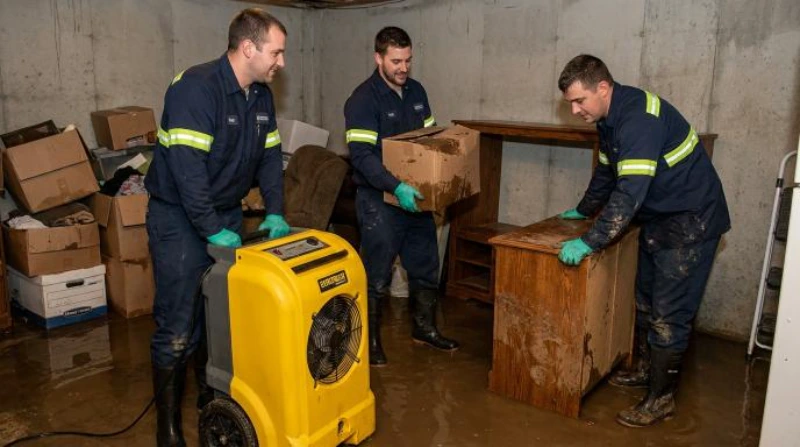
On streets throughout Dearborn — on Hanover Street in Dearborn Heights, on blocks in East Dearborn along Warren Avenue, in the Fordson neighborhood — furniture, appliances, carpeting, and water-logged drywall piled up on curbs in the days following the storm. Residents pulled apart their basements, carrying out the possessions they could not save and the structural materials that had to be removed. Some families had not finished repairing damage from the 2014 or 2018 flooding when June 2021 arrived.
GFL and other waste haulers organized special debris pickup schedules for Dearborn and Dearborn Heights because the volume of damaged material exceeded what normal trash collection could manage. Volunteer organizations including Disaster Relief at Work (DRAW) set up distribution points for cleaning supplies. The Red Cross traveled neighborhood to neighborhood distributing cleanup kits. Leon's Family Dining on Michigan Avenue offered free meals to residents affected by the flooding. The community response was substantial, but so was the scale of what individual families were dealing with in their homes.
The Federal Response — What Dearborn Received
Representative Debbie Dingell worked with the Biden Administration to secure a Presidential Disaster Declaration for Wayne County under FEMA Disaster 4607. This made federal individual assistance available to qualifying Dearborn residents. The FEMA Disaster Recovery Center at 16301 Michigan Ave in Dearborn 48126 operated seven days a week, providing access to FEMA registration, SBA home and business loans, and other federal services. A second center operated at 4900 Pardee Ave in Dearborn Heights. Applications for individual assistance remained open until November 12, 2021.
At the city level, the economic development department received approximately $27 million from HUD's Community Development Block Grant Disaster Recovery program. This funding supported a range of recovery and infrastructure projects, with the Colson Palmer Stormwater Line — designed to route stormwater from northeast Dearborn directly to the Rouge River — representing one of the largest single projects funded through this recovery allocation.
FEMA separately approved $2.37 million to reimburse Dearborn for debris removal costs incurred during the storm response. Captain Kevin Sweeney of the Michigan State Police Emergency Management and Homeland Security Division noted at the time that this federal funding would free up additional city resources that could be used to prevent future flood damage through mitigation efforts.
The July 2026 FEMA Hazard Mitigation Grant
In July 2026, FEMA announced an $8.1 million Hazard Mitigation Grant for Dearborn — the second phase of an $8.4 million total grant through FEMA's Hazard Mitigation Grant Program. The project installs approximately 6,200 feet of new storm sewers, grade protection, and flapgate structures in east Dearborn specifically between Chase Road and Greenfield Avenue.
Mayor Hammoud explained the flapgate concept publicly: rather than installing individual backflow prevention valves in each home, the flapgate serves as a backflow preventer for an entire neighborhood. The project is expected to protect approximately 3,000 homes in the targeted area. FEMA covered 90 percent of the project cost; the city of Dearborn covered the remaining 10 percent.
This grant addresses the same east Dearborn neighborhoods that FEMA and the city identified as most flood-distressed following June 2021. The Chase Road to Greenfield Avenue corridor in east Dearborn — covering the zip code 48124 area including blocks near Fordson High School and the Warren Avenue corridor — was the focus of both the CDBG-DR recovery spending and this 2026 hazard mitigation investment.
Why June 2021 Still Matters for Dearborn Homeowners Today
The June 2021 flood was not a one-time event that has been addressed and resolved. It was a forcing event that exposed what Dearborn's combined sewer infrastructure was actually capable of handling — and what happened when it was not enough. The infrastructure upgrades funded since 2021 address portions of the city. They do not address all of it.
Some Dearborn homeowners who flooded in June 2021 flooded again in subsequent storm events. Residents near Ecorse Creek in Dearborn Heights reported that FEMA claims from the 2024 flooding produced $250 in assistance against cleanup costs of $1,500 to $2,000. The coverage gap between what standard homeowners insurance excludes (sewer backup), what FEMA assistance covers (limited amounts for individual losses), and what the actual cleanup costs is a persistent financial problem for Dearborn and Dearborn Heights residents.
The most important thing June 2021 made clear: if your basement has flooded once in Dearborn, particularly if it flooded from floor drain backup during a heavy rain event, you are in a location that will flood again when conditions are right. The question is when and how severe, not whether.
What Changed After June 2021
Mayor Hammoud directed the city to commission a comprehensive two-year assessment of Dearborn's water infrastructure, including analysis of how climate change would affect storm event frequency and intensity. In September 2025, Hammoud and City Council President Mike Sareini held a public press conference to address ongoing flooding challenges and outline the city's infrastructure investment timeline. The assessment and ongoing project pipeline represent a more systematic response to flooding than the city had undertaken in prior decades.
The city also publicly recommended individual-level prevention measures including check valve installation on basement floor drains, sump pump installation for flood-prone properties, and flood insurance acquisition. These recommendations acknowledge a reality that many Dearborn homeowners already know: city-level infrastructure fixes take years, and individual homes need protection during the years it takes to complete them.
Why Wayne County Homeowners Call Us — Not a 1-800 Franchise
✓ Dryout Michigan
- Real person answers — no hold queue
- 60-minute response, Wayne County
- IICRC S500/S520 certified protocol
- Written estimate before work begins
- Insurance documentation from arrival
- No upselling of unnecessary demo
✗ Common complaints about franchise companies
- Callback promised, never comes
- Multiple visits to bring equipment
- Slow — working multiple projects
- Over-demolition to maximize insurance
- Communication gaps during drying
- Family moved to hotel for weeks
Related Wayne County Flooding Guides
CSO infrastructure, city-by-city flood risk, and full restoration protocol.
Why Downriver cities flood, CSO overflow events, and what to do first.
Which watershed is flooding your basement and what it means for cleanup.
June 2021 Dearborn Flood — Frequently Asked Questions
What caused the June 2021 Dearborn flooding?
Storms on June 25 and 26, 2021 dropped approximately 6 to 7 inches of rain in less than five hours. Dearborn's combined sewer system has a daily capacity of approximately 3.5 inches. The storm volume nearly doubled that in half the time. FEMA classified it a 1,000-year rainfall event. The system overflowed and pushed sewage backup into approximately 20,000 Dearborn homes. I-94 between Dearborn and downtown Detroit submerged.
What is FEMA Disaster 4607?
FEMA Disaster 4607 is the official federal designation for the June 2021 severe storms, flooding, and tornadoes event in Michigan. President Biden signed a Presidential Disaster Declaration for Wayne and Washtenaw Counties. This enabled federal assistance for qualifying residents and city-level recovery funding. FEMA established Disaster Recovery Centers at 16301 Michigan Ave in Dearborn 48126 and 4900 Pardee Ave in Dearborn Heights.
How much federal money did Dearborn receive after the June 2021 flood?
Dearborn received $27 million from HUD's CDBG-DR program, $2.37 million in FEMA debris removal reimbursement, and in July 2026, an additional $8.1 million FEMA Hazard Mitigation Grant for east Dearborn sewer upgrades. Total federal investment in Dearborn's post-2021 flood recovery and mitigation exceeds $37 million.
Can I still apply for FEMA assistance from the June 2021 Dearborn flood?
The application window for FEMA Disaster 4607 individual assistance closed in November 2021. For subsequent flooding events, contact your insurer and document all damage. If a new federal disaster is declared for a future Dearborn flooding event, new applications would open at disasterassistance.gov. Current city resources are at dearborn.gov/residents/flood-preparedness-recovery.
Could the June 2021 type of flooding happen again in Dearborn?
Yes. While June 2021 was classified as a 1,000-year event, Dearborn's combined sewer system remains vulnerable to any storm exceeding its 3.5-inch daily capacity. The FEMA-funded east Dearborn infrastructure upgrades protect approximately 3,000 homes. Sewer separation work is ongoing but has not extended across the entire city. Homes outside current project areas remain at risk during storms that overwhelm sewer capacity.
What neighborhoods in Dearborn were worst affected in June 2021?
The northeast and southeast sections of Dearborn were designated most flood-distressed by FEMA and the city. East Dearborn along Warren Avenue and the Fordson neighborhood experienced widespread flooding. Springwells near the Rouge River also saw significant impacts. The FEMA $8.1 million grant approved in July 2026 specifically targets east Dearborn between Chase Road and Greenfield Avenue — the corridor identified as most severely and repeatedly affected.
What happened on I-94 during the June 2021 Dearborn flood?
The eastbound lanes of I-94 between Dearborn and downtown Detroit submerged under several feet of water. Motorists abandoned vehicles on the highway. Governor Whitmer held a press conference on the still-flooded I-94. The image of a major interstate under water highlighted the scale of the event and the gap between Metro Detroit's drainage infrastructure and the demands placed on it by modern storm intensity.
What caused the June 2021 Dearborn flood?
On June 25–26, 2021, a storm dropped approximately 6–7 inches of rain in roughly five hours across Dearborn, Dearborn Heights, and surrounding Wayne County cities — nearly double the daily capacity of the combined sewer system. The CSO infrastructure — one pipe carrying both storm water and raw sewage — was overwhelmed. Sewage pressurized backward through floor drains across roughly 20,000 Dearborn-area homes. FEMA declared this Disaster DR-4607, releasing $27M in HUD recovery funds.
Was the June 2021 Dearborn flood a FEMA declared disaster?
Yes. FEMA Disaster Declaration DR-4607 was issued for Wayne County following the June 2021 flooding event. This declaration unlocked $27M in HUD Community Development Block Grant — Disaster Recovery (CDBG-DR) funds. In July 2026, FEMA approved an additional $8.1M specifically for Dearborn stormwater infrastructure upgrades to reduce future flood risk — the infrastructure investments responding directly to the 2021 event's scale.
Did the June 2021 Dearborn flood involve sewage?
Yes — and this is the part that many homeowners didn't fully understand at the time. The flooding was not clean storm water. Dearborn's combined sewer system carries both storm runoff and raw sewage in one pipe. When the pipe overwhelmed, what backed up through floor drains was IICRC Category 3 sewage water — containing E. coli, Hepatitis A, Norovirus, and other documented pathogens. Homes that were 'cleaned up' with shop vacs and fans without proper decontamination were left with sewage contamination in flooring and drywall.
How fast does mold grow after a basement flood?
The EPA and CDC confirm mold begins growing on wet materials within 24 to 48 hours. In Wayne County basements during summer — typically 65–80°F — conditions are ideal. Growth starts inside drywall and insulation before it's visible on the surface. If drying didn't begin within 24 hours, antimicrobial treatment is necessary even if you see no mold yet.
If You Experienced Flooding in June 2021 and Have Flooded Since
Some Dearborn homeowners have flooded multiple times since June 2021. Each event creates new damage on top of repairs that may not have been fully completed. If your basement has flooded since 2021 — whether from a subsequent storm, a sump pump failure, or a pipe failure — the documentation process still matters. Call us for a current damage assessment. We document what we find for your insurance claim and advise on what options remain for coverage and assistance.
FEMA — $8.1 Million Dearborn Stormwater Hazard Mitigation Grant, July 2026
Rep. Debbie Dingell — Flood Resources and FEMA Disaster 4607 Information
City of Dearborn — Flood Preparedness and Recovery (HUD CDBG-DR information)
ClickOnDetroit — FEMA is Covering 90% of Flood Help in Dearborn, July 2026
WDET 101.9 FM — Dearborn Receives $8 Million FEMA Funds for Stormwater Management, July 2026
Michigan Public Radio — Dearborn is Taking Aggressive New Measures to Avoid Flooding, October 2023
ClickOnDetroit — How Dearborn is Improving Stormwater Systems, September 2025
FEMA Disaster Assistance — disasterassistance.gov
Complete Dryout Michigan Resource Library
IICRC Water Damage Restoration Technician (WRT) #WRT-48291
IICRC Applied Structural Drying Technician (ASD) #ASD-32817
Licensed Contractor · Serving Dearborn MI since 2019
Event facts are drawn from FEMA disaster documentation (DR-4607) and city of Dearborn records. Last reviewed: October 2026.
Head Office
No extra charge for nights or weekends
+ Dearborn Heights · Allen Park · Lincoln Park · Wayne County
Serving all of Dearborn, Wayne County, and surrounding communities 24/7
Flooded Basement Cleanup — All Wayne County Cities
Dealing With Dearborn Basement Flooding?
Whether it happened in 2021 or it is happening right now, we respond 24/7 to flooded basements across all Dearborn neighborhoods. Real person answers. Crew dispatched immediately.
📞 (866) 838-7745 — Call 24/7