
Flooded Basement Cleanup Inkster MI
Middle Rouge Runs Through the Middle of Inkster — and the Combined Sewer Is One of the Oldest in Wayne County.
Basement flooding? The Middle Rouge runs through Inkster and its combined sewer is among the oldest in Wayne County, so backflow starts sooner here. Our flooded basement cleanup Inkster MI crews respond 24/7.
Why Inkster Basements Flood — Middle Rouge River + Legacy CSO Infrastructure
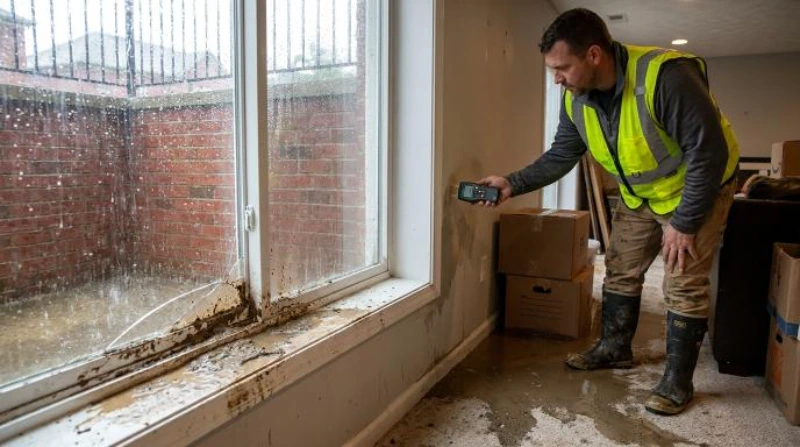
Inkster's housing stock is primarily 1940s and 1950s construction — brick and concrete block homes on lots that reflect the dense development pattern of that era. Original clay tile sewer laterals throughout the city are now 70 to 80 years old. Many show significant joint failure at inspection. This means Inkster basements can receive water from two sources simultaneously during heavy rain: CSO backflow through the floor drain from the overtaxed sewer system, and groundwater seeping in through cracked lateral joints. Inkster borders Dearborn Heights, and our Dearborn basement flood cleanup crews cover both.
In Inkster, water coming up through the floor drain is almost always sewer backflow — treat it as Category 3 sewage. Don't step into it without protection, don't run fans, and turn off the basement breaker at the main panel before you call us.
Emergency Flood Cleanup in Inkster MI
We cover all Inkster 48141 addresses 24 hours a day. Inkster's infrastructure age means flooding events can escalate faster than in newer systems — limited capacity reserves mean the sewer reaches overflow threshold sooner after rainfall begins. Calling us as soon as water appears, rather than waiting to see how high it will go, is the correct response in Inkster more than almost anywhere else in Wayne County.
See our full 24/7 emergency response protocol →
Sewage Backup Cleanup in Inkster MI
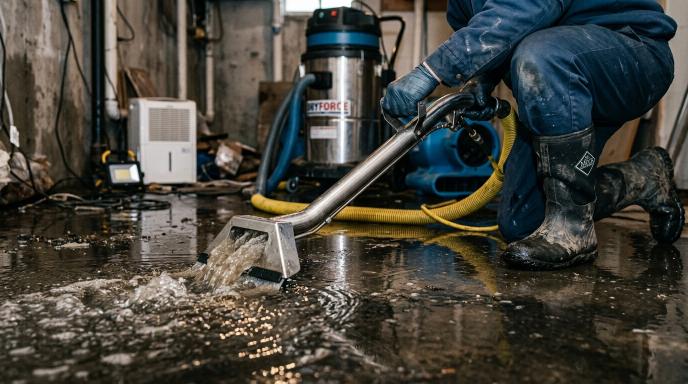
Inkster's 70-to-80-year-old clay tile lateral connections are in various states of joint failure throughout the city. When the combined sewer backs up, the water entering your basement is Category 3 sewage regardless of whether it comes through the floor drain or seeps through a cracked lateral joint — both sources are classified as gross contamination under IICRC S500. Full Category 3 protocol applies to every Inkster sewage event: PPE, sealed extraction, EPA-registered disinfectant at proper dwell time, HEPA air scrubbing, written clearance.
Full Category 3 sewage backup protocol →
Basement Water Removal in Inkster MI
Inkster's basement extraction follows standard Wayne County protocol — industrial submersible pumps for standing water, commercial wand extraction for floor-surface moisture, LGR dehumidification for the structural drying phase. The older clay tile laterals present a variable: if a lateral joint has failed, groundwater entry can continue even after extraction is complete and the storm has passed. We assess for active groundwater infiltration during extraction and document any identified entry points for your contractor follow-up.
Our complete water removal process →
Structural Drying in Inkster MI
Inkster's 1940s and 1950s concrete block dries in 3 to 5 days at IICRC S500 drying standards. The older housing sometimes has original concrete floors with rougher surface texture than more modern slabs — this doesn't materially affect drying time but requires broader extraction wand coverage to ensure complete floor-surface moisture removal before the drying phase begins. Daily pin meter readings are logged and provided in writing.
How IICRC S500 structural drying works →
Mold Remediation in Inkster MI
Inkster's basement mold risk is elevated by a factor specific to its infrastructure age: the cracked clay tile laterals that allow groundwater entry during dry periods. A basement that is not actively flooded may still maintain above-normal humidity from slow lateral seepage between storm events. This elevated baseline means a flood event in Inkster starts from a wetter starting point, and the 24-to-48-hour mold establishment window that applies under normal conditions effectively compresses. If your Inkster basement has had a persistent musty odor before this flood, that is a signal that mold may have already been establishing from the baseline moisture condition.
Full IICRC S520 mold remediation protocol →
Inkster Neighborhoods We Serve
North Inkster — Michigan Ave Corridor
North Inkster along Michigan Avenue is the city's commercial hub. The dense impervious surface of the commercial strip — parking lots, rooftops, driveways — adds substantial storm water volume to the combined sewer network serving the residential streets immediately south. These streets experience flooding at lower rainfall thresholds than the rest of the city because of the commercial runoff loading they absorb in addition to residential rainfall.
Central Inkster — Middle Rouge Zone
The central Inkster zone straddles the Middle Rouge River corridor. Properties here are most directly affected by river-level flooding. The Middle Rouge in central Inkster has a documented history of bank overflow during significant rain events — when the river exceeds its channel, water moves across the surface as well as pushing back through the underground combined sewer network.
South Inkster — Cherry Hill District
South Inkster's Cherry Hill district is slightly removed from the river's direct influence. 1950s and 1960s construction here is in better average condition than the city core, but the sewer infrastructure is still original and the area is still connected to the Wayne County combined system that overflows during major storms. Flooding here is typically CSO-only rather than river-overflow-plus-CSO.
East Inkster — Dearborn Heights Border
East Inkster borders Dearborn Heights, and the infrastructure connection between the two cities means that during major Wayne County CSO events, backpressure propagates across the municipal boundary. Homeowners in eastern Inkster sometimes experience flooding triggered by overflow conditions in the Dearborn Heights system as much as by Inkster's own sewer capacity.
What Does Flooded Basement Cleanup Cost in Inkster?
Inkster cleanup costs follow Wayne County averages but with one consistent variable: the older infrastructure means lateral inspection after a flooding event sometimes reveals deterioration that needs addressing to prevent recurrence. We note any visible drain infrastructure concerns during cleanup at no additional charge. Standard pricing: $1,200 to $3,000 clean water, $2,000 to $5,000 gray water, $2,800 to $8,000 Category 3 sewage in unfinished space.
Why Wayne County Homeowners Call Us — Not a 1-800 Franchise
✓ Dryout Michigan
- Real person answers — no hold queue
- 60-minute response, Wayne County
- IICRC S500/S520 certified protocol
- Written estimate before work begins
- Insurance documentation from arrival
- No upselling of unnecessary demo
✗ Common complaints about franchise companies
- Callback promised, never comes
- Multiple visits to bring equipment
- Slow — working multiple projects
- Over-demolition to maximize insurance
- Communication gaps during drying
- Family moved to hotel for weeks