⚠ Wayne County Flood Alert: Combined sewer capacity is 3.5"/day. Any storm above that pushes sewage into basements. Mold begins within 24 hours.Call (866) 838-7745
Dryout Michigan — Wayne County Guide
Wayne County Basement Flooding — The Complete Homeowner's Guide
📅 2026-09-23👷 James Novak, IICRC WRT #WRT-48291 & ASD #ASD-32817⏱ 8 min read
Basement flooding again? Wayne County basement flooding hits tens of thousands of homes a year through combined sewer overflow. This guide explains why, what the water categories mean, and the decisions that matter in the first hour.
Why Wayne County Basements Flood More Than Anywhere Else in Michigan
Wayne County's basement flooding problem is not an accident of geography — it is the direct consequence of engineering decisions made between 1890 and 1970. During that 80-year period, municipalities across the county built combined sewer systems that carry both storm water and household sewage in a single pipe network. This was standard practice throughout the United States at the time. The problem is that those pipes were sized for the population that existed at the time of installation, and the county's population grew dramatically after most of the infrastructure was built. Dryout Michigan is headquartered in Dearborn, and our flooded basement cleanup Dearborn MI page covers the city in detail. North of 8 Mile, our Oakland County water damage restoration guide covers that county's sewer districts and claim rules.
The secondary factor is the Rouge River watershed. Wayne County sits at the terminus of the Rouge River system — a 466-square-mile watershed that drains portions of Oakland, Washtenaw, and Livingston counties before reaching Wayne County. Every heavy rain event upstream eventually drains through Wayne County's rivers and combined sewer system. By the time the water reaches communities like Dearborn, Lincoln Park, Inkster, and Wyandotte, it has accumulated the runoff of half a dozen counties.
A third factor is terrain. Much of Downriver Wayne County sits on flat glacial lake-bottom sediment with minimal natural drainage gradient. Water does not drain away from the flat terrain quickly — it collects, it ponds, and it overwhelms infrastructure faster than in communities with natural topographic relief.
The Key Statistic:
Wayne County's combined sewer overflow (CSO) threshold is approximately 3.5 inches of rainfall per day. That threshold is exceeded multiple times every spring and summer in most years. Each exceedance produces Category 3 sewage backflow into connected basements across the county.
The Combined Sewer Overflow (CSO) System Explained
Your basement floor drain connects to a lateral pipe that runs from your home to the street. In most Wayne County communities, that lateral connects to a combined sewer main — a single pipe that carries both the storm water from your street's catch basins and the household sewage from your sinks, toilets, and washing machine.
Under normal conditions, this combined flow travels to the Wayne County wastewater treatment plant for processing. The system works adequately when rainfall is light or moderate. When rainfall is heavy and sustained, storm water enters the combined sewer faster than it can travel to the treatment plant. The pipes fill with water faster than the treatment plant can accept it.
At that point — the overflow threshold — the combined system has nowhere to go except backward. Hydraulic pressure in the system reverses, and the contents of the combined sewer main push back through every connected lateral into the basements that drain into it. The water that enters your basement at this point is not rainwater. It is the full contents of the combined sewer — raw sewage from your neighborhood and everything upstream of it.
This is what the IICRC classifies as Category 3 water: grossly contaminated, known to carry bacteria including E. coli and Salmonella, viruses including Hepatitis A and Norovirus, and potentially parasitic organisms. Every porous material that contacts Category 3 water must be removed under the IICRC S500 standard — this is not a judgment call, it is the standard, and it exists because the health consequences of leaving contaminated porous materials in a living space are documented and serious.
Water Categories: What Came Into Your Basement Matters
Category
Source
Contamination
Protocol
Category 1
Clean water supply pipe failure, appliance failure
None on entry
Extraction + drying
Category 2
Washing machine overflow, sump failure, overflow from fixtures
Moderate — gray water
Extraction + antimicrobial treatment + drying
Category 3
Combined sewer backflow, toilet overflow, external flood water
Gross — raw sewage, bacteria, viruses
Full extraction + removal of all porous materials + disinfection + HEPA + drying + written clearance
⚠ Important: If your Wayne County basement flooded during a rainstorm, assume Category 3 until confirmed otherwise. Combined sewer backflow — the most common flooding cause in Wayne County — is always Category 3 regardless of how long the water was present or whether you can detect a sewage odor. Do not enter without PPE. Do not run personal fans. Turn off the electrical breaker to the basement.
City-by-City Flood Risk Reference — Wayne County
DearbornRouge River + combined sewer. Most service calls in our area.
Lincoln ParkHighest per-acre CSO load of any Downriver city. Dense sewer.
WyandotteDetroit River + Lower Rouge. River-level events without rain.
SouthgateRauch Creek drainage bowl. 1953-1965 all-at-once build.
TaylorTaylor Drain fills in 90 minutes. Mixed slab and basement.
WestlandMiddle Rouge built the city. Finished basements common.
LivoniaWayne County's largest city. Highest finished-basement loss.
TrentonDetroit River shoreline. River level alone floods drains.
RiverviewDetroit River west, Flat Rock Creek east. Two sources.
Garden City5.2 sq mi — most compact Wayne County city. All in CSO zone.
RomulusDTW Airport impervious surface drains into residential sewer.
Melvindale2.3 sq mi. CSO pressure from three bordering systems.
Flat RockHuron River watershed. Different flooding calendar than Rouge.
CantonGrew from 25K to 100K — Middle Rouge never kept up.
EcorseDetroit River + Ecorse Creek. Oldest infrastructure Downriver.
City of WayneMiddle Rouge corridor. Compact. 60 years of flooding history.
BellevilleBelleville Lake rises with Huron River. Lake-level flooding.
What to Do the First Hour After Flooding Begins
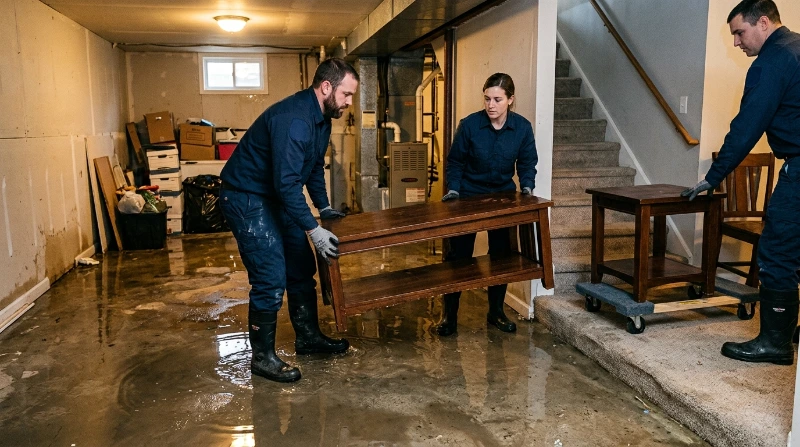
1. Do not enter the basement. If water entered through the floor drain during rain, it is Category 3 sewage. The risk is not primarily drowning — it is bacterial infection through skin contact, eye contact, or inadvertent ingestion. Without PPE, entering a Category 3-flooded basement is a health risk, not an inconvenience.
2. Turn off the electrical breaker to the basement at the main panel. If you must access the main panel to do this and the panel is in the basement, call an electrician or your utility company before entering. Electrocution from flooded electrical equipment is a documented cause of death in flood events.
3. Call a restoration company before the storm ends. The most common mistake Wayne County homeowners make is waiting until the water stops rising to call for help. Every hour of sewage contact with porous materials increases the scope of required removal and the total cleanup cost. Categories don't improve with time — they worsen. Calling mid-storm is the correct action.
4. Do not run personal fans. Consumer fans spread contaminated droplets from Category 3 water into the air column above. This aerosolizes bacteria and viruses and contaminates areas above the flood line that would otherwise be unaffected. IICRC S500 protocol uses negative-pressure air scrubbers with HEPA filtration, not fans.
5. Document everything before any removal. Photograph the standing water level, all affected materials, and any visible contamination marks. These photographs are the foundation of any insurance claim, municipal assistance application, or FEMA documentation that may apply. A professional restoration company will do this from the moment they arrive — which is another reason to call before you start moving anything.
Basement flooding right now? Call immediately — every hour increases the scope.
The Drying Timeline — Why IICRC S500 Takes 3–5 Days
IICRC S500 structural drying setup — dehumidifiers, air movers, and moisture meters working in concert over 3–5 days.
After extraction, visible water is gone. The basement may look dry. It is not dry. Concrete block absorbs water into the block material itself — into the cellular voids within each block. The floor slab absorbs water through its entire depth. Wood framing elements absorb water through the grain. None of this absorbed moisture is visible on the surface, and none of it is removed by extraction.
IICRC S500 structural drying addresses this absorbed moisture through LGR (Low Grain Refrigerant) dehumidifiers. LGR dehumidifiers remove moisture from the air at a rate that exceeds standard dehumidifiers significantly — pulling the ambient air humidity down to a level that draws moisture out of the building materials. This process requires 3 to 5 days of continuous operation in most Wayne County unfinished basements, and 5 to 7 days in finished basements after material removal.
The standard is met when pin meter readings — moisture content measured at specific test points within the building materials themselves — fall to the acceptable range for each material type. We provide these readings in writing at the end of each drying day. Equipment is removed only when every reading reaches certified dry. Not when the basement looks and smells dry. Not when a set number of days has passed. When the meter says it is dry.
Michigan Insurance and Wayne County Flooding
Standard Michigan homeowners insurance policies exclude two types of flooding that are responsible for the vast majority of Wayne County basement events: sewer backup and surface water flooding. These exclusions are standard, not unusual, and they apply to virtually every base homeowners policy sold in Michigan.
Sewer backup coverage is available as an add-on rider — typically $10 to $30 per month, depending on the insurer and policy limits. If you do not have this rider and your basement floods from combined sewer backflow, your homeowners policy will not cover it.
After major flood events, Wayne County and individual municipalities sometimes offer relief programs or municipal assistance for qualifying homeowners. FEMA disaster declarations can also activate federal assistance programs. Having professional, written documentation of damage — completed before any cleanup begins — is a prerequisite for virtually all of these programs. A restoration company that documents as they work is providing this documentation as a matter of course. Request it explicitly and confirm you will receive a copy.
Prevention: What Actually Works
Several prevention measures are effective for Wayne County CSO flooding specifically — not all commonly recommended measures address the actual cause of flooding here.
Overhead sewer conversion is the single most effective prevention measure. An overhead sewer replaces the standard floor drain connection with one that is physically above the street sewer level, making gravity backflow from the combined sewer system impossible. The cost is $3,000 to $8,000 depending on the home's plumbing configuration. It eliminates CSO backflow flooding. It does not prevent surface water entry from other sources.
Backwater valves (also called check valves or backflow preventers) are less expensive — $500 to $1,500 installed — and can prevent sewer backflow when functioning properly. They require maintenance and can stick in either the open or closed position. Wayne County has documented failures of backwater valves during major CSO events. They are better than nothing but less reliable than overhead sewer conversion.
Sump pumps handle groundwater infiltration and some surface water scenarios but do not prevent combined sewer backflow — the water coming up through your floor drain is not groundwater, it is sewer pressure, and a sump pump cannot overcome that pressure. Battery backup sump pumps are valuable for sump-failure scenarios but are not a CSO prevention measure.
FEMA DR-4607 declared disaster, insurance claims, and long-term mold risk.
Frequently Asked Questions — Wayne County Basement Flooding
Why does Wayne County flood more than other Michigan counties?
Wayne County has three converging factors: a legacy combined sewer system sized for 1960s-era population, the terminus of the Rouge River's 466-square-mile watershed, and flat glacial terrain with minimal natural drainage gradient. These factors combine to produce CSO overflow events multiple times per year during heavy rainfall seasons.
What is a combined sewer overflow (CSO)?
A combined sewer carries both storm water and household sewage in a single pipe. When heavy rain overloads the pipe's capacity, the excess contents — sewage included — reverse through every connected floor drain into basements. This water is Category 3 (grossly contaminated) under the IICRC S500 standard.
How long does Wayne County basement cleanup take?
Extraction takes 2 to 6 hours for most residential basements. Structural drying runs 3 to 5 days for unfinished concrete block and 5 to 7 days for finished basements where material removal is required. Equipment is removed when certified dry is confirmed by pin meter readings, not by appearance.
Does homeowners insurance cover Wayne County flooding?
Standard Michigan homeowners policies exclude sewer backup and surface water flooding. A sewer backup rider — typically $10 to $30 per month added to your policy — is required for coverage. Contact your insurance agent to confirm your current coverage before the next flood season.
What is the most effective flood prevention for Wayne County homes?
Overhead sewer conversion eliminates gravity-driven CSO backflow flooding and is the most reliable solution. Cost: $3,000 to $8,000. Backwater valves are less expensive but less reliable. Neither measure prevents all possible flooding scenarios — heavy surface water events can still enter through window wells, door thresholds, and foundation cracks.
How quickly should I call after my Wayne County basement floods?
Immediately — mid-storm if possible. Every hour of Category 3 sewage contact with porous materials (carpet, drywall, insulation) increases the required removal scope and total cleanup cost. Calling after the storm ends rather than when flooding begins is the single most common and most costly mistake Wayne County homeowners make.
How long does basement drying take after a flood?
Water extraction takes 2–6 hours. Structural drying under IICRC S500 takes 3–5 days with continuous equipment running. Sewage events add 1–2 days for full decontamination. We take daily moisture readings and remove equipment only when every measurement reaches certified dry. You receive a clearance document for your insurance file at completion — not before.
Basement flooded right now? We cover all Wayne County communities — 60-minute response, 24/7/365.
Lead Water Damage Restoration Technician · Dryout Michigan IICRC WRT #WRT-48291 · IICRC ASD #ASD-32817 Licensed Contractor · Serving Dearborn MI & Wayne County since 2019
IICRC S500 & S520Licensed Contractor
All technical claims are sourced from IICRC standards (S500, S520), EPA guidelines, CDC health advisories, Wayne County CSO documentation, and NOAA river gauge data. Last reviewed: October 2026.
Coverage Area
Flooded Basement Cleanup — All Wayne County Cities
Every hour of standing water in your basement increases mold risk, contamination spread, and your final cleanup bill. The EPA gives you 24–48 hours. The clock is already running.
🦠
Mold starts growing within 24–48 hours
EPA and CDC confirmed. In Michigan summer basements (65–80°F), growth hits the fast end of that window. Visible mold means it has been inside the walls for days already.
📈
Every 12-hour delay adds ~7% to your cost
IICRC data. A $3,000 sewage cleanup becomes $5,000+ when mold remediation is added. Calling now is the cheapest decision you can make today.
☣️
Wayne County flooding is mostly Category 3 sewage
When the combined sewer system overflows, raw sewage pushes back through your floor drain. Do not enter. Do not use fans. Call us first.