
Water Damage Categories Dearborn MI — Cat 1, 2 and 3
Is the water in your basement clean or sewage? Water damage categories decide everything about the cleanup. Most Dearborn basement floods are Category 3 — here's how Cat 1, 2 and 3 differ and why testing comes before anything else.
Water Damage Categories in Dearborn MI — Cat 1, Cat 2, and Cat 3 Explained
The IICRC S500 Standard classifies water damage into three categories based on the source of water and its contamination level. The category of your flooding determines the entire cleanup protocol, the health precautions required, which materials can be saved versus removed, and ultimately what the job costs. In Dearborn MI, most basement flooding during heavy rain is Category 3 — a fact that most homeowners do not know until a crew arrives and tests the water. Every Dearborn basement flood cleanup we take on starts by classifying the water category.
Category 1 — Clean Water
Water from a supply line, water heater, or other sanitary source. No contamination at the time of loss. Cat 1 can deteriorate to Cat 2 if left standing more than 24–48 hours. Protocol: extraction and structural drying. All materials that dried quickly can typically be salvaged.
Category 1 sources in Dearborn basements: burst supply pipe, water heater failure, washing machine supply line rupture, dishwasher overflow. These are the cleanest and least expensive events. Extraction and IICRC S500 structural drying are the complete protocol. Most finished basement materials can be salvaged if drying begins quickly.
Cost range: $500 to $4,000 for a standard Dearborn basement depending on size and finish level. The critical variable is response time — Cat 1 water that sits 48 hours becomes Cat 2 through bacterial growth and contact with building materials.
Category 2 — Gray Water
Water with significant contamination — biological, chemical, or physical — that poses health risk if ingested or contacted. Antimicrobial treatment required in addition to extraction and drying. Porous materials in prolonged contact may require removal.
Category 2 sources in Dearborn basements: sump pump failure and groundwater intrusion, washing machine discharge, dishwasher overflow, toilet overflow without solid waste, storm water entering through window wells or foundation cracks. Sump pump failure during power outages is extremely common in Dearborn — the same storm that fills the pit also kills the power.
Cost range: $1,500 to $5,000 for a standard Dearborn basement. Antimicrobial treatment adds to extraction and drying costs. Carpet in contact with Cat 2 water for extended periods should typically be removed per IICRC S500 guidance.
Category 3 — Black Water (Sewage)
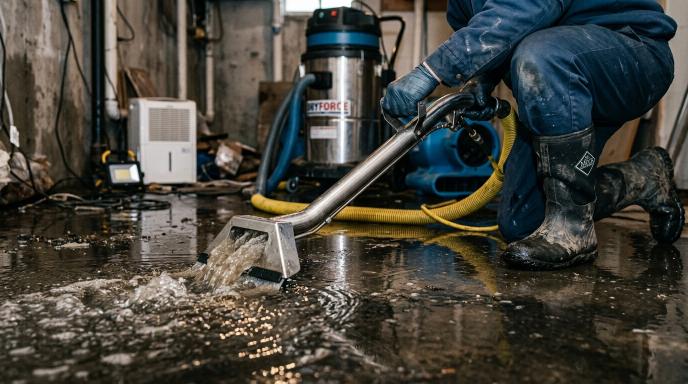
Grossly contaminated water containing pathogenic agents. The CDC identifies sewage as a source of 120+ viruses, bacteria including E. coli, Salmonella, and Hepatitis A, and parasitic organisms including Giardia and Cryptosporidium. Full biohazard protocol required. Do not enter. Turn off the breaker. Call immediately.
This is the most important fact about Dearborn basement flooding: most flooding during heavy rain is Category 3. Dearborn uses a combined sewer system — one pipe carries both storm water and household sewage. The system handles 3.5 inches of rain per day. Any storm exceeding that capacity causes pressure to reverse in the pipe, pushing raw sewage back through the lowest drain in your home — the basement floor drain. This is combined sewer overflow (CSO).
During the June 2021 FEMA Disaster 4607 event — 6 to 7 inches in five hours — the combined sewer system failed completely. Sewage pushed into approximately 20,000 Dearborn homes this way. This is not a plumbing problem. It is an infrastructure problem. And it means that most Dearborn basement flooding events require the most rigorous cleanup protocol in the IICRC S500 standard.
Category 3 protocol includes: full personal protective equipment (Tyvek suit, respirator, gloves, eye protection), sealed extraction equipment, hospital-grade EPA-registered disinfectant with proper dwell time, removal of ALL porous materials that contacted sewage (carpet, insulation, lower drywall), HEPA air scrubbing, and final clearance testing. Cost range: $3,000 to $15,000+ depending on basement size, finish level, and response time.
| Factor | Category 1 — Clean | Category 2 — Gray | Category 3 — Black |
|---|---|---|---|
| Common source | Burst pipe, water heater | Sump failure, storm seepage | Floor drain backup, CSO |
| Health risk | Low | Moderate | HIGH — biohazard |
| Enter basement? | Yes (carefully) | With caution | NO — turn off breaker |
| Porous materials | Usually salvageable | Assess by contact time | Must be removed |
| Antimicrobial | Optional | Required | Required (hospital-grade) |
| Typical cost range | $500 – $4,000 | $1,500 – $5,000 | $3,000 – $15,000+ |
Why Wayne County Homeowners Call Us — Not a 1-800 Franchise
✓ Dryout Michigan
- Real person answers — no hold queue
- 60-minute response, Wayne County
- IICRC S500/S520 certified protocol
- Written estimate before work begins
- Insurance documentation from arrival
- No upselling of unnecessary demo
✗ Common complaints about franchise companies
- Callback promised, never comes
- Multiple visits to bring equipment
- Slow — working multiple projects
- Over-demolition to maximize insurance
- Communication gaps during drying
- Family moved to hotel for weeks