
Structural Drying Dearborn MI — IICRC S500 Certified
Walls still damp after the water's gone? Pumping is the start, not the finish. Structural drying Dearborn MI pulls moisture out of block, joists and framing where mold begins — LGR dehumidifiers, daily readings, IICRC S500 clearance.
Structural Drying in Dearborn MI — What It Is and Why It Matters
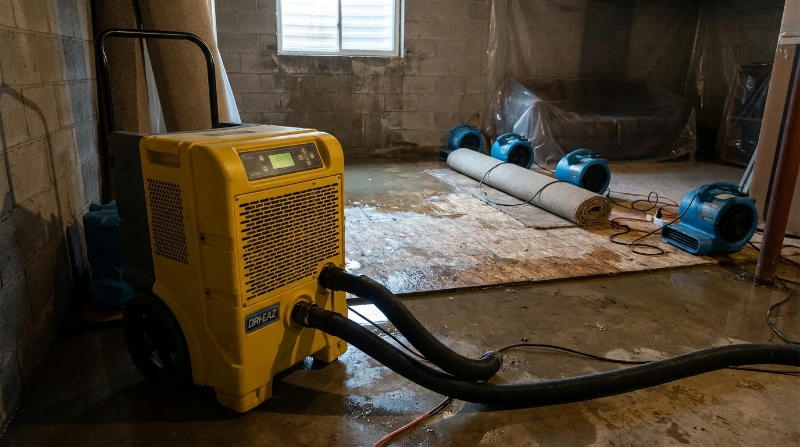
After water is pumped out of a flooded Dearborn basement, the visible cleanup is done but the real problem is just starting. Concrete block walls absorb water like a sponge. Subfloor joists hold moisture at the joint between the wood and the concrete. The base of drywall panels wicks water up into the framing. A household dehumidifier and box fans move surface air. They do not extract moisture from inside structural materials — and that embedded moisture is where mold begins. Structural drying is the final stage of every Dearborn flooded basement cleanup we run.
Structural drying is the IICRC S500-defined process of extracting moisture from inside building materials using professional equipment. LGR (Low-Grain Refrigerant) dehumidifiers pull moisture from inside materials by lowering the vapor pressure of the air around them — forcing moisture to migrate outward. Industrial air movers positioned to match the specific floor plan and material types accelerate that migration. The process is monitored daily with pin moisture meters inserted into structural materials, and equipment is removed only when every reading reaches certified dry standard.
Under the IICRC S500 standard, structural drying for a clean water event (Category 1) takes 3 to 5 days. Sewage backup events (Category 3) require an additional decontamination phase and typically take 5 to 7 days. The daily moisture readings we take are logged, time-stamped, and provided to you as part of the clearance document — the insurance adjuster's primary evidence that professional drying occurred.
Moisture mapping
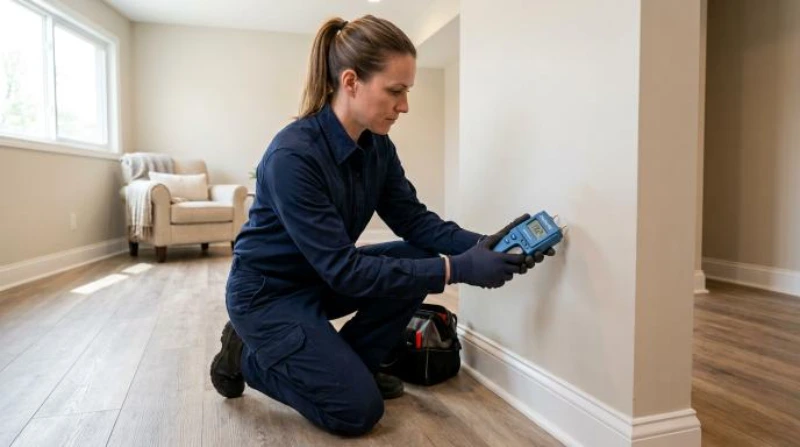
Pin meters and thermal detection identify moisture pockets inside concrete, drywall, and subfloor materials that are invisible from the surface. This determines equipment placement and drying time.
LGR dehumidification
Low-Grain Refrigerant dehumidifiers work at the material level — not just room humidity. Industrial units pull 100+ pints per day compared to 30–50 for hardware store units.
Directed air movement
Industrial air movers positioned per IICRC S500 airflow calculations — not randomly placed. Each mover is aimed to create the pressure differential that drives moisture outward through material surfaces.
Daily monitoring
Pin meter readings taken and logged at the same test points every 24 hours. Written daily report provided. Equipment stays until every reading meets certified dry standard — not just surface dry.
Antimicrobial treatment
EPA-registered antimicrobial applied during drying to prevent mold from establishing in materials that were wet. Required on Category 2 and 3 events regardless of drying speed.
Clearance document
Final moisture readings, equipment log, and IICRC S500 clearance document provided at completion. Required by most insurance carriers to approve water damage claims.
Why Dearborn's Housing Stock Makes Structural Drying Critical
The median Dearborn home was built in 1952. Approximately 24 percent of Dearborn homes predate 1940. These homes have concrete block foundations — which absorb and retain water differently than poured concrete. Concrete block is porous by design, with mortar joints that act as capillary pathways. A 1950s Dearborn basement that flooded with sewage from a combined sewer overflow can hold moisture inside the block for weeks after the visible water is gone.
Plaster walls — still present in some of the oldest East Dearborn and Springwells homes — absorb water into the substrate and do not release it easily to surface airflow. The gap between what the surface looks and feels like versus what the material moisture meter actually reads can be enormous. A basement that looks dry in 48 hours may register 40% moisture content inside the block — well above the IICRC S500 certified dry threshold of 15–17% for concrete masonry.
A basement that "looks dry" after fans and a hardware store dehumidifier may still have 30–40% moisture content inside concrete block. Mold grows inside the material before it reaches the surface. By the time you smell it, the colony has been there for days. Professional structural drying with daily moisture monitoring is the only way to confirm actual dry status.
Why Wayne County Homeowners Call Us — Not a 1-800 Franchise
✓ Dryout Michigan
- Real person answers — no hold queue
- 60-minute response, Wayne County
- IICRC S500/S520 certified protocol
- Written estimate before work begins
- Insurance documentation from arrival
- No upselling of unnecessary demo
✗ Common complaints about franchise companies
- Callback promised, never comes
- Multiple visits to bring equipment
- Slow — working multiple projects
- Over-demolition to maximize insurance
- Communication gaps during drying
- Family moved to hotel for weeks