
Flooded Basement Cleanup Farmington MI
Rouge River rain, 1950s foundations and a regional sewer that backs up in big storms
Water seeping through the basement wall or rising from the floor drain? Our flooded basement cleanup Farmington MI team pumps it out, dries it right and records every reading, with a 60-minute response target any hour of the day.
Farmington's Own List: Three Ways Water Gets In
The City of Farmington names three causes of basement flooding: groundwater seeping through walls, surface runoff, and sanitary sewer backup. Every flooded basement cleanup Farmington MI call we take traces back to one of them, and each one changes how the cleanup goes. Seepage and runoff are usually clean or gray water. A sewer backup is Category 3 (black water) and has to be handled as a health hazard. For a slow seep along one wall, a wet-dry vac and a dehumidifier can hold things steady until a crew arrives.
The city's guidance is blunt about that last one. It warns that sewer backups can make you sick, damage your home and create a risk of electrocution. That is why the first call in a Farmington flood is about safety, and the second is to a crew that knows what to do with contaminated water.
The city also suggests steps homeowners can take to cut the risk: seal wall cracks, extend downspouts, fix grading, raise window wells and check the sewer lateral for roots. Several of these need a permit, so ask the city before you start. If your basement is already wet, the DPW line is 248-473-7250 and the public safety non-emergency line is 248-474-4700.
Before We Arrive: Your First Hour in a Wet Farmington Basement
The first hour decides how much of the basement you keep. Do these in order:
- Stay out of the water if it is near the panel, the water heater or extension cords. Kill power at the breaker only if you can reach it while standing somewhere dry.
- Look and smell before you step in. Gray or brown water with an odor means sewage, so keep everyone out.
- Stop adding water: hold off on laundry, showers and flushing until you know the drain is clear.
- Photograph the waterline on the walls, the floor drain and anything damaged.
- Call DPW at 248-473-7250 if you suspect the sewer, then call us at (866) 838-7745.
The Upper Rouge Runs Right Through Town
Farmington is a small city, about 2.66 square miles with 11,597 residents, and a branch of the Rouge River crosses it. The Upper Rouge flows south from Farmington Hills through the north and east parts of the city. The city describes the river valley as a distinctive landform, and the Rouge meets the Grand River corridor near Power Road. When flood waters rise along the Rouge, homes on lower ground near the river have the least margin.
Shiawassee Park, a 26-acre park on Shiawassee Road, follows about half a mile of the Upper Branch. In a June 2025 notice about a boardwalk and bridge linking downtown to the park, the city stated that the project site lies in the floodplain and wetland of the Upper Rouge. Those wetlands are described as forested and intermittently flooded.
Flooding along this stretch is not a new concern. In 1964, Farmington asked the U.S. Army Corps of Engineers for a flood plain study of the upper Rouge, with maps of areas covered by floods of different sizes.
Two water systems shape basement risk here: the Upper Rouge on the surface, and the Evergreen-Farmington Sanitary Drain underground. River flooding is a concern near the valley. Sewer backups during heavy storms can reach any block. A backwater valve and a working sump protect against both in different ways.
Farmington Sewer Backup Cleanup and the Evergreen-Farmington Drain
Farmington's sanitary sewage flows into the Evergreen-Farmington Sanitary Drain, a regional system run by the Oakland County Water Resources Commissioner. The drain was built in the early 1960s and has had wet-weather capacity problems since the 1980s. A 1988 abatement order, a 2004 consent order (with a first phase of about $63 million) and a 2019 amended order all aimed at adding capacity. The county's own presentation lists basement backups and sanitary sewer overflows as a regional issue.
In plain terms, when a big storm drives extra water into the sanitary system, the pipes can fill faster than they empty. The lowest drain in many houses is the basement floor drain, and that is where it shows up.
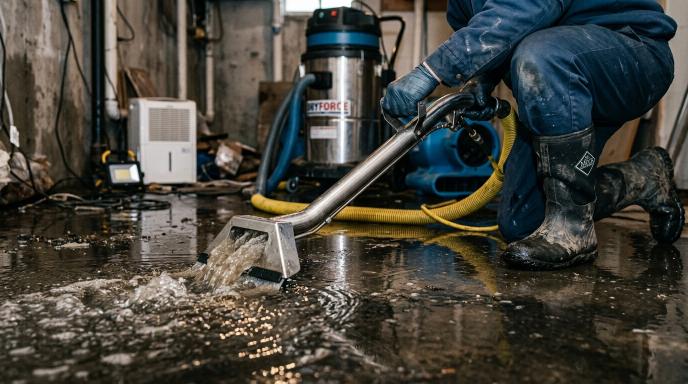
Our sewage backup cleanup follows IICRC S500 for Category 3 water. We set containment, extract the waste, remove soaked porous materials, clean and disinfect hard surfaces, then dry the structure. If you are unsure which category you have, our page on the three water damage categories explains the difference.
Notice to the city: 45 days
Michigan's Act 222 of 2001 requires written notice of a sewer backup claim to the governmental agency within 45 days of discovery. To recover, you must show a defect in the public sewer that the agency knew about, or should have, and did not fix in a reasonable time, and that it caused at least half of the damage. We cannot tell you whether you have a claim, but our dated photos and moisture logs give you a record to send. Write down the date and time you found the water, because your insurance claim and any city report will both ask for it.
1950s Basements, 1950s Weak Points
Farmington's housing skews older. The median home was built in 1966, and about 30% of the city's 5,512 housing units went up in the 1950s, more than any other decade. Another 19% date to the 1960s. That means well over 1,600 homes are around 70 years old.
Age shows up in predictable places. Mortar joints and wall cracks let groundwater through. Older sewer laterals can collect roots, which the city itself flags. Window wells that sit too low take in runoff, and downspouts that empty right beside the foundation feed the soil against the wall. None of these is a disaster alone. Together, during a long soaking rain, they are how a dry basement gets an inch of water.
The Historic District and the east side
The oldest homes are north and west of downtown in the Farmington Historic District, listed on the National Register in 1976. The east side has older, modest homes on smaller lots, and it also sits along the Upper Rouge. When we work in these houses, we expect plaster, original trim and tight mechanical rooms, and we plan drying around them.
Basement Water Removal in Farmington, Step by Step
Basement water removal in Farmington follows the same sequence on every job, because skipping a step is how mold gets a head start. Mold can begin growing within 24 to 48 hours on wet materials. On 1950s block walls, mold growth tends to start in the mortar joints and behind any paneling.
1. Inspect and classify
We identify the source and the water category, check for electrical hazards and take baseline moisture readings on walls, floors and framing.
2. Extract
Truck-mounted or portable extractors pull standing water and saturated carpet water. Most basements take two to six hours.
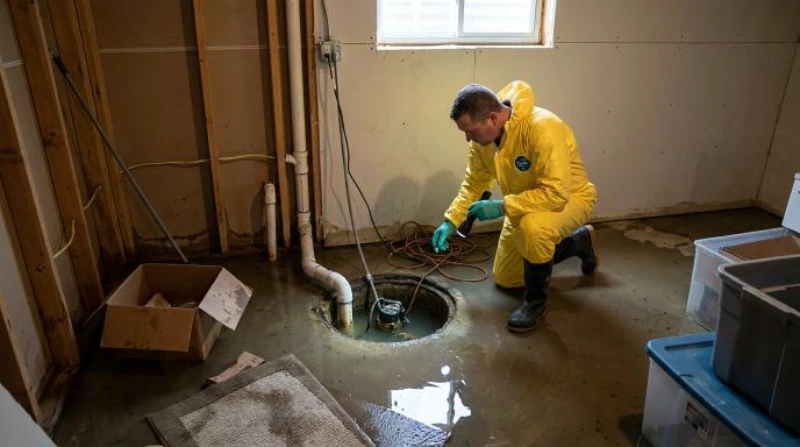
3. Remove what cannot be saved
Wet drywall gets cut above the waterline, and padding and soaked insulation come out. In clean-water losses, more can be dried in place.
4. Dry and verify
Dehumidifiers and air movers run for three to five days. We return daily to log readings and only pull equipment when materials hit dry targets.
What Flooded Basement Cleanup Costs in Farmington
The median owner-occupied home in Farmington is valued at about $297,000, so we keep the scope to what the damage actually requires and explain each line item. An unfinished utility basement costs far less to restore than a finished family room. These are typical ranges, not quotes, and you get a written estimate before work starts.
| Situation | Typical range |
|---|---|
| Clean water, small unfinished basement | $500–$1,500 |
| Sump failure (Category 2), unfinished | $1,500–$4,000 |
| Sewage backup (Category 3), unfinished | $3,000–$8,000 |
| Finished basement with sewage | $7,000–$18,000 |
| Mold remediation (added) | $1,500–$5,000+ |
| Backwater valve installation | $300–$800 |
Waiting costs money on any flooded basement cleanup Farmington MI job. Each extra 24 hours of standing water typically adds about $1,500–$3,000 of scope. For homes that have backed up before, a backwater check valve is the cheapest line on that list and the one most likely to stop a repeat. If growth has already started, our mold remediation crew works under IICRC S520.
Farmington Areas We Serve
Farmington is bordered on three sides by Farmington Hills and on the south by Livonia. Here is how basement flood cleanup in Farmington plays out across the city, mostly in ZIP 48335 and 48336.
Downtown on Grand River Avenue
Downtown centers on Grand River Avenue and Farmington Road, near the Civic Theater and the 1876 Masonic Temple. We handle water in older commercial and residential basements here with a written scope before work begins.
Historic District
The oldest houses are north and west of downtown in the Historic District. We dry plaster and original woodwork carefully rather than tearing it out by default.
East Side Along the Rouge
The Upper Rouge runs through the north and east parts of the city, where older, modest homes sit on smaller lots. Runoff and seepage are the usual problems after long rains.
Shiawassee Park Area
The park follows half a mile of the Upper Branch and lies in a mapped floodplain and wetland. Homes nearby should keep sump pumps tested and window wells covered.
South Farmington Road
The established neighborhood along Farmington Road near Flanders Elementary is one of the city's settled residential areas. We respond here for seepage, sump failures and sewer backups.
West Side Near M-5
Newer subdivisions sit on the west side near the M-5 interchange and Orchard Lake Road. If a lower level here is finished, we move contents out fast to limit losses.
Why Farmington Homeowners Call Dryout Michigan
We have been doing this work since 2019, starting with flooded basement cleanup in Dearborn and growing across Wayne and Oakland counties. Lead technician James Novak holds IICRC WRT and ASD certifications, and every crew works to S500 and S520 standards. A real person answers the phone at any hour, nights and weekends cost the same, and insurance documentation starts the minute we arrive.
Oakland County was included in the August 2014 (DR-4195) and June 2021 (DR-4607) federal disaster declarations. Storms like those will come again, and a frozen discharge line can flood a basement in January just as easily. Our winter sump pump failure guide covers that risk, and the Oakland County water damage guide explains the county drain system in more depth. Watch the water level in the sump pit during a storm; if it keeps rising while the pump runs, the pump is losing.
We also serve the communities around you, including Southfield basement flood cleanup and West Bloomfield water removal. Call (866) 838-7745 for flooded basement cleanup Farmington MI residents can count on at 3 a.m. as much as at noon.