
Emergency Basement Flood Cleanup Dearborn MI — 24/7
Your basement just flooded? Emergency basement flood cleanup Dearborn MI starts with one call: water removal, structural drying, mold prevention, decontamination and insurance documentation. We dispatch 24/7 to every Dearborn ZIP.
One call. Real person. Everything handled.
Before you go downstairs: Turn off the breaker to the basement at the main panel. If you smell sewage, do not enter. Keep children and pets away from the area. Once everyone is safe, the full flooded basement cleanup Dearborn MI process starts with one call.
Do: Take photos from the top of the stairs for your insurance claim. Call us now — we walk you through what to do while the crew is en route.
What Emergency Basement Flood Cleanup Actually Covers
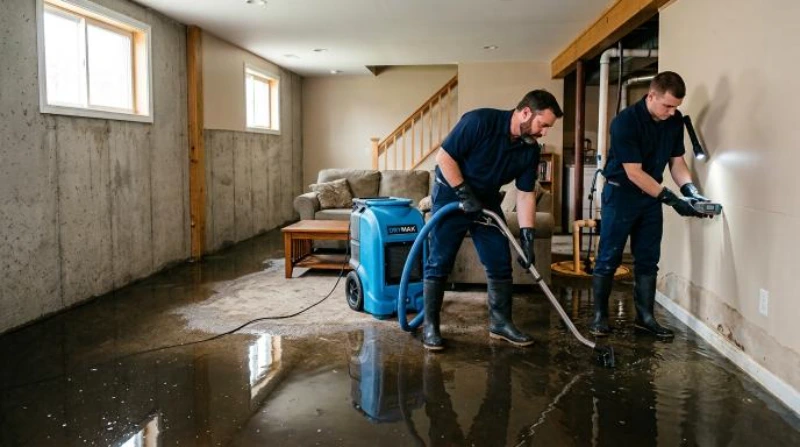
When you search for emergency basement flood cleanup in Dearborn, you are not looking for a water pumping company. You are looking for one team that picks up the phone at 2 AM, arrives fast, assesses what you are actually dealing with, removes the water, dries the structure properly, treats for contamination if needed, and hands you a documentation package that makes your insurance claim work. That is the full job.
We bring everything on one truck: submersible pumps, commercial extraction equipment, LGR dehumidifiers, air movers, moisture meters, thermal imaging cameras, PPE for Category 3 sewage events, EPA-registered antimicrobial products, and documentation tools. We do not arrive, assess, and then leave to get different equipment. We arrive ready for whatever we find.
Why Emergency Response in Dearborn Is Different
When June 2021 hit Dearborn, national franchise call centers were overwhelmed within the first hour. Every restoration company in Wayne County was stretched. Homeowners in Fordson and East Dearborn waited days for callbacks. The families who had local teams that picked up their own phones got help first. That is the difference between a national routing center and an actual Dearborn-area team.
Dearborn's flooding profile also makes emergency response more complex than a standard water event. A city infrastructure study commissioned by Mayor Hammoud and presented in September 2025 confirmed that Dearborn's combined sewer system has a 3.5-inch daily rainfall capacity. Most Dearborn basement flooding during severe storms involves combined sewer overflow — the pipe carries both storm water and sewage, and when it fills, sewage pushes back through basement floor drains. That is Category 3 contamination under the IICRC S500 standard. It requires different equipment, different protective protocol, and different disposal than clean water events.
A team that does not know the difference between a burst pipe (Category 1) and a CSO backup (Category 3) will show up with the wrong protocol. That costs you time, health risk, and — when the mold shows up two weeks later — more money than the original cleanup would have cost if done right the first time.
What Happens From Your Call to a Cleared Basement
You Call. A Real Person Answers.
Not a voicemail. Not a routing center. We get your address, confirm your neighborhood, dispatch a crew, and give you an exact arrival estimate. While you wait, we tell you whether it is safe to enter, what to do about the breaker, whether sewage may be involved based on what you describe, and what not to do before we arrive. The assessment starts with the phone call.
Water Category Assessment — Before Touching Anything
The crew arrives and identifies the water source and contamination level before touching anything. Burst pipe is Category 1 — clean water, standard extraction protocol. Sump pump failure is Category 2 — gray water carrying soil bacteria, requiring extraction and antimicrobial treatment. Sewer backup is Category 3 — raw sewage requiring full biohazard protocol, sealed equipment, and decontamination before drying begins. We explain what we found and what that means for the job. You see the scope and sign off before work starts.
Emergency Water Extraction
Industrial submersible pumps remove standing water. Commercial extraction equipment removes the moisture embedded in concrete floors, subfloor joists, wall bases, and any remaining materials. More than 95 percent of total water volume comes out in this phase. This step determines whether your basement recovers or whether you are dealing with a mold remediation job in three weeks.
Structural Drying — Three to Seven Days
LGR dehumidifiers and industrial air movers run continuously. We take daily pin meter readings and log them. Standard clean water events dry in three to five days. Sewage backup events require five to seven days because of additional decontamination steps before drying can begin. Equipment stays until every reading meets IICRC S500 certified dry standards. The daily reading log becomes part of your insurance documentation.
Decontamination and Antimicrobial Treatment
Every surface in the affected area receives EPA-registered antimicrobial treatment. Sewage backup areas require hospital-grade disinfectant applied with proper manufacturer dwell time — 10 to 15 minutes depending on the product — per EPA protocol. Porous materials that contacted sewage are removed and properly disposed of as contaminated waste. We do not cut corners on this step. The CDC confirms that improper cleanup of Category 3 water creates ongoing illness risk for the people living in that home.
Insurance Documentation Package
You receive photos taken on arrival before any work began, daily moisture readings with the logged drying progression, the written water source and category assessment, the complete scope of work, and a final clearance document with certified dry readings. This package is formatted for insurance adjuster review. We communicate directly with adjusters from all major carriers and, where coverage applies, bill the carrier directly.
Common Dearborn Basement Flood Emergencies We Handle
Combined Sewer Overflow — The Most Common Dearborn Emergency
When the city's combined sewer system fills beyond its 3.5-inch daily rainfall capacity, the pressure reverses and raw sewage pushes back through basement floor drains. This is Category 3 — the highest contamination level. Most Dearborn basement flooding during severe storms is this type. Do not enter without protective equipment. Do not use fans. Call us first.
Sump Pump Failure — The Second Most Common Dearborn Emergency
Dearborn storms knock out power. The pump running your sump pit stops the moment the lights go out — which is exactly when you need it most. The result is Category 2 gray water. Less dangerous than sewage but still contaminated, requiring extraction, drying, and antimicrobial treatment.
Storm Water Intrusion
Heavy rain overwhelms drainage around the foundation and enters through window wells, the cove joint where floor meets wall, and foundation cracks widened by freeze-thaw cycles. Often Category 1 clean water if no sewer involvement, but can escalate to Category 2 or 3 if it contacts contaminated materials or sits more than 24 hours without treatment.
Burst Pipe Basement Emergency
Michigan freeze-thaw cycles burst pipes in uninsulated exterior walls — common in Dearborn's pre-1960 housing where pipes often run through unheated wall cavities. Category 1 clean water, but it spreads fast in older homes with concrete block construction. Call immediately — clean water becomes Category 2 within 24 to 48 hours as bacteria colonize wet materials.
What to Do Before We Arrive — The Short Version
Turn off the breaker. Go to the main panel — not the one in the basement. Turn off the circuit for the basement or the whole lower level if you cannot identify the specific breaker. Water and electricity kill.
Do not enter if sewage odor is present. The smell of raw sewage means Category 3 contamination. The CDC confirms that improper exposure to sewage causes gastroenteritis, Hepatitis A, Norovirus, and respiratory illness from airborne bioaerosols. Your rubber boots are not adequate protective equipment for Category 3 exposure.
Do not use fans if sewage is involved. Fans move airborne contaminants throughout the basement and potentially into the upper living space. They are helpful for clean water evaporation and actively harmful for sewage contamination.
Take photos from the stairs. Every room, every angle you can reach safely. Video is better. This is your insurance documentation before anything changes.
Call your insurer. Do it now, before cleanup begins. Most policies require prompt notification after a loss. Waiting can affect your coverage. We handle the professional documentation, but the notification to your insurer needs to come from you as soon as possible.
Dearborn Basement Flood Emergencies — What the Data Shows
The June 2021 storm that flooded approximately 20,000 Dearborn homes was designated FEMA Disaster 4607. It was not a one-time event. Dearborn's heaviest flood years since 2000 were 2014, 2018, and 2021, according to reporting from ClickOnDetroit and FEMA documentation. In July 2026, FEMA approved $8.1 million for east Dearborn sewer upgrades between Chase Road and Greenfield Avenue — work that Mayor Hammoud described as installing flapgate structures that act as neighborhood-wide backflow preventers for about 3,000 homes. That work is ongoing and not yet complete across the full city.
NOAA river gauge data for the Lower Rouge at Dearborn shows specific flood stage thresholds for this area: Brady Street in Dearborn floods when the river exceeds 13.6 feet, and Wayne Park submerges when it hits 14.4 feet. Residents in Springwells, which sits directly on the Rouge River and is bounded by Rotunda Drive and Greenfield Road, face these thresholds more frequently than any other Dearborn neighborhood.
Why Wayne County Homeowners Call Us — Not a 1-800 Franchise
✓ Dryout Michigan
- Real person answers — no hold queue
- 60-minute response, Wayne County
- IICRC S500/S520 certified protocol
- Written estimate before work begins
- Insurance documentation from arrival
- No upselling of unnecessary demo
✗ Common complaints about franchise companies
- Callback promised, never comes
- Multiple visits to bring equipment
- Slow — working multiple projects
- Over-demolition to maximize insurance
- Communication gaps during drying
- Family moved to hotel for weeks
Emergency Basement Flood Cleanup Dearborn MI — FAQ
What do I do when my basement floods in Dearborn at 2 AM?
Call us immediately. We answer 24 hours a day every day. Before we arrive: turn off the basement breaker at the main panel, do not enter if you smell sewage, and take photos from the top of the stairs. Do not use household fans if sewage odor is present. We guide you through each safe step by phone while the crew is dispatched. Do not wait until morning.
How fast can you respond to a basement flood emergency in Dearborn MI?
We aim to arrive within 60 minutes of your call anywhere in Dearborn. East Dearborn, Fordson, Springwells, and Warrendale are all within our primary response zone. A real person answers every call and dispatches a crew with an exact arrival estimate. You are not reaching a routing center — you are reaching the team that shows up at your door.
What is the difference between emergency flood cleanup and regular cleanup?
Emergency cleanup means responding while the event is still active or within hours of it — water is in the basement, damage is actively spreading, the 24 to 48 hour mold window is running. Regular scheduled cleanup happens after the immediate crisis passes. Emergency response matters because every hour of water contact with organic materials advances mold colonization, structural saturation, and permanent damage.
What caused the emergency basement flooding in Dearborn in June 2021?
Storms on June 25 and 26, 2021 dropped 6 to 7 inches of rain in roughly five hours, nearly double Dearborn's daily sewer capacity. FEMA classified it a 1,000-year rainfall event under Disaster 4607. The combined sewer overflowed into approximately 20,000 homes. President Biden signed a Presidential Disaster Declaration for Wayne County. In July 2026, FEMA approved $8.1 million for east Dearborn sewer upgrades between Chase Road and Greenfield Avenue.
Is basement flood cleanup covered by homeowners insurance in Michigan?
It depends on the cause. Burst pipe damage is typically covered. Sewer backup from a CSO event, the most common Dearborn cause, is usually excluded without a sewer backup rider. Groundwater seepage is typically excluded. Sump pump failure requires its own endorsement. We document all damage starting on arrival — photos, moisture readings, water source identification — formatted for insurance adjuster review from the first hour on site.
How long does emergency basement flood cleanup take in Dearborn?
The emergency phase — pump-out and initial extraction — takes two to six hours. Structural drying takes three to five additional days with continuous equipment. Sewage backup events add decontamination time, typically five to seven days total. You receive a clearance document with certified moisture readings at completion, which becomes part of your insurance documentation.
Can an emergency flood cleanup company help with my insurance claim?
Yes. We photograph all damage before touching anything, create written moisture readings, document the water source and category, and prepare a scope of work formatted for insurance adjusters. We communicate directly with adjusters from all major carriers and, where coverage applies, bill the carrier directly. Most covered homeowners pay little to nothing out of pocket when we handle documentation from arrival.
Which Dearborn neighborhoods see the most basement flood emergencies?
Springwells sees the most emergency calls because of Rouge River proximity and drainage infrastructure dating to the early 1900s. East Dearborn along Warren Avenue and the Fordson neighborhood experience frequent CSO backup during heavy rain. The Lower Rouge River gauge at Brady Street reaches flood stage during sustained rainfall — the same storms that overwhelm the Wayne County combined sewer and push sewage into Dearborn basements. FEMA and the city identified northeast and southeast Dearborn as the most flood-distressed zones after June 2021.
How fast can you respond to an emergency basement flood in Dearborn?
We target 60 minutes to your Dearborn address from first call. Every call reaches a live dispatcher — not a voicemail, not an answering service. During major storm events when call volume is high, we work through the queue by call order. Call (866) 838-7745 the moment you see water — not after you've spent two hours trying to manage it yourself.
What qualifies as a basement flood emergency?
Any standing water from an unknown source, any sewage smell with water present, any floor drain backup during or after heavy rain — these are all emergencies. Even clean water from a burst pipe becomes a mold emergency after 24 hours. The most expensive mistake Wayne County homeowners make is waiting to see if the water goes down on its own. It doesn't — it absorbs into drywall and subfloor while you wait.
What is the first thing to do when your basement floods?
First: do not enter if water is near electrical outlets, panels, or appliances — shut the main breaker first. Second: do not use your sump pump if water smells like sewage (it may recirculate contamination). Third: call us at (866) 838-7745. While you wait, keep people and pets out and open windows for airflow if safe. Document photos for insurance from the doorway before anyone enters.
Is a flooded basement a health hazard?
Yes, if the water source is a combined sewer overflow — which most Dearborn basement flooding events are. IICRC Category 3 water contains E. coli, Hepatitis A, Norovirus, Salmonella, and over 120 other viruses documented by the CDC. Aerosolized sewage particles from fans or pumping without containment can contaminate living areas above the basement. Keep children, elderly, and immunocompromised individuals out of the home until cleanup is complete.
Does homeowners insurance cover sewage backup in Michigan?
Standard Michigan homeowners policies exclude sewer backup. You need a separate sewer backup endorsement — typically $10–$30 per month. Burst pipe damage may be covered under the sudden and accidental provision. Groundwater seepage is also typically excluded. We photograph and document all damage from the moment we arrive so your insurance claim has the strongest possible foundation.
Can I clean up a flooded basement myself?
For a small, confirmed clean-water spill from a known pipe — yes, with a wet-dry vacuum and fans. For any sewer backup, water sitting more than 24 hours, or unknown water source — no. The CDC confirms sewage causes serious illness. Insurers require professional documentation that DIY cleanup cannot provide. Call us for a free assessment before you decide — we will tell you honestly if you can handle it yourself.
Related Services and Resources
Complete Dryout Michigan Resource Library
IICRC Water Damage Restoration Technician (WRT) #WRT-48291
IICRC Applied Structural Drying Technician (ASD) #ASD-32817
Licensed Contractor · Serving Dearborn MI since 2019
The emergency steps here are the ones our team follows on every call, aligned with IICRC S500 and CDC guidance. Last reviewed: October 2026.
Head Office
No extra charge for nights or weekends
+ Dearborn Heights · Allen Park · Lincoln Park · Wayne County
Serving all of Dearborn, Wayne County, and surrounding communities 24/7
Flooded Basement Cleanup — All Wayne County Cities
Basement Flooding Right Now in Dearborn, MI?
Do not manage this alone. One call and we handle everything — water out, structure dried, mold prevented, insurance documented. We serve every Dearborn neighborhood 24 hours a day.
📞 (866) 838-7745 — Emergency Line 24/7