
Basement Water Removal Dearborn MI — We Pump Today
Water still sitting in your basement? Every hour it soaks deeper into concrete, joists and walls, and mold can start within 24–48 hours. Our basement water removal Dearborn MI crews bring industrial pumps 24/7 to every Dearborn ZIP.
Real person answers. Crew dispatched immediately.
How We Remove Water From Your Dearborn Basement
Basement water removal is not one step — it is three, and they have to happen in sequence. Skipping any one of them is why so many Dearborn homeowners who tried to handle flooding themselves ended up with a mold problem three weeks later. Here is what the process looks like from the moment we arrive. Extraction is only step one of a full Dearborn basement flood cleanup — drying, decontamination and documentation follow.
Step 1 — Industrial Pump-Out (Standing Water)
We deploy submersible pumps immediately on arrival. High-capacity units move hundreds of gallons per minute. Pump-out time runs 30 minutes to two hours depending on the size of your Dearborn basement and how deep the water stands. Before we begin, we assess the water category. If sewage odor or visible contamination is present, we switch to Category 3 protocol — sealed equipment, full PPE, and a completely different approach. You are told what we found before any pump goes in.
Water is discharged away from the foundation and through proper drainage channels. We do not discharge contaminated water onto your property or into the storm drain — that creates new problems and, in the case of sewage, is illegal.
Step 2 — Commercial Extraction (What Pumps Leave Behind)
Submersible pumps remove visible standing water. They leave behind 10 to 15 percent of the total moisture volume embedded in porous materials — concrete floors, wood subfloor, carpet padding, and the lower six to eight inches of drywall. That is the moisture you cannot see and cannot remove with a shop vac or box fan.
Commercial extraction equipment operates at much higher suction than consumer tools. It pulls moisture from inside materials rather than just off the surface. This step determines whether your basement fully recovers or whether you are pulling up flooring and cutting drywall two months from now because the mold you could not see in week one is now visible on the surface in week eight.
Step 3 — Structural Drying (Three to Five Days)
LGR (Low-Grain Refrigerant) dehumidifiers and industrial air movers are positioned throughout the affected area according to the floor plan. LGR units work at the material level, pulling moisture from inside structural materials as it evaporates, rather than just conditioning the air. We take daily pin meter readings from concrete, wood framing, and any remaining materials. Readings are logged and provided to you as part of the insurance documentation package.
Equipment stays until every reading meets IICRC S500 certified dry standards. In a standard Dearborn unfinished basement, that typically takes three to five days with equipment running continuously. Finished basements with drywall, insulation, and flooring take longer. We do not remove equipment early to save time on a job — the readings tell us when the job is done, not the clock.
Why Professional Water Removal Matters in Dearborn Specifically
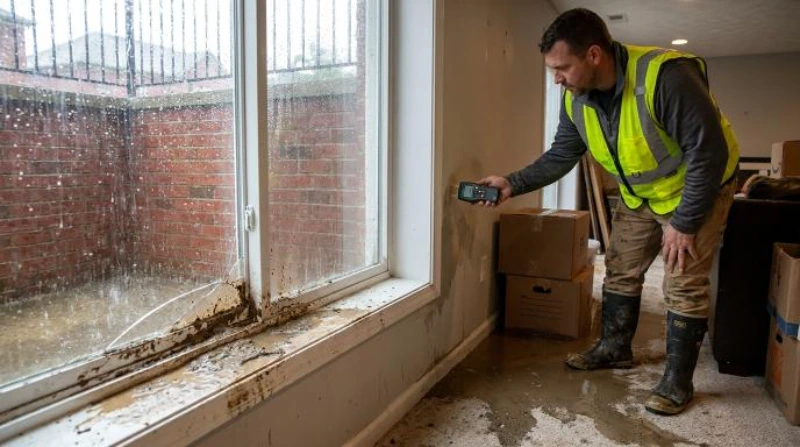
Dearborn's housing stock has specific characteristics that make professional water removal more important here than in newer suburbs. The median home was built in 1952. Concrete block foundations, which are common in pre-1960 Dearborn construction, absorb water differently than poured concrete — and they hold it longer. Clay tile drain systems common in these older homes collect moisture at the joints. Plaster walls, still present in some of the oldest East Dearborn and Springwells homes, absorb water into the substrate and do not release it easily to surface airflow.
The EPA states that The EPA states that mold establishes on wet building materials within 24 to 48 hours — a window that starts the moment flooding stops, not the moment you call. The IICRC confirms this as the industry benchmark. In summer flooding events in Dearborn — when basement temperatures typically stay between 65 and 80 degrees Fahrenheit — the EPA notes mold grows optimally in exactly that temperature range. The gap between when your basement flooded and when extraction begins is the variable you can actually control. Everything else follows from that.
Dearborn's Combined Sewer Problem and What It Means for Water Removal
Most Dearborn basement flooding during heavy rain involves combined sewer overflow (CSO). When the city's sewer system fills beyond its 3.5-inch daily rainfall capacity — confirmed by a city infrastructure study presented by Mayor Hammoud in September 2025 — the pressure reverses and pushes sewer content back through basement floor drains. That water is not just rainwater. Under the IICRC S500 standard, it is Category 3 contamination.
Category 3 water removal requires different equipment, different protective protocol, and different disposal than clean water removal. If you smell sewage in your flooded basement, do not enter. Call us. We arrive with full Category 3 protocol already loaded on the truck. We do not need to leave and come back with different equipment — that delay costs you time you do not have.
Basement Water Removal Across Dearborn Neighborhoods
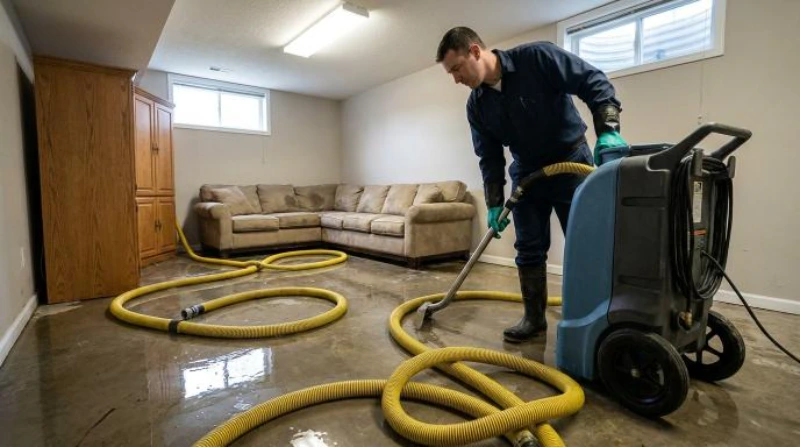
We work basements in every Dearborn neighborhood. Each area has its own flooding patterns based on infrastructure age, soil type, and proximity to the Rouge River.
East Dearborn (48124) — Warren Avenue and Michigan Avenue corridor homes, many built in the 1940s and 1950s with clay tile drainage and concrete block foundations. Floor drain backup from CSO events is the dominant cause. The older mains in this section tend to stay backed up longer after a CSO event than newer infrastructure elsewhere in the city.
Fordson (48126) — Flat terrain with no natural drainage gradient. Homes near Dix Avenue and Schaefer Road call us frequently. Sump pump failure during power outages is the second most common cause here, after CSO backup.
Springwells — The oldest neighborhood in Dearborn, first settled in 1826 and listed on the National Register of Historic Places. Sits directly on the Rouge River. Water pressure comes from two directions during severe storms: CSO backup from below through the floor drain, and groundwater pressure from river-saturated soil pushing through foundation cracks from outside. NOAA gauge data shows Brady Street in Dearborn floods when the Lower Rouge exceeds 13.6 feet.
West Dearborn and Warrendale (48126) — Near Ford World Headquarters and Fairlane Town Center. The large commercial impervious surface of the mall redirects storm runoff toward adjacent residential blocks, adding to CSO load.
South Dearborn (48128) — Near University of Michigan-Dearborn campus. Sees more storm water intrusion and sump pump failure than heavy CSO events, though major storms affect this area too.
What to Do Before We Arrive
Safety first. Do not enter a flooded basement if water is at or near electrical outlet height, or if you smell sewage. Both situations require immediate action and neither is safe to navigate without proper protective equipment.
Turn off the breaker to your basement at the main panel — not the breaker inside the basement if you cannot reach it safely, but the main panel elsewhere in the house. This eliminates the electrocution risk from submerged outlets and appliances.
Take photos from the top of the stairs. Do not wait until the water level drops. Your insurance claim needs photos that show the original water level, affected materials, and the condition on arrival. Take video if possible — walk around the top of the stairs and capture all visible damage from that safe vantage point.
Do not use household fans if sewage odor is present. Fans spread airborne contaminants including bioaerosols from raw sewage. The CDC warns that improper cleanup of Category 3 water creates respiratory illness risk through inhalation of airborne organisms. Fans that help evaporation in a clean water spill actively make the situation worse in a sewage backup.
Call us while you wait. We give you specific guidance based on what you describe. The assessment starts the moment you call.
Cost of Basement Water Removal in Dearborn, MI
Every basement flooding situation is different and we will not give you a final number without seeing your specific basement. Here are honest ranges based on the type of water and the scope of work.
| Service Scope | Typical Range |
|---|---|
| Water extraction only — clean water, small unfinished basement area | $500 to $1,500 |
| Extraction plus full structural drying — standard Dearborn basement | $1,500 to $4,000 |
| Category 2 gray water — sump pump failure, requires decontamination | $2,000 to $5,000 |
| Category 3 sewage backup — full decontamination protocol required | $3,000 to $8,000+ |
Variables that move the number: how long the water sat before extraction began, the square footage of the affected area, whether the basement is finished or unfinished, whether sewage contamination requires removal of drywall or flooring, and what your insurance covers. Industry data from HomeGuide puts water damage restoration broadly between $1,300 and $5,600 for standard events, with sewage backup cases significantly higher.
We provide a written estimate before any work begins. The damage assessment is free. Call and we come look.
Why Wayne County Homeowners Call Us — Not a 1-800 Franchise
✓ Dryout Michigan
- Real person answers — no hold queue
- 60-minute response, Wayne County
- IICRC S500/S520 certified protocol
- Written estimate before work begins
- Insurance documentation from arrival
- No upselling of unnecessary demo
✗ Common complaints about franchise companies
- Callback promised, never comes
- Multiple visits to bring equipment
- Slow — working multiple projects
- Over-demolition to maximize insurance
- Communication gaps during drying
- Family moved to hotel for weeks
Basement Water Removal Dearborn MI — Frequently Asked Questions
What is the fastest way to remove water from a flooded basement?
Industrial submersible pumps move hundreds of gallons per minute and are the fastest method for standing water. A household shop vac empties roughly every 90 seconds during active flooding and cannot keep up with a basement flood. After pump-out, commercial extraction equipment is needed to remove moisture still embedded in concrete, subfloor, and wall bases — that embedded moisture is what feeds mold growth if left in place.
What soaks up water in a basement?
Nothing effectively soaks up water in a flooded basement at any useful scale. Standing water in a basement needs to be extracted, not absorbed. Towels and mops work for small drips. For any actual flood event, you need a submersible pump followed by commercial extraction equipment to pull moisture from materials. Any absorbent material left wet becomes a mold habitat within 24 to 48 hours according to EPA guidance.
How quickly can you remove water from a Dearborn basement?
We aim to arrive within 60 minutes of your call anywhere in Dearborn. Pump-out of standing water takes 30 minutes to two hours depending on basement size and water depth. The full extraction and structural drying process takes three to five days. The sooner extraction begins, the less total damage accumulates.
Will water come up through a concrete basement floor in Dearborn?
Yes, during combined sewer overflow events — which are Dearborn's most common flooding cause. When the combined sewer fills beyond its 3.5-inch daily rainfall capacity, pressure reverses and water pushes back up through the basement floor drain and the cove joint where floor meets wall. Hydrostatic pressure from saturated soil can also push groundwater through cracks in concrete block or poured concrete foundations during and after heavy rain.
Can I remove basement water myself with a shop vac in Dearborn?
For a small clean water spill from a known pipe, yes. For standing water from a storm or sewer backup, no. A 12-gallon shop vac empties roughly every 90 seconds during active flooding and cannot move the volume in a basement flood. It also cannot remove moisture embedded in concrete and subfloor materials after pump-out. If the water source involves sewage, the CDC confirms contact creates serious illness risk. Call us for a free assessment first.
What should I do before water removal professionals arrive in Dearborn?
Turn off the breaker to your basement at the main panel. Do not enter if water is near outlet height or if sewage odor is present. Do not use fans if sewage is involved — they spread airborne pathogens. Take photos from the top of the stairs for your insurance claim. Move valuables upstairs only if you can do so without entering the water. Call us and we walk you through each step while the crew is on the way.
Does basement water removal include drying and mold prevention?
Yes. Water extraction is only step one. Our service includes structural drying with LGR dehumidifiers and air movers, daily moisture monitoring, and antimicrobial treatment. We do not leave until certified moisture readings confirm the structure meets IICRC S500 dry standards. That is what separates professional water removal from water pumping alone.
How much does basement water removal cost in Dearborn MI?
Basic extraction of clean water in a small unfinished Dearborn basement starts around $500 to $1,500. A standard basement with structural drying runs $1,500 to $4,000. Sewage contamination requiring decontamination adds cost and typically runs $3,000 to $8,000 or more. We provide a written estimate before any work begins. The damage assessment is free.
How is professional water removal different from using a shop vac?
Professional truck-mounted extraction units move thousands of gallons per hour — roughly 10–20x the capacity of a consumer wet-dry vacuum. More importantly, professional equipment includes submersible pumps for standing water, extraction wands for carpet and flooring, and the ability to work continuously without emptying a tank. The real difference, though, is what comes after water removal: professional moisture meters, desiccant dehumidifiers, and air movers that actually dry structural materials — not just visible surfaces.
How long does professional basement water removal take?
Water extraction from a typical Dearborn basement (1,000–1,200 sq ft with moderate standing water) takes 2–6 hours with professional equipment. This is removal only — structural drying takes 3–5 additional days under IICRC S500. We stay on-site through extraction and set drying equipment before leaving. You receive daily moisture readings until clearance.
Should I remove water from my basement before calling a professional?
Only if you can do so safely. If the water source is sewage backup — floor drain overflow with odor — do not use electrical appliances or run fans without containment. If it's a burst pipe with clean water and your electrical panels are safe, starting removal with a wet-dry vacuum reduces total damage time. Call us simultaneously — we'll advise while dispatching. The biggest mistake is waiting to call until you've 'tried to handle it' for 24+ hours.
Why does my basement smell like sewage after heavy rain?
That odor is combined sewer overflow gas entering your home through floor drains. When Wayne County's combined sewer system exceeds 3.5 inches per day of rainfall capacity, the single pipe carrying both storm water and raw sewage fills and pressurizes backward. Gas and water push up through floor drains. If water also came up — you have Category 3 contamination and need professional cleanup.
Water Removal Resources — Dearborn MI
Complete Dryout Michigan Resource Library
IICRC Water Damage Restoration Technician (WRT) #WRT-48291
IICRC Applied Structural Drying Technician (ASD) #ASD-32817
Licensed Contractor · Serving Dearborn MI since 2019
Based on our crew's extraction work in Dearborn basements and the IICRC S500 drying standard. Last reviewed: October 2026.
Head Office
No extra charge for nights or weekends
+ Dearborn Heights · Allen Park · Lincoln Park · Wayne County
Serving all of Dearborn, Wayne County, and surrounding communities 24/7
Flooded Basement Cleanup — All Wayne County Cities
Water in Your Dearborn Basement Right Now?
Every hour matters. We dispatch 24/7 to East Dearborn, Fordson, Springwells, Warrendale, South Dearborn, and every Dearborn ZIP code. Real person answers. Crew goes out immediately.
📞 (866) 838-7745 — Call 24/7