
Flooded Basement Cleanup Lincoln Park MI
35,000 People, One Overloaded Sewer Line. You're Not Last — You're First.
Is your basement the first to back up? Lincoln Park is Wayne County's most densely populated city — more pavement, one aging sewer. Our flooded basement cleanup Lincoln Park MI crews respond 24/7 with IICRC S500 protocol.
Why Lincoln Park Basements Flood — The Density Problem
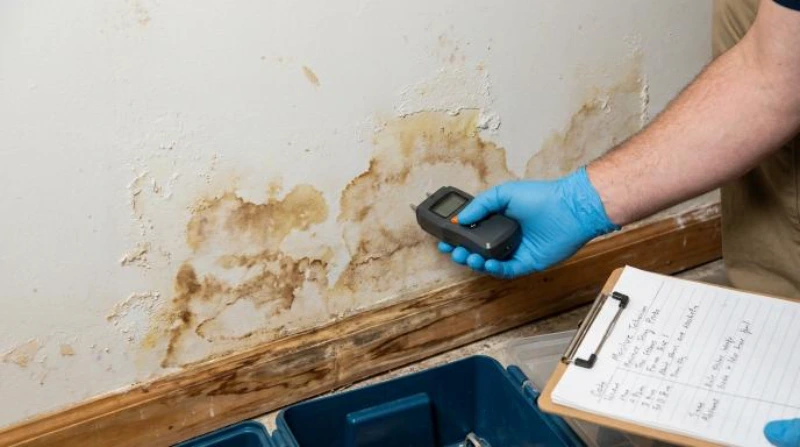
To understand why Lincoln Park basements flood so often, you need to understand one number: 6,481. That is the approximate population density of Lincoln Park per square mile — making it the most densely populated city in Wayne County. In plain terms, more people live on each acre of Lincoln Park than on any comparable piece of Downriver Michigan ground. Lincoln Park is a short drive from our flooded basement cleanup Dearborn MI headquarters.
Every one of those residents has a roof that sheds water when it rains, a driveway that sends water to the curb, and a lateral connection to the combined sewer main. Every square foot of parking lot, sidewalk, and commercial pavement in Lincoln Park does the same. During a heavy rain event — the kind that drops 2 to 3 inches per hour — the Wayne County combined sewer system receives more water per acre of Lincoln Park than it receives from any comparably sized neighboring community. That system has a known overflow threshold of 3.5 inches per day. Lincoln Park hits that threshold faster, from more angles, than any other municipality Downriver.
When the combined sewer overflows, the pressure doesn't go up — it has nowhere to go. It reverses through the path of least resistance: your basement floor drain. The Ford River Branch, which crosses through the northern portion of Lincoln Park near the border with Dearborn, creates an additional drainage pathway that contributes to backpressure during overflow events. Hydraulic models submitted to Wayne County show the Ford River Branch receiving combined sewer overflow during storms that exceed the 3.5-inch daily threshold — the same storms that fill Lincoln Park basements.
The age of Lincoln Park's infrastructure compounds the density problem. Most of the residential lateral connections in Lincoln Park were installed in the 1940s — clay tile pipe that has now been subject to 75 to 80 years of Michigan freeze-thaw cycles. Those clay tile laterals crack at the joints. When they crack, groundwater can enter the lateral independent of any CSO event. Lincoln Park homeowners sometimes find themselves dealing with two simultaneous water sources: sewer backup pushing up from below and groundwater seeping in through failing lateral joints. A shop vac and a mop address neither.
Your basement floor drain is connected to the most volume-stressed combined sewer segment in Downriver Michigan. A storm that gives Southgate a wet basement gives Lincoln Park a flooded one. Call immediately — do not wait until morning. We are in your ZIP 48146 in under 60 minutes.
Emergency Flood Cleanup in Lincoln Park MI
Every minute after your Lincoln Park basement fills with water, the category of damage gets harder to reverse. Standing sewage-contaminated water penetrates porous building materials — concrete block, drywall, wood framing, carpet — and those materials cannot simply be dried and saved. They must come out. The IICRC S500 standard is unambiguous on this point: materials contaminated by Category 3 water are not restorable. Faster arrival means less demolition, which means lower total cost.
We dispatch to all Lincoln Park 48146 addresses 24 hours a day, 7 days a week. A live dispatcher answers every call — no voicemail, no callback system during emergencies. When you describe sewage odor or floor drain backup, we dispatch with Category 3 protocol loaded: full PPE, sealed extraction equipment, EPA-registered disinfectant, HEPA air scrubbers. We do not assess first and return with different equipment. One call, one truck, full capability on arrival.
We know Lincoln Park's street grid. We've responded to the Beech Daly corridor, the Dix-Toledo commercial strip, and the residential blocks east of Fort Street. Lincoln Park basements are typically concrete block construction — faster to extract than brick, but still requiring full drying periods. We know what to expect before we arrive.
See our full 24/7 emergency response protocol →
Sewage Backup Cleanup in Lincoln Park MI
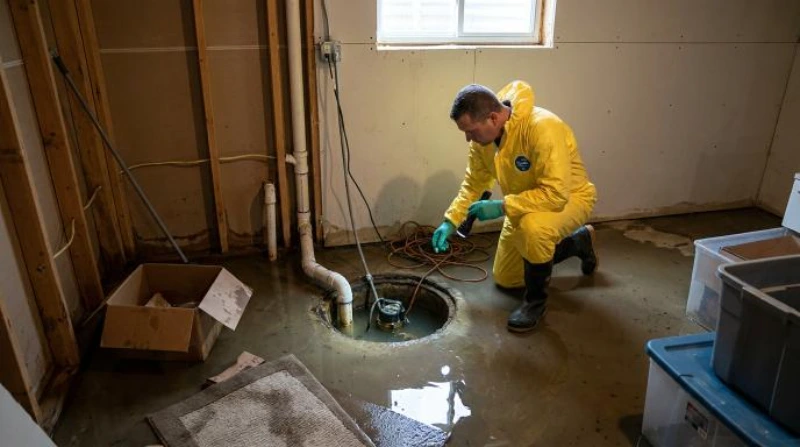
When Lincoln Park's combined sewer backs up through your floor drain, you are not dealing with rainwater. You are dealing with Category 3 sewage — raw waste carrying bacteria, viruses, and parasitic organisms at concentrations sufficient to cause serious illness. The CDC identifies sewage as a vector for E. coli, Salmonella, Hepatitis A, Norovirus, Giardia, and over 120 additional pathogens. The IICRC S500 treats Category 3 water with the same protocol you'd expect in a hospital decontamination situation.
What that means practically for your Lincoln Park basement: every porous material that contacted the sewage water must be removed. This includes carpet and carpet pad, drywall to the flood line, insulation, and any wood framing in direct contact. These materials cannot be dried and declared safe. They absorb contaminated water at a cellular level that sanitizing chemicals cannot reach from the surface. Removal is not optional under IICRC S500 — it is the standard.
After removal, all remaining hard surfaces receive EPA-registered hospital-grade disinfectant applied at the correct concentration with the correct dwell time — not diluted, not cut short. HEPA air scrubbers run throughout the process to manage airborne particles. We provide a Category 3 clearance document at completion for your insurance and personal records.
Full Category 3 sewage backup cleanup protocol →
Basement Water Removal in Lincoln Park MI
Lincoln Park basements tend to be concrete block construction — the standard for Wayne County homes built in the 1940s. Concrete block is more porous than poured concrete: it absorbs water into the cells of the block material itself, not just into surface moisture. Industrial submersible pumps remove standing water in the first phase. Commercial extraction equipment — truck-mounted or portable wand systems — follows immediately to pull moisture from the concrete floor slab and block walls that standing water has already penetrated.
What you cannot do in a Lincoln Park basement: remove standing water with a shop vac or sump pump alone and assume the basement is ready for drying. The block walls continue to release absorbed moisture back into the space for days after visible water is gone. Without industrial extraction and directed airflow, that moisture re-wets already-dried surfaces and extends the total drying period. We have seen Lincoln Park basements that homeowners "cleaned up" themselves require full mold remediation three weeks after the original flood event because the walls were never actually dry.
Our complete extraction and water removal process →
Structural Drying in Lincoln Park MI
Lincoln Park's concrete block foundations dry differently than the brick foundations common in older Wyandotte or Old Dearborn properties. The block itself is more porous but also more uniform — LGR dehumidifiers and directed air movers can achieve certified dry faster in concrete block than in solid brick, assuming the equipment is properly positioned and sized for the space. A typical unfinished Lincoln Park basement reaches certified dry — defined as 15% to 17% moisture content per IICRC S500 — in 3 to 5 days of continuous industrial drying.
That timeline extends significantly if a finished basement has wood subfloor, insulation in the walls, or finished drywall that was not immediately removed. Finished materials that remain wet for more than 48 hours are generally unsalvageable and extend the drying period for the structural materials behind them. Calling us the night of the flood rather than the morning after is the single most effective way to reduce this risk in a finished Lincoln Park basement.
We provide daily pin meter readings logged at marked test points, provided to you in writing. Equipment is removed only when every reading at every test point reaches IICRC S500 certified dry. That documentation is your proof of proper drying for insurance and future property disclosure purposes.
How IICRC S500 structural drying works →
Mold Remediation in Lincoln Park MI
Lincoln Park's housing density creates a mold risk variable that's easy to overlook: air circulation. Homes built close together on narrow lots receive less ambient wind exposure than homes in lower-density suburbs. Less wind circulation around the structure means the building envelope dries more slowly after a wet event. Combined with Wayne County's humid summers — average relative humidity above 70% from June through August — Lincoln Park basements that aren't professionally dried after a flood event create near-perfect mold growth conditions.
The EPA confirms mold can establish on wet building materials within 24 to 48 hours. In a warm Lincoln Park basement in July or August — ambient temperature 65 to 75 degrees Fahrenheit, humidity already elevated — that window is 24 hours or less. If your basement flooded more than a day ago without professional drying, you should assume mold establishment has begun even if no visible growth appears on surfaces. Visible mold on a wall means growth inside the material has been active for days longer than the surface indicates.
Our IICRC S520 mold remediation process includes moisture assessment, negative pressure HEPA containment, removal of mold-affected materials, EPA-registered antimicrobial treatment with verified dwell time, HEPA air scrubbing, and post-remediation clearance air sampling. You receive written clearance at completion.
Full IICRC S520 mold remediation protocol →
Lincoln Park Neighborhoods We Serve
North Lincoln Park — Ford River Corridor
The northern portion of Lincoln Park borders Dearborn along the Ford River Branch watershed. This corridor carries the highest storm water overflow load in the city during large rain events. Homes here — primarily 1940s concrete block construction on narrow lots — are among the most frequently affected by CSO backflow. Fort Street and Southfield Road serve as the main north-south arteries; residential side streets off these corridors have the densest sewer connections per block in the city.
Central Lincoln Park — Beech Daly Corridor
The commercial heart of Lincoln Park along Beech Daly Road and the residential blocks surrounding it. 1940s and 1950s housing stock with original clay tile lateral connections showing accelerating joint failure. The combination of aging laterals and high-density storm water loading creates both sewer backup risk and groundwater intrusion risk in the same event. Many homeowners in this corridor have experienced both simultaneously in major storms.
South Lincoln Park — Wyandotte Border
The southern edge of Lincoln Park along the Wyandotte boundary. This area drains into the same combined sewer system segment that serves northern Wyandotte — meaning the two cities' CSO pressure compounds during large storms. Homes here are slightly later construction (late 1940s to 1950s) than the northern core, but still on original clay tile laterals and still subject to the per-acre sewer load that defines Lincoln Park flooding.
West Lincoln Park — Allen Park Border
The western strip bordering Allen Park is slightly lower-density than the city core, with modestly larger lot sizes and slightly younger housing. The sewer system here connects to Wayne County infrastructure that drains south through Allen Park. During county-wide CSO events, backpressure propagates through this connection. Homes adjacent to the Allen Park border are typically affected 15 to 30 minutes after the central city, giving a narrow window between the CSO event starting and basement flooding beginning.
What Does Flooded Basement Cleanup Cost in Lincoln Park?
Lincoln Park cleanup costs are consistent with Wayne County averages, with one area of variation: the density and age of construction sometimes means more material removal is needed for a given square footage than in newer suburbs. A clean water event from a pipe failure in an unfinished Lincoln Park basement typically runs $1,200 to $3,200. A sump pump failure or gray water event runs $2,200 to $5,000. A Category 3 sewage backup — the standard Lincoln Park heavy rain event — runs $3,200 to $8,500 for unfinished space and $5,500 to $14,000 for finished basements.
The cost variable you control is response time. Every additional hour of sewage contact with concrete block, wood framing, drywall, or insulation is an additional increment of material that cannot be saved. A call at 11 PM is not inconvenient — it is the difference between $3,500 and $7,000 in final cost. We answer 24 hours a day with the same crew and same rate at 2 AM as at 2 PM.
Why Wayne County Homeowners Call Us — Not a 1-800 Franchise
✓ Dryout Michigan
- Real person answers — no hold queue
- 60-minute response, Wayne County
- IICRC S500/S520 certified protocol
- Written estimate before work begins
- Insurance documentation from arrival
- No upselling of unnecessary demo
✗ Common complaints about franchise companies
- Callback promised, never comes
- Multiple visits to bring equipment
- Slow — working multiple projects
- Over-demolition to maximize insurance
- Communication gaps during drying
- Family moved to hotel for weeks