
Oakland County Water Damage Restoration: A Homeowner's Guide
Who to call, what to file, what it costs: the whole basement-flood playbook in one place
Sewage in the basement after a storm, and no idea who pays? This guide covers Oakland County water damage restoration start to finish: why basements back up, the 45-day claim rule, insurance gaps and real cleanup costs.
This guide is for Oakland County homeowners who are standing in a wet basement right now, or who want to be ready before the next big storm. It explains how the county's sewer systems work, which storms have already flooded thousands of local basements, how to protect a sewer backup claim, and what Oakland County water damage restoration involves from the first phone call to the last moisture reading. Good restoration services document each stage, so you have proof of what was removed, dried and cleared.
We are the Dryout Michigan crew, IICRC-certified in water damage (S500) and mold (S520), working out of Dearborn since 2019. What follows is what we tell homeowners on site, written down so you can read it before the water comes. Mold growth is the reason speed matters: the longer materials stay wet, the more has to be removed.
Why Oakland County Basements Flood: Combined vs. Separated Sewers
Most Oakland County basement floods come down to one question: does rainwater share a pipe with sewage on your street? In a combined system, storm runoff and household sewage travel in the same pipe. In a separated system, they run in different pipes. When a combined pipe overloads in a heavy storm, the overflow that pushes up through a floor drain is a mix of rainwater and raw sewage. This kind of urban flooding comes from overloaded pipes on built-out land, which is why flood risk varies street by street.
The county has both kinds, sometimes inside a single city. Royal Oak sits entirely within a combined-sewer area. Troy is mostly separated, with a small combined section of under one square mile. Southfield is combined on its east end and separated on its west end. That is why two neighbors a mile apart can have very different flood histories.
The George W. Kuhn Retention Treatment Basin
Southeast Oakland County's combined sewers drain toward the George W. Kuhn Retention Treatment Basin in Madison Heights. It serves all or parts of 14 communities: Troy, Royal Oak, Madison Heights, Clawson, Ferndale, Berkley, Huntington Woods, Pleasant Ridge, Oak Park, Hazel Park, Royal Oak Township, Birmingham, Southfield and Beverly Hills. The concrete basin can hold up to 150 million gallons of combined sewage and stormwater and is about 2.1 miles long.
The system was built in stages since the 1960s, with a major expansion in the 2000s. In normal weather the flow goes on to Detroit for treatment. In big storms, screened and disinfected overflow is released to the Red Run Drain in Macomb County. The county's position is that this release keeps sewer water out of area basements. When storms outrun even this capacity, basements are where the water goes. The antimicrobial step is there to slow microbial growth on concrete and framing that stay in place.
Evergreen-Farmington and the northern systems
Other parts of the county rely on different systems. The Evergreen-Farmington Sanitary Drain, built in the early 1960s, has had wet-weather capacity problems since the 1980s and lists basement backups among its regional issues. Farmington and Troy both send flow into it. In 2023 it received a $4 million federal earmark toward a green-infrastructure park designed to hold 100 million gallons of overflow.
Farther north, Independence Township and Clarkston send sewage through the Clinton-Oakland Sewage Disposal System. The Pontiac Clinton River Water Resource Recovery Facility treats about 30 million gallons a day of stormwater and sanitary sewage for 13 communities, including Pontiac and Auburn Hills. And Oakland County still has many homes on septic (roughly 80,000 systems by an older county-wide count), where a failing system can push water back toward the basement too.
The Storms That Set Oakland County's Flood Record
Oakland County has been included in more than one federal disaster declaration for flooding, and each one left a trail of soaked basements.
August 11–13, 2014 (FEMA DR-4195)
On the evening of August 11, 2014, 4 to 6.5 inches of rain fell on parts of Wayne, Oakland and Macomb counties, most of it in about four hours. The Federal Emergency Management Agency's (FEMA's) early damage assessment counted 2,269 residences affected across the three counties, and only 43.9% of those were insured. About 2 billion gallons of wastewater moved through the Kuhn system into the Red Run. The county's water resources commissioner said at the time, "We design for a 10-year storm, and this is much larger than the average 10-year storm."
Southeast Oakland was among the hardest-hit areas, with thousands of basements swamped by sewage-filled water. Lawsuits over the backups ended in an $11.5 million class-action settlement covering ten communities, Royal Oak and Troy among them. The settlement admitted no fault.
June 25–26, 2021 (FEMA DR-4607)
The June 2021 storms were first declared a disaster for Washtenaw and Wayne counties only. Oakland and Macomb were added for individual assistance on September 24, 2021, after more than 1,000 homes across the two counties self-reported damage. In Bloomfield Township alone, the southwest part of the township saw more than four inches of rain on June 25 and police took 275 calls that evening.
Since then
Oakland County was also among the counties that received individual assistance under DR-4757 for the August 24–26, 2023 storms. On April 2, 2025, more than a million gallons of raw sewage was released from the Dequindre Interceptor into the Red Run; the commissioner said 700 to 800 homes would otherwise have flooded "with pure sewage." The same storm dropped 3.21 inches of rain in 24 hours near Lake Orion.

Who Handles What: Your City, the County and You
Your local city or township water and sewer department is the first call for a sewer backup, not the county. Local crews check whether the blockage is in the public main or in your private line. The owner is responsible for the private sewer lead, which runs from the house to the main, and for anything inside the home.
The Oakland County Water Resources Commissioner (WRC) runs county drains, the regional sewage systems described above, and the sewer system in some communities. In Pontiac, for example, the WRC operates the sewage system, so Pontiac residents file sewer backup claims with the WRC instead of the city. The WRC is based at One Public Works Drive in Waterford.
Some local after-hours numbers we have confirmed: Orion Township water and sewer, (248) 858-4911; Waterford DPW, 248-618-7550; Bloomfield Township, 248-433-7730. Troy, Southfield and Royal Oak each publish their own daytime and after-hours lines as well. Keep your community's number on the fridge or in your phone before you need it.
Report a sewer backup to your local water and sewer department first, then mail your written claim to the agency that runs the system within 45 days of discovering the damage. In most cities that is the city; in Pontiac it is the county WRC. Start cleanup right away. Waiting for an inspection is not required, but your photos are.
Filing a Sewer Backup Claim in Oakland County Within 45 Days
Michigan's Public Act 222 of 2001 is the only route to recover sewer backup damage from a public agency, and its deadline is strict: a written claim must reach the governmental agency within 45 days after you discover the backup. Missing that window may waive your right to further action.
What the written notice needs
- Your name, mailing address and phone number
- The address of the affected property
- The date you discovered the damage
- A brief description of what happened and what was damaged
What a claimant has to show
Filing on time does not guarantee payment. Under the act, the claimant must show that all of the following existed at the time of the event:
- The agency was the appropriate governmental agency for that sewer system.
- The sewage disposal system had a defect.
- The agency knew, or with reasonable diligence should have known, about the defect.
- The agency, with the legal authority to do so, failed to take reasonable steps in a reasonable time to fix it.
- The defect was a substantial proximate cause of the backup and the damage.
You also need reasonable proof that you owned the damaged property and what it was worth. That is where restoration paperwork matters: our crews photograph everything and take moisture readings from the moment we arrive, so you have a dated record to attach.
Backups the act does not cover
A backup does not qualify if a main cause was an obstruction in your service lead that the agency did not cause, or a sump system, building drain, surface drain, gutter or downspout connected to the sewer. Acts of war or terrorism are also excluded. If your sump pump or downspouts tie into the sanitary line, a claim can fail on that point alone. We are not lawyers, so talk to one if your claim is large or disputed. A wet-dry vac helps with small clean-water spills, but not with sewage or water that has soaked into finished materials.
Does Insurance Cover Basement Water Damage in Michigan?
Often not under a basic policy. Michigan's Department of Insurance and Financial Services (DIFS) says damage from a sewer backup or sump pump overflow is not covered by a typical homeowners policy, but that coverage can be added through a special endorsement. Flood damage, meaning surface water from outside, is not covered by standard homeowners or renters policies at all and needs separate flood insurance, which usually takes 30 days to take effect. Open your insurance claim as soon as the water is found, and keep the agency notice on its own 45-day track.
DIFS also warns homeowners not to simply call every wet basement a "flood." A sewer backup or failing sump pump is a different cause and may be covered when the flood itself is not. Describe what actually happened, and call the DIFS hotline at 877-999-6442 if an adjuster's answer doesn't add up. Our page on whether homeowners insurance covers basement flooding in Michigan goes deeper on endorsements and claim wording.
The First Hour in a Flooded Oakland County Basement
What you do before the crew arrives shapes both your safety and your claim. Work through this list in order:
- Shut off power to the basement at the breaker panel, but only if you can reach it without stepping into water. If you can't, call the utility.
- Stay out of water that came up a floor drain or toilet. Treat it as sewage, keep kids and pets upstairs, and keep the basement door shut.
- Photograph and video the water line, the drain it came from, and every damaged item before anything is moved.
- Call your city or township sewer department to report the backup, and write down who you spoke with and when.
- Call your insurer and a restoration company. The sooner extraction starts, the smaller the job.
- Put the 45-day claim deadline on your calendar today.
How Water Damage Restoration Works, Step by Step
Oakland County water damage restoration follows the same five stages on nearly every job, and it starts with naming the water, because the category decides how much has to come out of the basement. The IICRC S500 standard sorts water into three groups:
| Category | Typical Oakland County source | What it means for cleanup |
|---|---|---|
| Category 1 (clean) | Supply line break, water heater leak | Dry in place where possible; carpet and pad are often saved if dried fast |
| Category 2 (gray) | Sump pump failure, washer overflow | Disinfect surfaces; carpet pad usually removed; drywall cut if wicking |
| Category 3 (black) | Sewer backup, combined-sewer overflow, outside floodwater | Porous materials removed; full decontamination; protective gear required |
Clean water does not stay clean. After a day or two of sitting, Category 1 water can be treated as Category 2. Read more on our water damage categories page.
1. Inspection and documentation
We find the source, confirm the category, and map wet areas with moisture meters. Photos and readings go into a file you can hand to your insurer or attach to a PA 222 claim. You get a written estimate before work begins.
2. Water extraction
Truck-mounted and portable extractors pull standing water out, usually in 2 to 6 hours depending on depth and how much the basement holds. Removing liquid water is far faster than evaporating it later, so this step is never rushed.
3. Tear-out and decontamination
On sewage jobs, wet drywall below the flood line, carpet, pad, insulation and soaked boxes come out. Hard surfaces are cleaned and treated with antimicrobial products. This is the part of sewer backup cleanup that should never be done in street clothes.
4. Structural drying
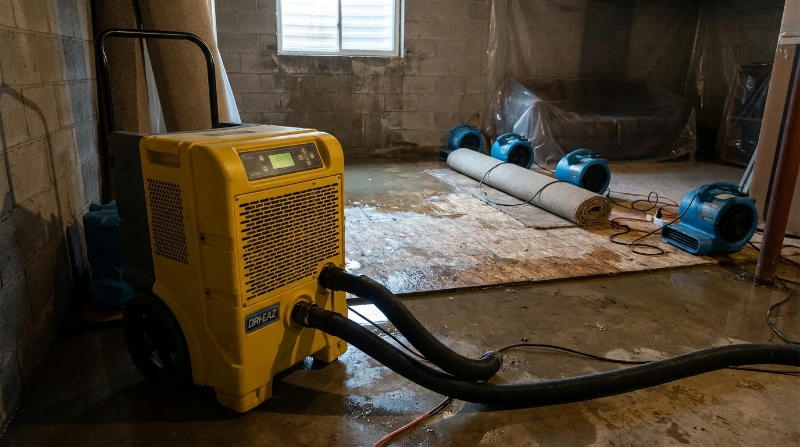
Low-grain refrigerant dehumidifiers and air movers run for 3 to 5 days in most basements. We take readings every day and adjust equipment until walls, framing and slab reach dry standard. Our structural drying page explains the equipment and readings.
5. Mold check and rebuild
Mold can begin growing within 24 to 48 hours on wet materials, which is why speed matters more than anything else on this list. If growth has started, mold remediation is handled under the IICRC S520 standard before rebuild begins.
Oakland County Water Damage Restoration Costs
Cost depends mostly on three things: the water category, whether the basement is finished, and how long the water has been sitting. These are typical ranges from our work, not quotes:
| Situation | Typical range |
|---|---|
| Clean water, small unfinished basement | $500 – $1,500 |
| Sump pump failure (Category 2), unfinished | $1,500 – $4,000 |
| Sewage backup (Category 3), unfinished | $3,000 – $8,000 |
| Finished basement with sewage | $7,000 – $18,000 |
| Mold remediation, if growth has started | adds $1,500 – $5,000+ |
| Each extra 24 hours of standing water | adds roughly $1,500 – $3,000 of scope |
| Backwater (check) valve installation | $300 – $800 |
The last row is the cheapest part of the table and often the one that keeps the others from happening twice. For a number closer to your own basement, try our basement flood cost estimator. We charge the same rate nights and weekends.
Preventing the Next Oakland County Basement Backup
No home can be made flood-proof, but a few changes cut the odds of a repeat. Auburn Hills, for one, specifically recommends a backwater prevention device for low-lying homes and homes with past backups, and notes that the owner pays for it.
- Install a backwater valve. It lets sewage leave the house but blocks it from flowing back in. See our check valve installation page.
- Keep downspouts and sump lines out of the sewer. Besides overloading the pipes, a connection can disqualify a PA 222 claim.
- Extend downspouts and fix grading so roof water lands away from the foundation.
- Test the sump pump every few months and add a backup. Winter is when most pumps fail; our Michigan winter sump pump guide covers frozen lines and power outages.
- Add sewer backup coverage to your homeowners policy before storm season.
- Store valuables off the floor in plastic bins, not cardboard.
Flooded Basement Cleanup by Oakland County City
Every community has its own sewer setup, river and phone numbers. Here is the short version for each; the city pages go into detail.
Southeast Oakland
Royal Oak sits entirely in the Kuhn combined-sewer area, and its median home was built in 1956, so older drains and combined lines go together there. Troy is mostly separated but sends wastewater through three county districts (Evergreen-Farmington, Oakland-Troy and Kuhn), and its 45-day notice goes to the City Attorney's Office. In Southfield, the east side is combined and the west side separated; the city logged 37 flooding reports after the June 20, 2024 storm.
Rouge River communities
The City of Bloomfield Hills drains entirely to the Rouge River and still publishes guidance for homes on septic. In Farmington, the Upper Rouge runs through the north and east parts of the city, and the city itself lists groundwater seepage, surface runoff and sewer backup as the three causes of basement flooding. West Bloomfield has 28 inland lakes and about 1,500 acres of wetlands, with the Clinton, Rouge and Huron watersheds all touching the township.
Pontiac and the Clinton River corridor
In Pontiac, the Clinton River runs underground beneath downtown for about a mile, covered in 1963 to prevent flooding, and the county WRC operates the sewer system. Auburn Hills sends stormwater to the Clinton River, Galloway Creek and the Rouge, and a city plan describes river areas that flood after heavy rain or spring snowmelt. Waterford runs more than 350 miles of sanitary sewer and 63 pump stations across glacial kettle-lake terrain with muck soils around its wetlands.
Northern Oakland lakes
Clarkston and Independence Township sit at the Clinton River headwaters and send sewage through the Clinton-Oakland system. Around Lake Orion, the village lowers the lake about a foot each fall, and a gauge near the lake recorded 3.21 inches of rain in 24 hours in April 2025.
Every one of these communities is served by the same IICRC-certified team that handles flooded basement cleanup in Dearborn, with a 60-minute response target, real people answering 24/7, and insurance documentation from the minute we arrive. Call (866) 838-7745.